37 lakh NGOs. How many actually exist?
Visualisation
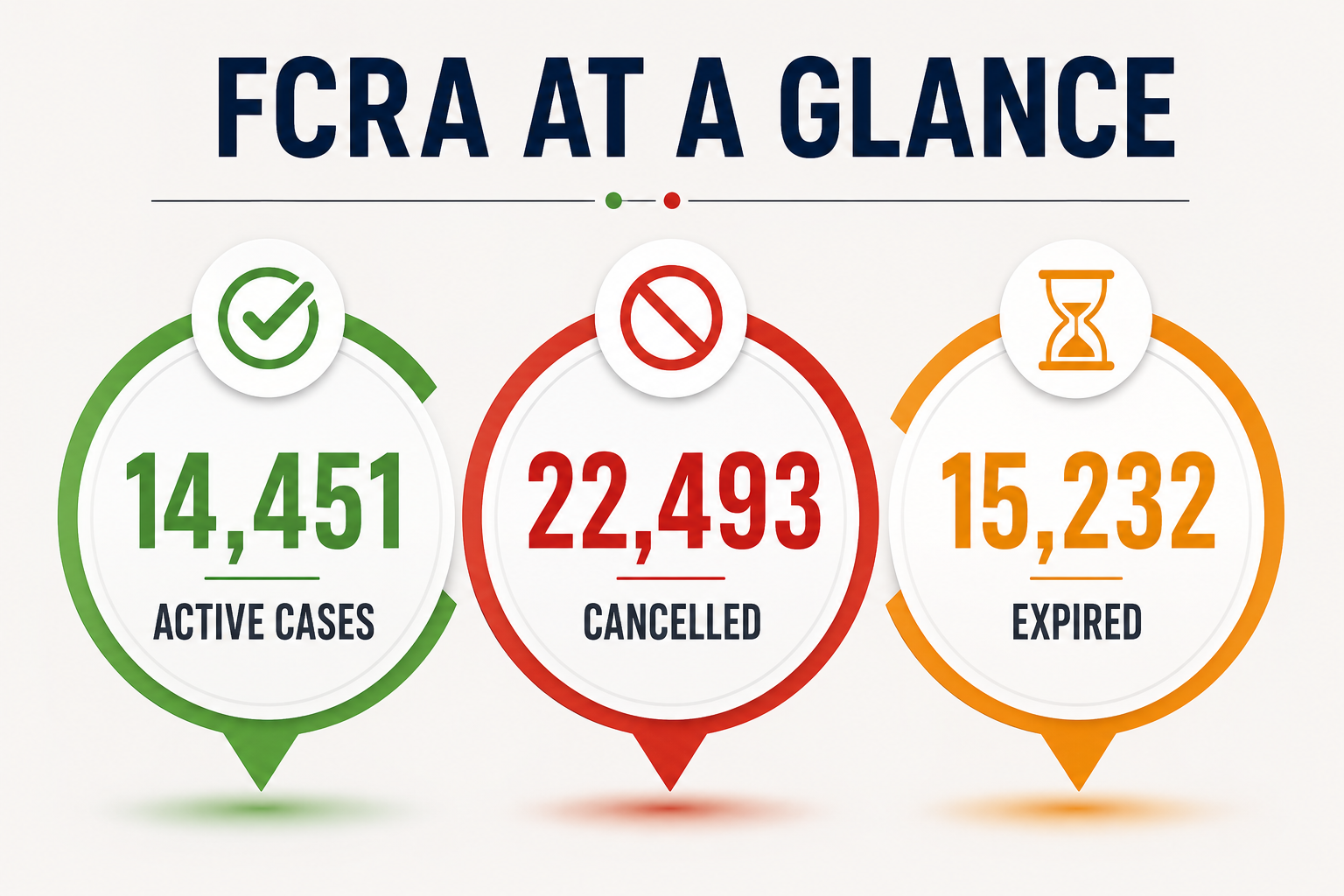
At a Glance
The regulatory framework governing non-governmental organisations (NGOs) in India remains a deeply contested policy issue. Whenever the government cancels registrations under the Foreign Contribution (Regulation) Act (FCRA), critics often describe it as a shrinking of civic space. Supporters, on the other hand, argue that such action is essential to safeguard national security, ensure financial transparency, and prevent the misuse of foreign funds.
The truth lies beyond these competing narratives. To understand what is really happening, it is necessary to step away from political rhetoric and examine the evidence. The data tells a far more nuanced story: a non-profit sector that has expanded to an extraordinary scale, operating within a regulatory framework that, for decades, remained too fragmented to ensure even basic standards of financial accountability.
1. The numbers don't lie: A global comparison of NGO Footprints
The sheer size of India's non-profit sector becomes clear only when viewed against the world's other major economies.
India's long tradition of seva selfless public service has inspired generations of charitable and community institutions. Yet, when millions of organizations are allowed to proliferate without robust regulatory oversight, what begins as a source of social strength can gradually become an administrative challenge and, in some cases, a national security concern.
The scale is striking. In an affidavit filed before the Supreme Court, the Central Bureau of Investigation (CBI) estimated that India has nearly 37 lakh registered NGOs, one of the largest concentrations of non-profit organizations anywhere in the world.
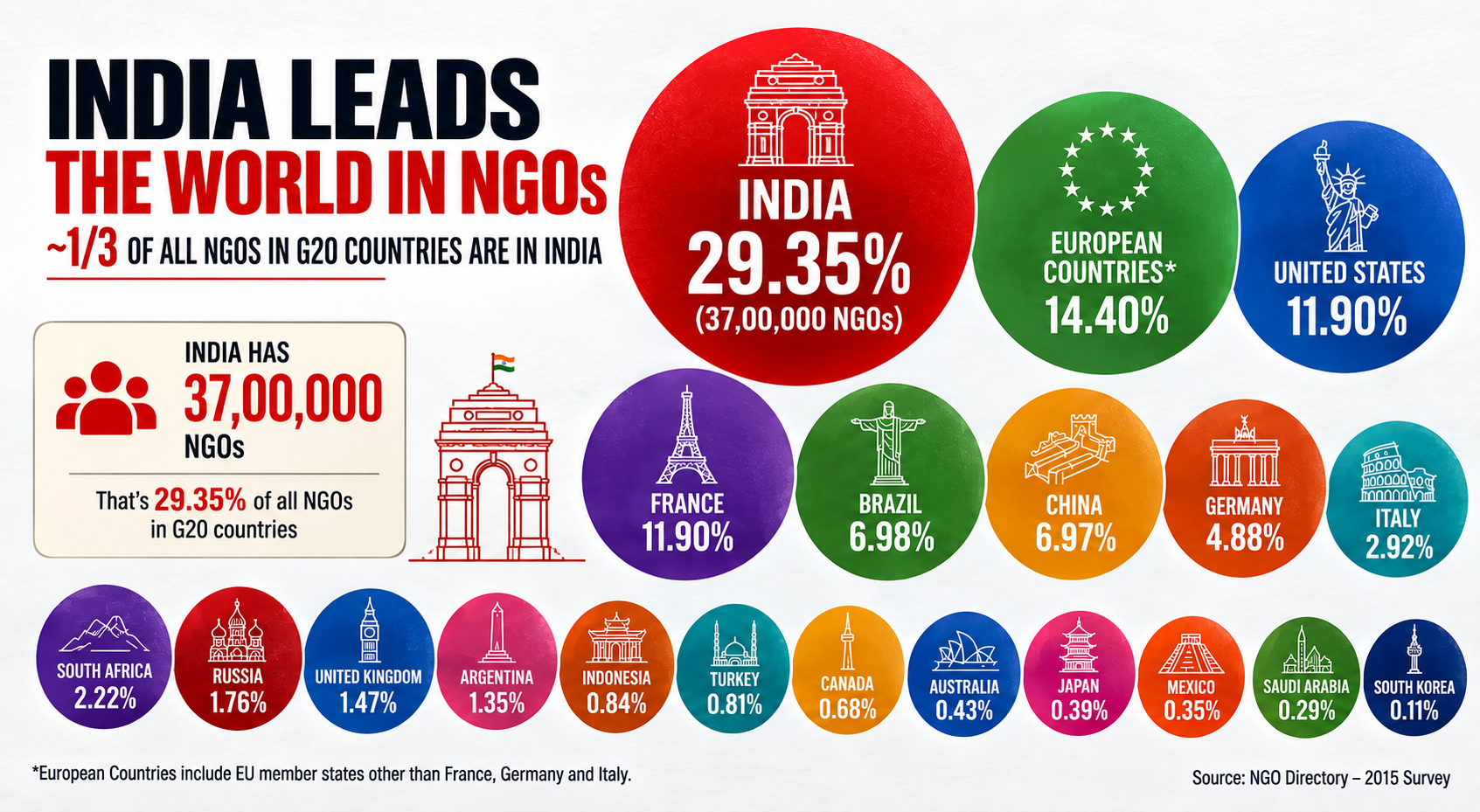
The sector has become one of the country's greatest regulatory challenges.
The 31-lakh compliance vacuum
The root of India's transparency crisis lies in how these non-profits are legally governed. For more than a century and a half, the registration of NGOs has fallen under the antiquated, colonial-era Societies Registration Act of 1860. Designed originally by the British Raj to allow citizens to form literary, scientific, or charitable clubs, this decentralised system was never built to monitor modern international financial flows or prevent sophisticated money-laundering schemes.
The consequence is striking: despite the oft-cited figure of 37 lakh, no one knows how many are genuinely active. Many may have ceased operations years ago, while others exist only on paper. In 2015, following a Supreme Court case on NGO funding, the Central Bureau of Investigation (CBI) attempted the country's first nationwide verification exercise. Even then, it could identify only about 31 lakh societies across 26 states, and the exercise remained incomplete because Karnataka, Odisha, and Telangana did not furnish their data.
The geographical concentration is equally revealing. Uttar Pradesh has the largest number of registered NGOs, with more than 5.48 lakh, closely followed by Maharashtra at 5.18 lakh
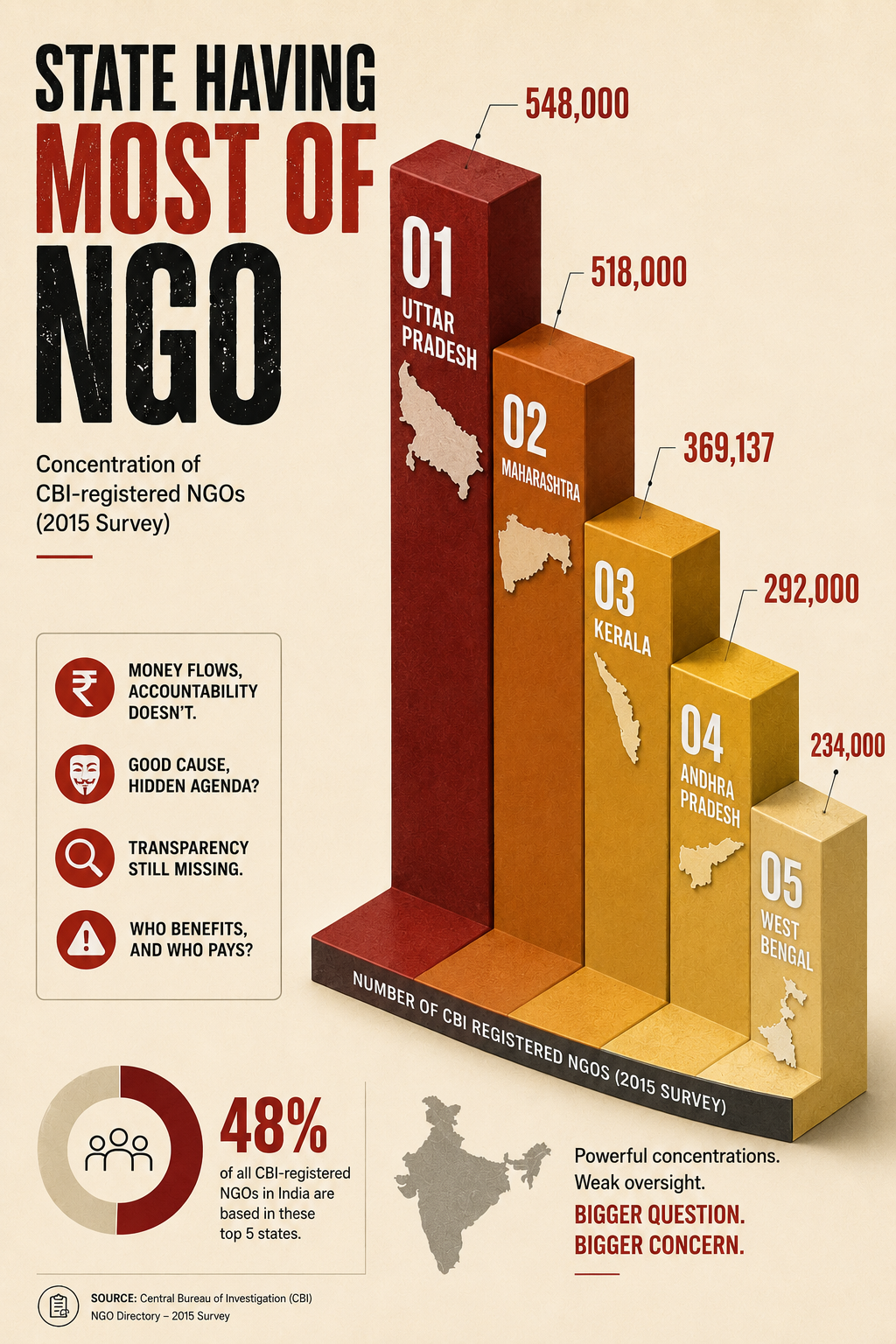
The 10% balance sheet club: Out of the roughly 30 lakh registered societies analysed, only 2.9 lakh (less than 10%) had ever bothered to file a balance sheet or annual financial statement with the Registrar of Societies.
The Kerala paradox: Kerala has nearly 3.7 lakh registered NGOs, yet not a single one had filed financial statements. This was not because every organization chose to ignore the law. The state's legal framework simply did not require societies to file annual financial returns. The result was a system where regulators had virtually no visibility into the financial health or activities of hundreds of thousands of registered entities.
The limits of NGO DARPAN
To address this administrative nightmare, NITI Aayog launched the central NGO DARPAN portal, designed to serve as a single gateway for any non-profit seeking government grants, tax exemptions, or FCRA approvals.
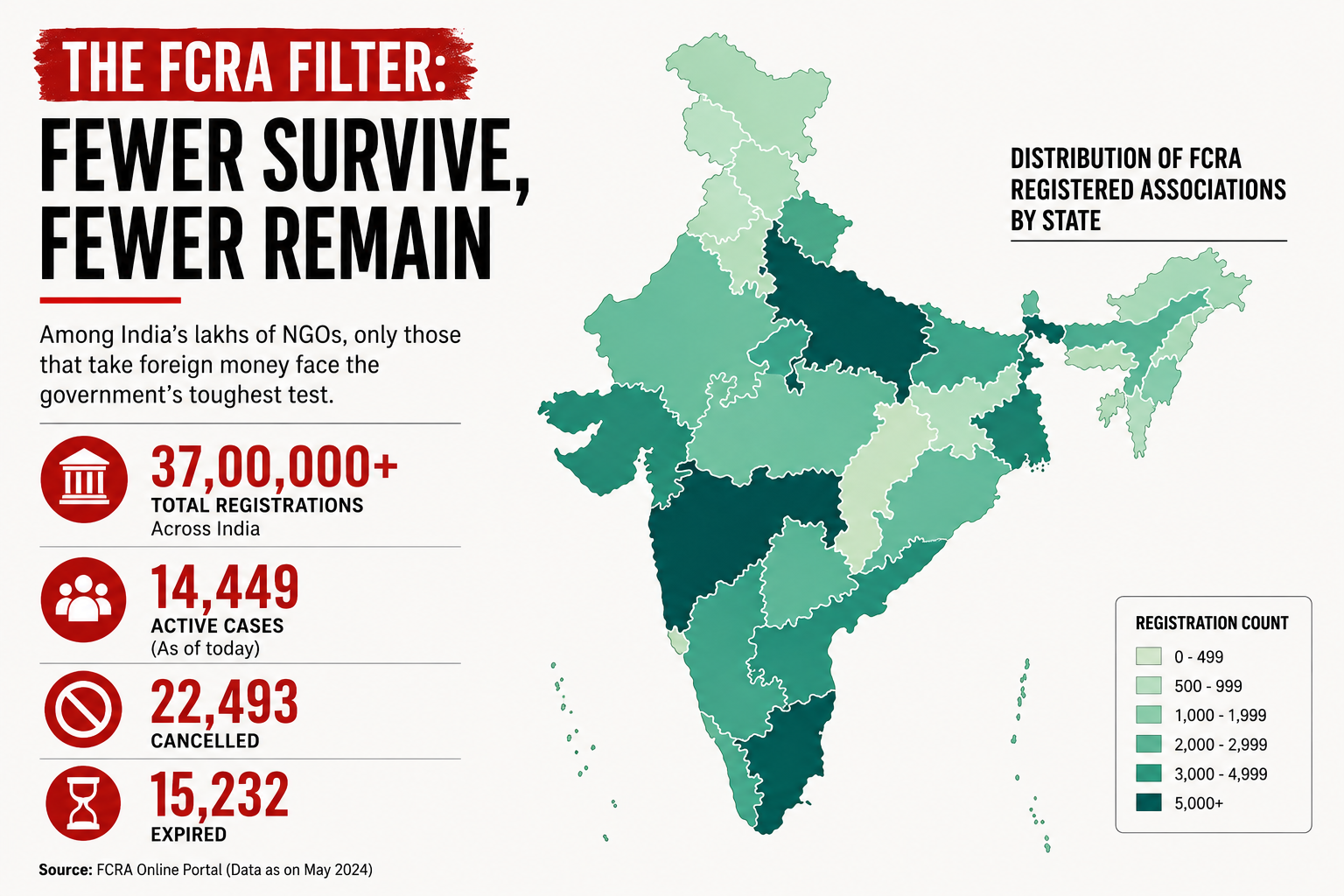
While the portal has expanded rapidly climbing from 1.87 lakh active IDs in October 2023 to 5.25 lakh by February 2026, the numbers expose a persistent gap. Even at its current scale, NGO DARPAN covers barely one-sixth of the CBI's conservative estimate of 31 lakh NGOs. The remaining five-sixths exist outside any comprehensive national database, scattered across state-level paper registries that are rarely digitised, seldom verified, and exceedingly difficult to monitor. Enter FCRA the one place the government actually looks Here is where the story turns. Among India's lakhs of NGOs, there is exactly one category the government watches closely: those that take money from abroad. This is where the Foreign Contribution Regulation Act, or FCRA, comes into law with real teeth. It demands renewal every five years, a single bank account in a specific Delhi branch, and yearly returns that someone actually checks. And the results show. As of today, only 14,451 FCRA associations remain active, down from over 40,000 in 2011, and down from 33,091 in 2016.
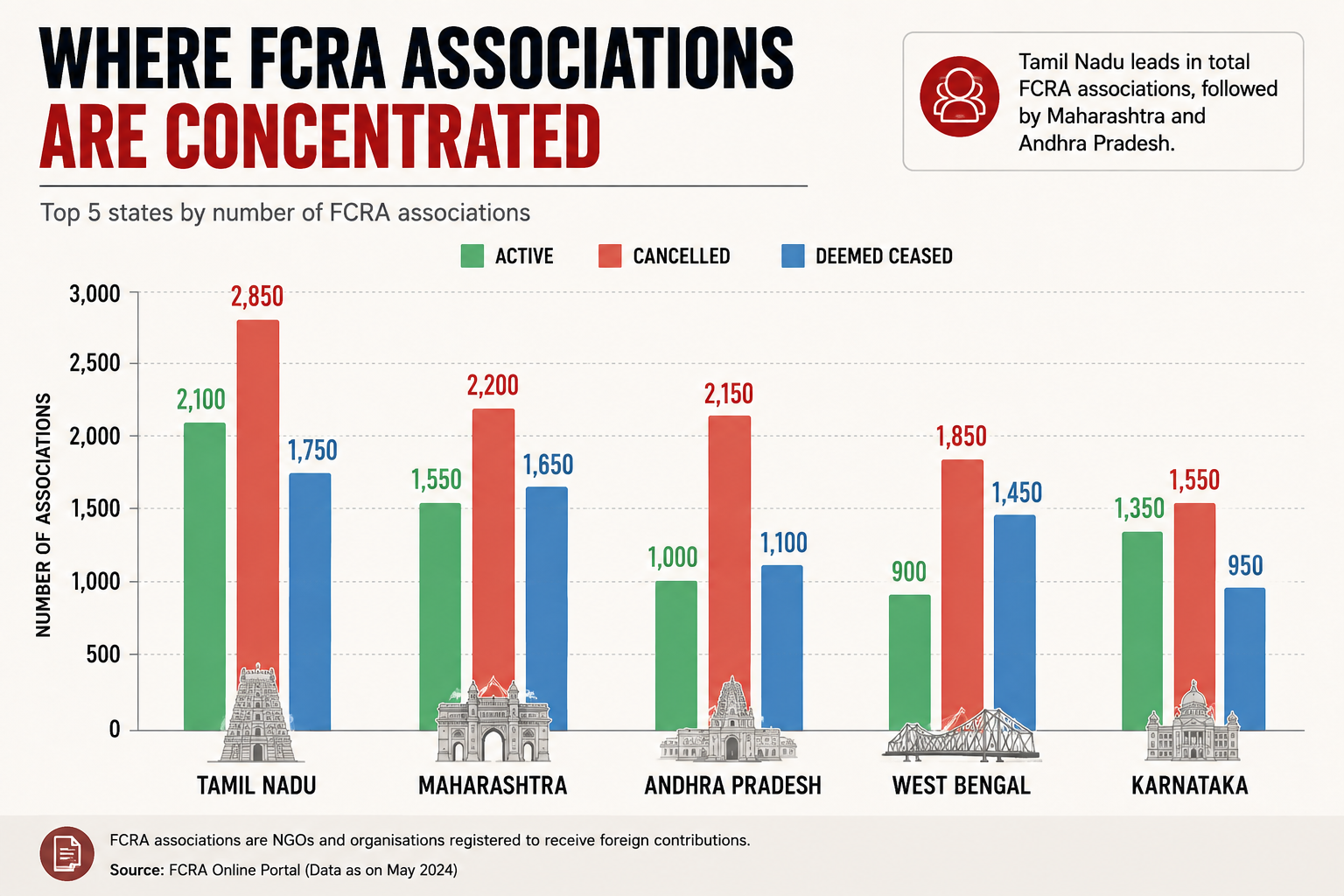
Tamil Nadu (2,575 cancellations between 2011-19), Andhra Pradesh (2,075) and Maharashtra (2,024) saw the most cancellations in raw numbers. Bihar leads the country with a combined cancellation and expiry rate of 85.2%, followed closely by Uttar Pradesh at 83.7%. Notably, the attrition rate in almost all northeastern states (such as Nagaland, Manipur, and Tripura) exceeds the national average. These states historically hosted numerous grass-roots organizations receiving international funding for localized socioeconomic, educational, and religious programs.
Why this story matters
The FCRA is quietly doing what the 165-year-old Societies Registration Act, 1860 was never built to do: make NGOs financially accountable.
The colonial-era law was designed to let people form literary, scientific, and charitable associations—not to regulate millions of organisations, track foreign funding, or verify audited accounts. Unsurprisingly, it failed to do so.
The FCRA takes a different approach. It brings every NGO receiving foreign contributions into a single compliance framework, requiring a designated bank account, regular disclosures, and financial reporting that can be centrally verified. Viewed through this lens, the shrinking number of active FCRA registrations reflects more than policy, it reflects the application of uniform financial scrutiny to foreign-funded organisations.
The numbers tell the larger story. A sector that expanded with minimal oversight is gradually being brought under a national compliance architecture. The real transformation is not the cancellation of licences, but the replacement of fragmented, paper-based regulation with a system built around transparency and verification.
Until states digitise and reconcile their decades-old Registrar of Societies records, India cannot say with confidence how many NGOs are genuinely active. In the meantime, the FCRA remains the country's only nationwide mechanism for tracking foreign-funded NGOs through a common regulatory framework.