Bamboo breaks out of the forest to build a new rural economy
Visualisation
At a Glance
India has plenty of bamboo, and its commercial potential is growing. The India State of Forest Report (ISFR) puts the country’s bamboo-growing area at 1,54,670 sq. km, an increase of more than 5,000 sq. km over earlier assessments. For farmers, this represents an opportunity to grow a versatile resource that can supply everything from traditional crafts to modern manufacturing. Yet, for decades, turning bamboo into a viable business was far from easy. The problem lay partly in a law introduced by the British in 1927, which classified bamboo as a tree under the Indian Forest Act.
That classification had consequences far beyond the pages of a law book. A farmer who wanted to harvest bamboo or transport it for sale could face a maze of permissions and forest department restrictions. What could have been a source of regular income became a cumbersome business to pursue. The restrictions discouraged commercial cultivation and made it harder for farmers and small entrepreneurs to build a market around a resource that grew naturally in abundance. Bamboo was everywhere, but growing it for business was another matter altogether.
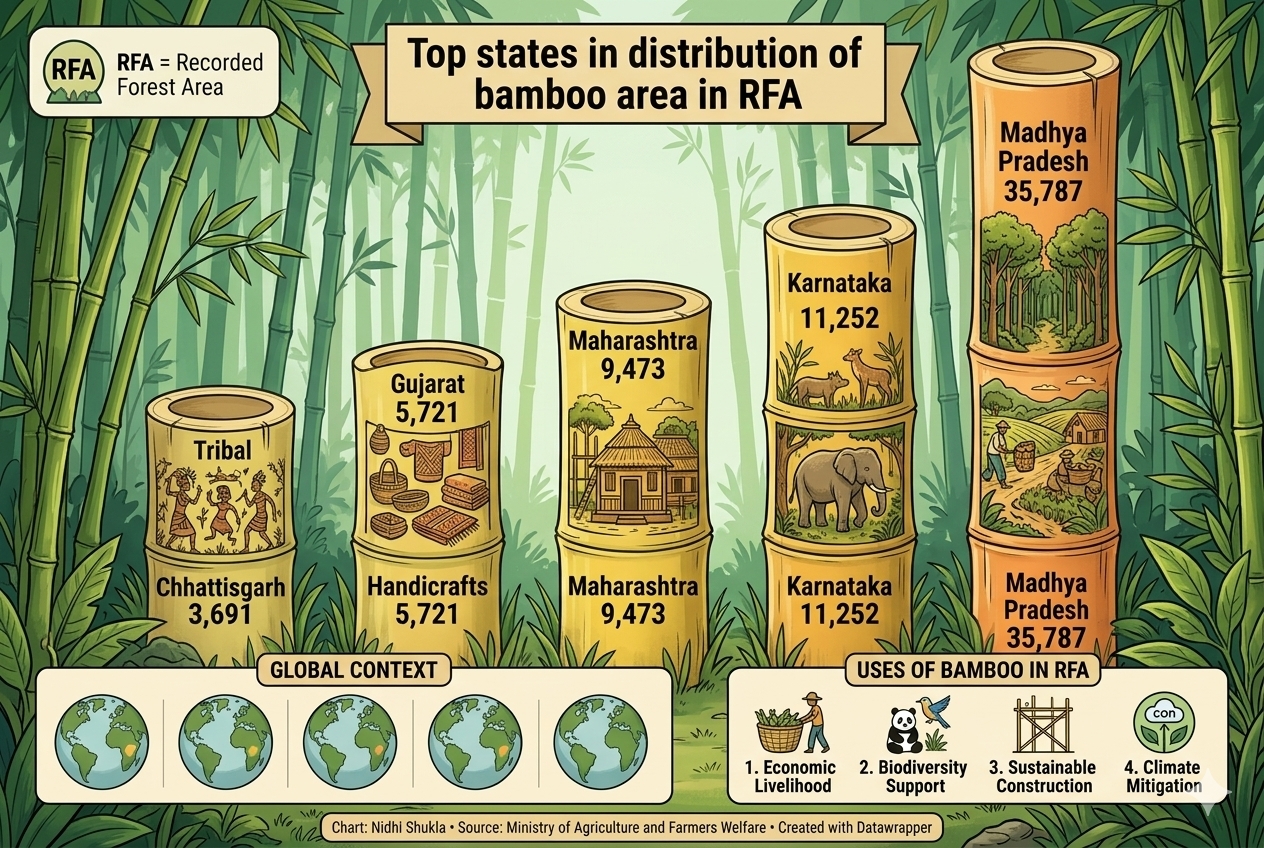
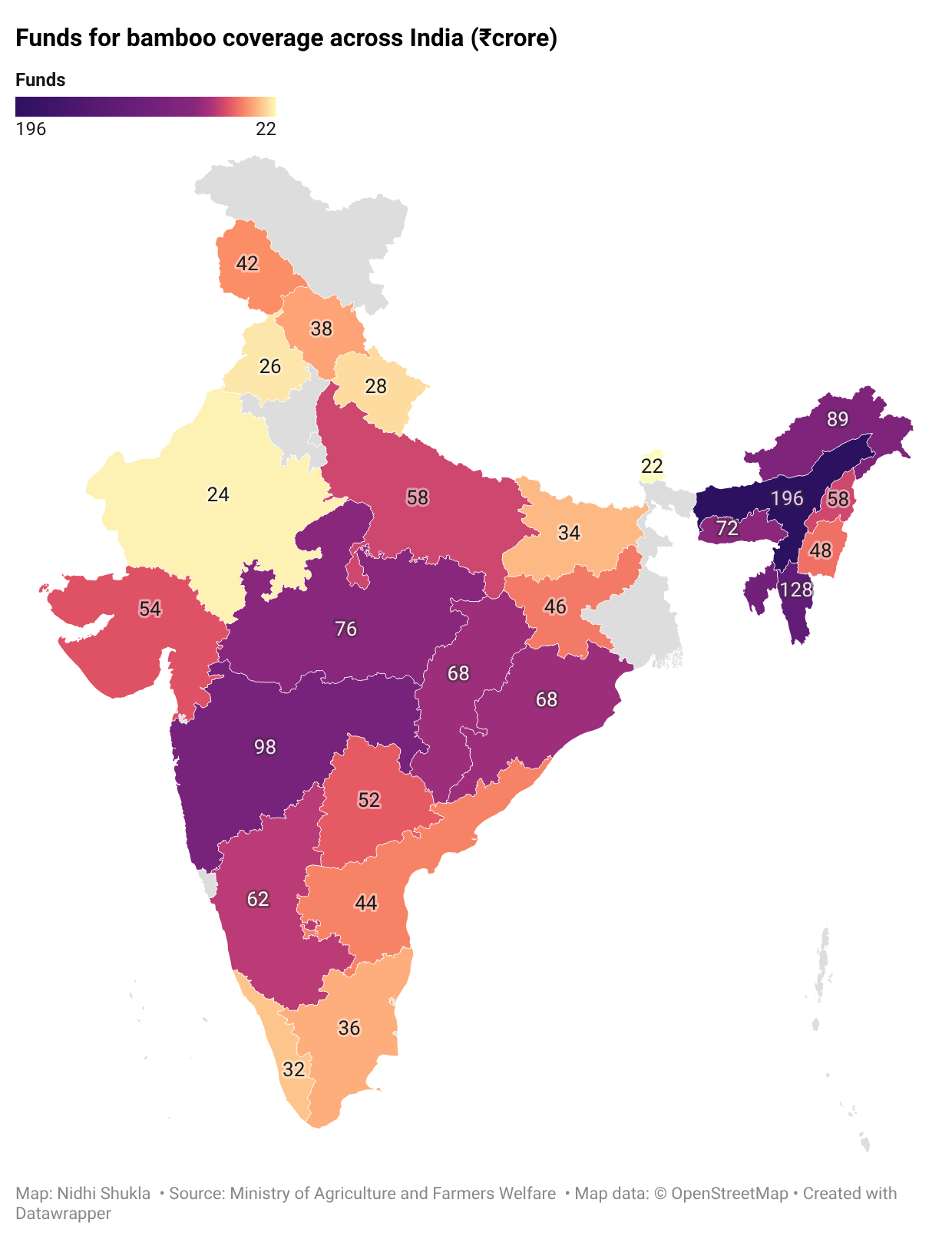
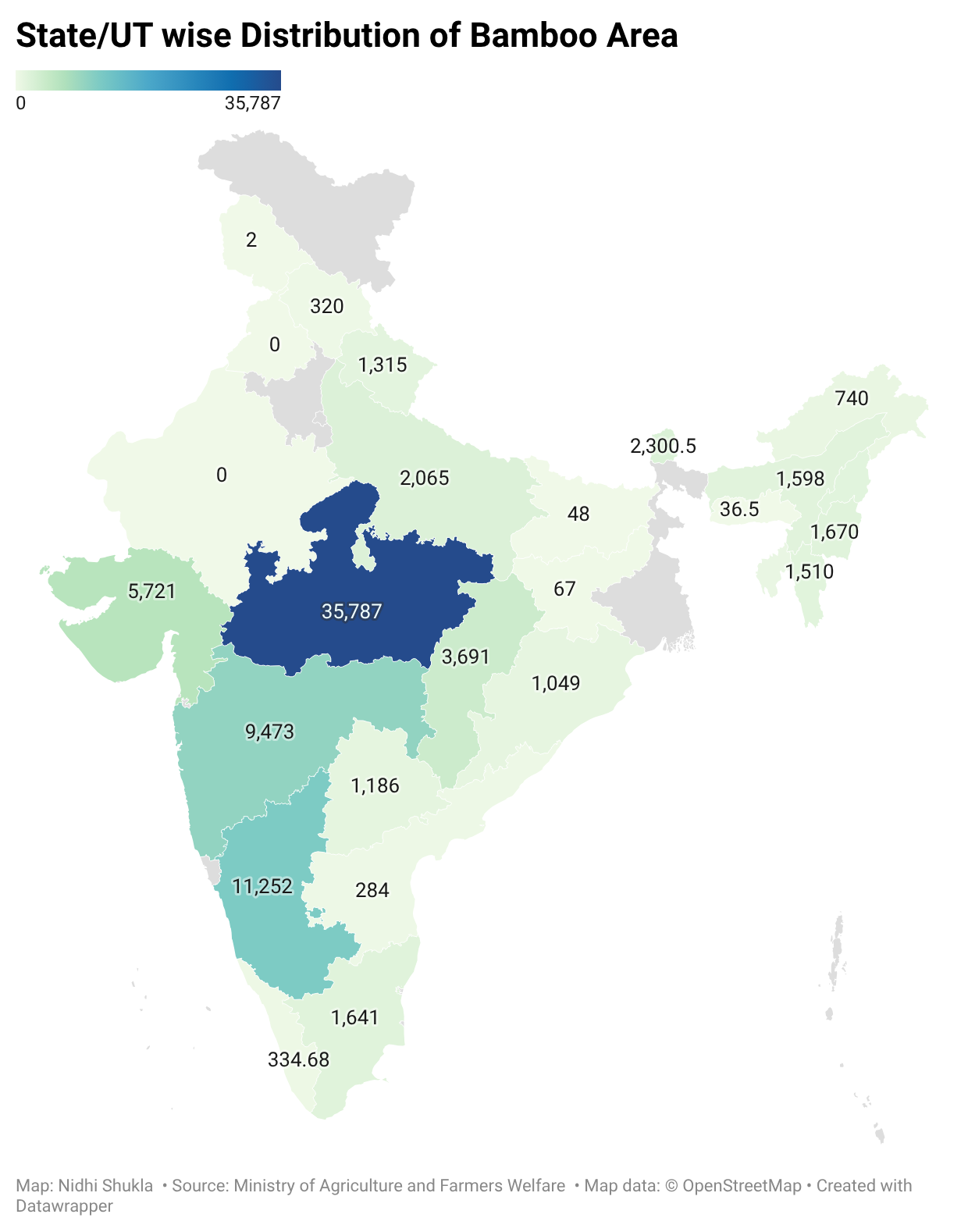
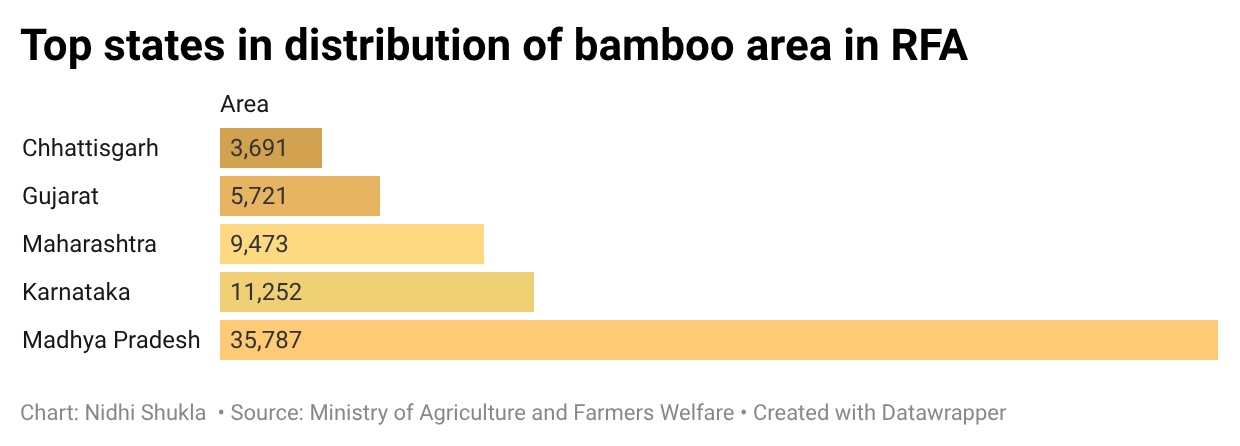
https://www.datawrapper.de/_/zfU21/?v=2 The impact of the reform must be seen against India's expanding bamboo resource. The India State of Forest Report 2023 puts the country's bamboo-growing area at 1,54,670 sq. km, an increase of more than 5,000 sq. km over the previous assessment. The figures point to a substantial resource base for farmers and industry alike. The 2017 reform removed an important legal barrier to commercial cultivation, although the increase in bamboo-growing area cannot be attributed to that change alone. The larger opportunity lies in connecting this resource with processing, manufacturing, and markets, so that farmers can earn more from a crop that India has in abundance. https://www.datawrapper.de/_/blAm3/ For a long time, bamboo was associated primarily with the Northeast, where it is woven into everyday life, traditional crafts and local livelihoods. The region remains a major centre of bamboo resources and expertise. Government figures based on the India State of Forest Report 2017 put the Northeast's share of the country's bamboo-bearing area at about 34.5%. Yet, the opportunity extends well beyond these eight states. The India State of Forest Report 2023 places Madhya Pradesh first in bamboo-bearing area, with 20,421 sq. km, followed by Arunachal Pradesh at 18,424 sq. km. Maharashtra and Odisha also have substantial bamboo-bearing areas, at 13,572 sq. km and 12,328 sq. km respectively. These figures challenge the notion that bamboo is a resource confined to one corner of India. The next challenge is to turn this geographical spread into a functioning national industry. Transporting bulky raw bamboo over long distances can add to costs, making it important to develop processing facilities closer to where the crop grows. The National Bamboo Mission has adopted a value-chain approach, supporting activities ranging from planting material and cultivation to processing, marketing and product development. In September 2020, the government launched 22 bamboo clusters across nine states, including Gujarat, Madhya Pradesh, Maharashtra, Odisha, Assam, Nagaland, Tripura, Uttarakhand and Karnataka. The idea is to connect growers with artisans, entrepreneurs and manufacturers, allowing more of the value to be created locally. For farmers, this could mean a wider market for their produce; for small businesses, a more dependable supply of raw material. The real test will be whether these links translate into sustainable demand, better returns for growers and jobs in bamboo-producing districts. https://www.datawrapper.de/_/5pI4H/ Bamboo's economic significance is perhaps most visible in the livelihoods it supports. According to a September 2026 backgrounder by the Press Information Bureau, bamboo-based technologies promoted by the North East Centre for Technology Application and Reach (NECTAR) generate around 30 million man-days of employment annually, rather than employment for 30 million individual people. In Gadchiroli, Maharashtra, the Gadchiroli Agarbatti Project shows what this can mean on the ground. By 2020, the initiative had established 32 production centres employing around 1,100 people, nearly 90% of them women. Monthly earnings reportedly reached about ₹5,000 per woman, while work expanded from roughly 45–60 days a year to more than 225 days. For women who previously had limited local employment options, this meant more regular earnings without having to leave their communities. The industry is also moving well beyond baskets, mats and other traditional products. Through engineering and specialised processing, bamboo can be converted into composite materials for modern construction. The same PIB backgrounder reports that more than 42 lakh sq. ft. of engineered bamboo structures have been built for disaster relief and rehabilitation. In Chhattisgarh, 576 school classrooms have been constructed using engineered bamboo, providing learning spaces for around 20,000 children. These projects demonstrate how a familiar natural material can find applications in infrastructure, including settings where speed of construction and the choice of building materials matter. They also point to a larger opportunity: connecting bamboo growers with modern manufacturing and construction can create markets beyond handicrafts, allowing the resource to support both rural livelihoods and new industrial applications.
In 2017, the government corrected a colonial-era anomaly that had held back bamboo cultivation for decades. It amended the Indian Forest Act, 1927, to remove bamboo grown on non-forest land from the legal definition of a tree. Until then, bamboo was treated like a tree under the law, subjecting its felling and transport to restrictions that did not apply to ordinary crops. The change gave farmers greater freedom to grow, harvest and sell bamboo from their own land without the same regulatory hurdles. It also opened the door to greater commercial investment. The potential for value addition was significant: bamboo products could raise the value of the raw material by as much as 70%, according to the Department of Science and Technology, turning a modest crop into a more promising source of income.
Sources
https://beyondthefyp.com/infopack/the-2017-reform-that-set-indias-bamboo-economy-in-motion https://www.pib.gov.in/PressReleasePage.aspx?PRID=2086742®=48&lang=2 https://www.pib.gov.in/FeaturesDeatils.aspx?id=159961&NoteId=159961&ModuleId=2®=48&lang=1 https://www.pib.gov.in/PressReleasePage.aspx?PRID=2086742®=48&lang=2 https://www.clearias.com/india-state-of-forest-report-2023/ https://fsi.nic.in/uploads/isfr2023/isfr_book_eng-vol-1_2023.pdf https://www.pib.gov.in/newsite/PrintRelease.aspx?lang=2®=48&relid=194712 https://static.pib.gov.in/WriteReadData/specificdocs/documents/2025/aug/doc2025829623001.pdf https://www.pib.gov.in/newsite/PrintRelease.aspx?lang=2®=48&relid=215014 https://www.pib.gov.in/PressReleseDetailm.aspx?PRID=2309378&lang=1®=3
Frequently Asked Questions
Why did a 2017 legal reform significantly boost India's bamboo sector?
The 2017 reform completely transformed India's bamboo economy by correcting a 90-year-old colonial anomaly under the Indian Forest Act of 1927, which had wrongly classified bamboo as a tree. This historical classification subjected bamboo to strict forestry regulations, making it incredibly cumbersome for farmers to harvest or transport the crop. By amending the law to remove bamboo grown on non-forest land from the legal definition of a tree, the government eliminated these bureaucratic hurdles. This change gave farmers the absolute freedom to cultivate, fell, and sell bamboo commercially, which sparked massive growth in local entrepreneurship and expanded the national value chain.
Which Indian states lead in terms of total bamboo-bearing area?
While bamboo has traditionally been associated with Northeast India—which holds about 34.5% of the country's bamboo-bearing area—the resource forms a massive nationwide industry that extends far beyond that region. According to the India State of Forest Report 2023, Madhya Pradesh ranks first in the nation with a substantial bamboo-bearing area of 20,421 sq. km. It is followed by Arunachal Pradesh at 18,424 sq. km, Maharashtra at 13,572 sq. km, and Odisha at 12,328 sq. km. This vast geographical distribution provides a robust supply base across diverse states, allowing the National Bamboo Mission to set up local processing clusters that reduce heavy transport costs and boost regional economies.
How is bamboo transitioning from traditional crafts to modern industrial applications?
Bamboo is rapidly evolving beyond baskets and mats into a high-tech material for modern construction through the development of engineered bamboo. This specialized composite material is made by binding and compressing raw bamboo fibers into structural shapes, attracting significant interest from contemporary architects and designers. The practical scale of this shift is visible in infrastructure projects across India, where more than 42 lakh square feet of engineered bamboo structures have been built for disaster relief and rehabilitation. Furthermore, this industrial application has successfully moved into public education; in Chhattisgarh, 576 school classrooms have been constructed using engineered bamboo, safely housing and providing green learning environments for approximately 20,000 children.