E20 Petrol: Why the whole country is talking about it
Visualisation
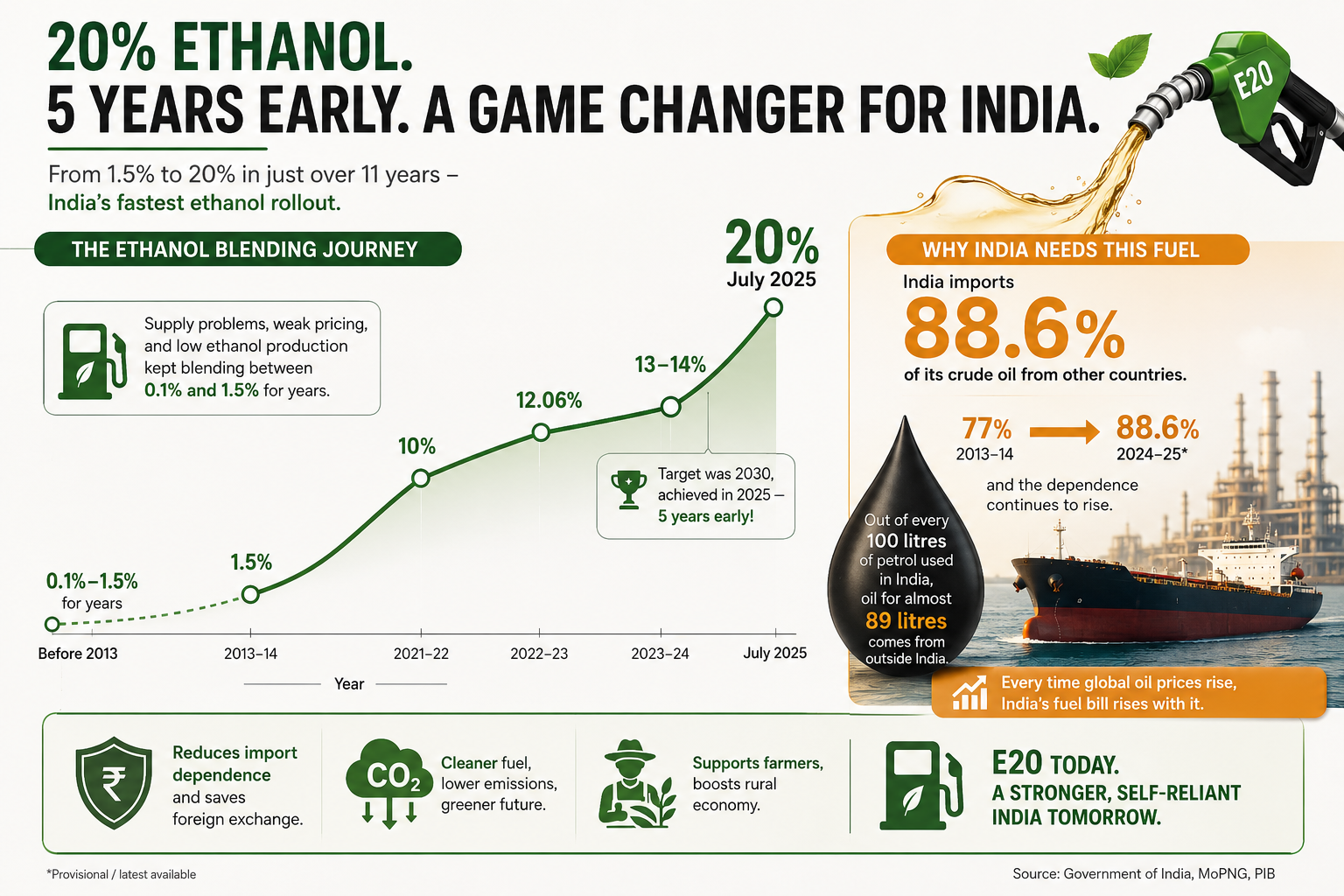
At a Glance
Every major change brings uncertainty, and India's shift to E20 petrol is no exception. Social media is full of videos debating fuel efficiency, vehicle compatibility and engine performance. Motorists swap experiences at fuel stations, automobile experts weigh in with technical explanations, and political debates have amplified public concerns. Yet behind the online noise lies a much larger story.
The move to E20 is not merely about changing the fuel at the pump; it is part of a long-term strategy to reduce dependence on imported crude oil, strengthen India's energy security, support sugarcane farmers through ethanol production, and lower transport emissions. Like many large policy shifts, the transition has sparked questions alongside expectations.
Understanding whether those concerns outweigh the potential benefits requires looking beyond anecdotes and examining the evidence, the economics and the science behind India's most significant change in transport fuel in decades. This is the story behind that question and the numbers behind India's biggest fuel change in fifty years.
What is E20?
E20 petrol is not pure petrol. It is a mix. 80% petrol and 20% ethanol. Ethanol is made from sugarcane, corn, and surplus grain.
How did India reach E20 ?
India did not start this overnight. Ethanol blending began on a pilot basis in 2001. The Ethanol Blended Petrol Programme was formally launched in 2003 by the UPA government, with a 5% blend mandated in a handful of states. In 2006, this 5% mandate was extended across most of the country.
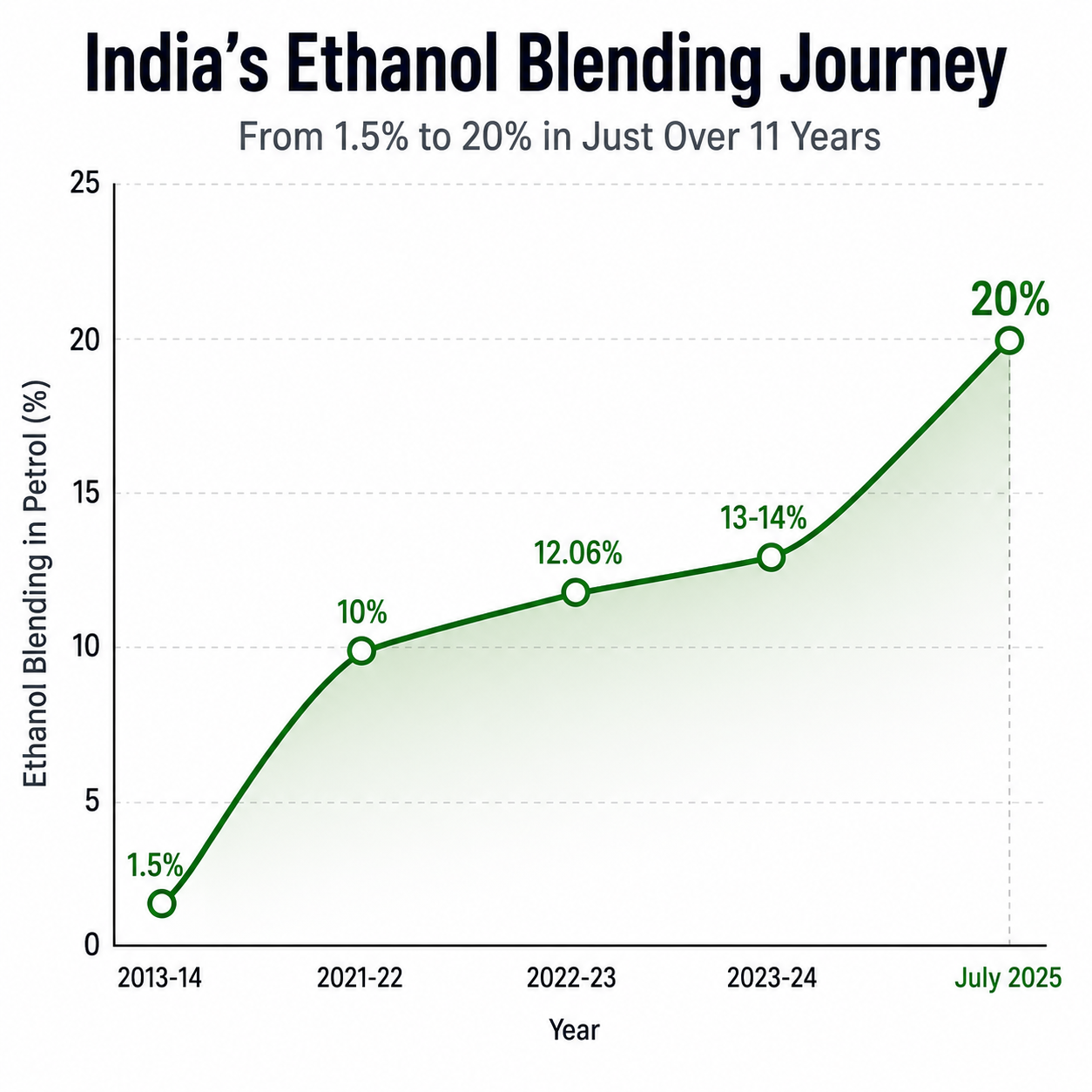
Supply problems, weak pricing, and low ethanol production meant the real blending rate crawled along at somewhere between 0.1% and 1.5% for years, and by 2013-14, it was still stuck at just 1.5%. Then the pace picked up.By 2021-22, blending reached 10%. By 2022-23, it moved to 12.06%. By 2023-24, it touched around 13-14%. Then, in July 2025, India reached 20% ethanol blending nationwide. The government had originally planned to reach this target by 2030. It arrived five years early. In just over 11 years, from 2014 to 2025, ethanol content in petrol rose nearly 13 times, from 1.5% to 20%. This is one of the fastest ethanol rollouts of any country in the world.
Why does India need this fuel?Here is a number that explains everything: India buys 88.6% of its crude oil from other countries. Out of every 100 litres of petrol used in India, oil for almost 89 litres comes from outside India. This number was 77% back in 2013-14. It has only grown due to the increasing number of vehicles and usage. Every time oil prices rise in the world, India's fuel bill rises with it.
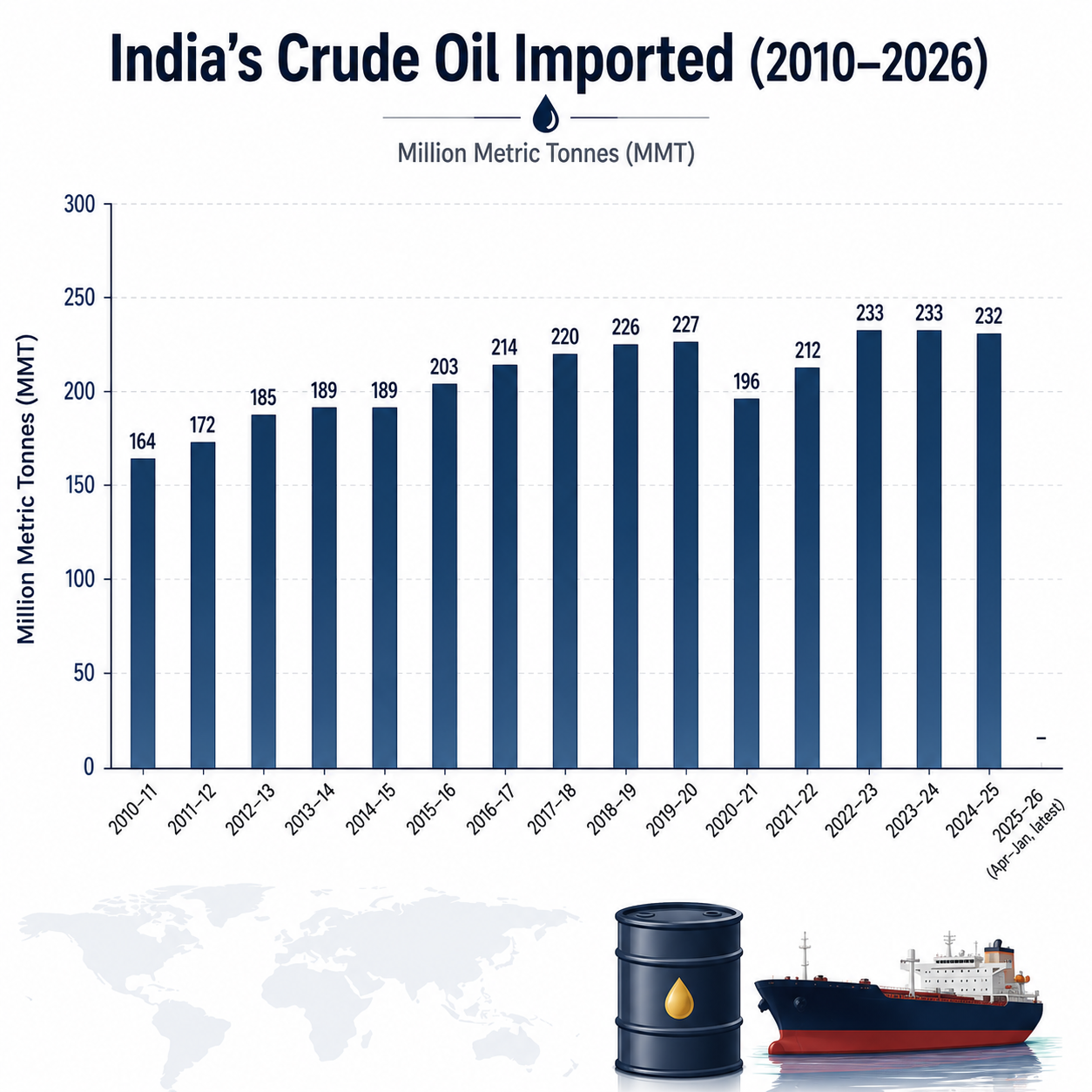
"India's oil import dependence climbed from 82% in 2010-11 to nearly 89% today.”
There is a bigger, slower danger looming. Oil is not an unlimited resource. The world has about 1.77 trillion barrels of proven oil reserves remaining, enough to last roughly 47 years at current consumption rates. Some analysts (experts), like those at Rystad Energy, take a more conservative view by counting only the most economically recoverable reserves, putting the figure at just 14 years. New oil discoveries are replacing only about 6% of what the world uses every year. The clock is ticking, and it is ticking faster than most people realise.
How much India saves
The petroleum ministry says that between 2014-15 and July 2025, ethanol blending saved India more than 1.44 lakh crore rupees in foreign exchange (an earlier estimate had put it at around 1.36 lakh crore). It also says the programme cut about 736 lakh tonnes of carbon emissions, which the government compares to planting 30 crore trees.
Source: Ministry of Petroleum & Natural Gas / PIB, as reported in Rajya Sabha proceedings, May–July 2026. https://www.pib.gov.in/PressReleasePage.aspx?PRID=2283376®=48&lang=2
Which companies sell E20?
Many people ask if some petrol brands mix more ethanol than others. The answer is simple.
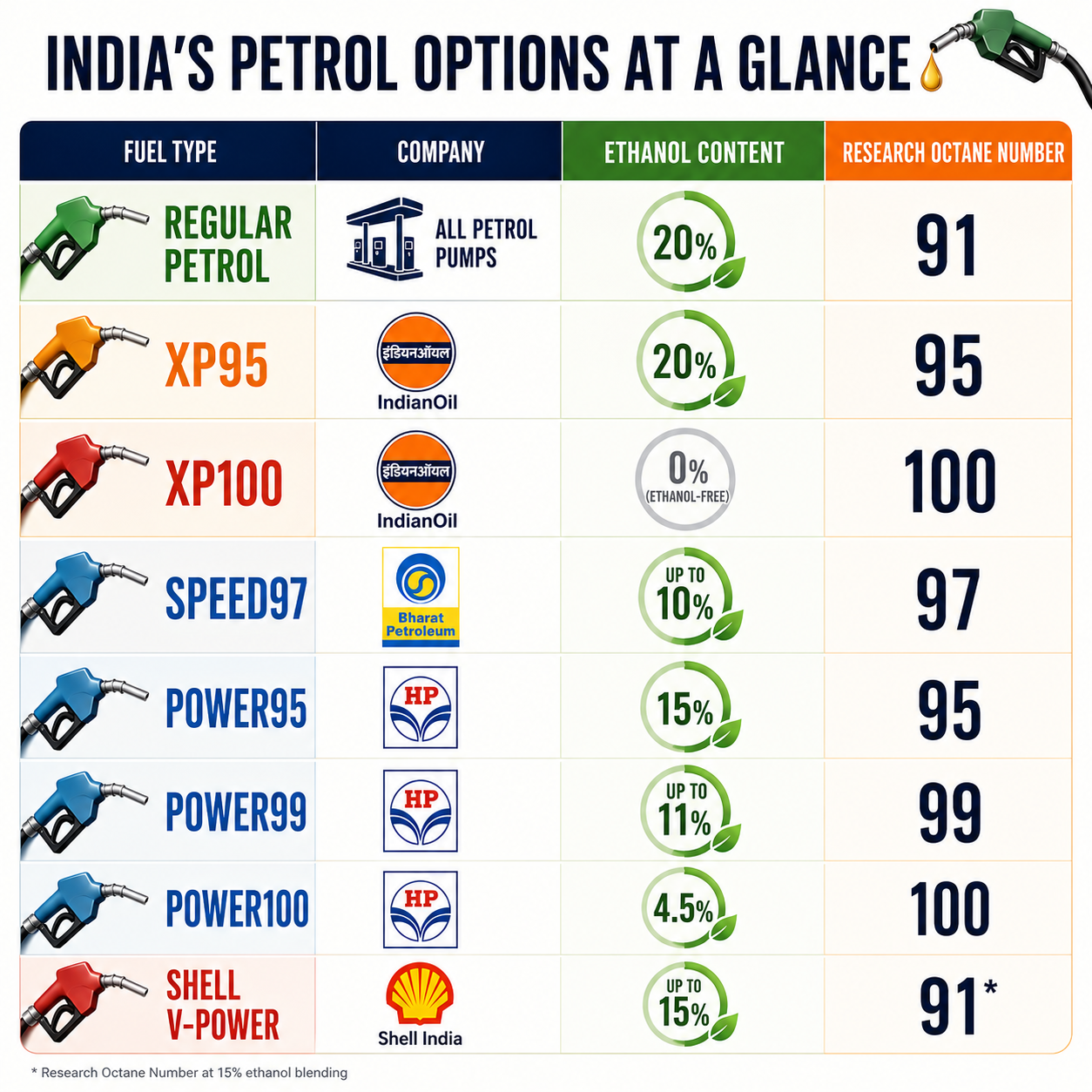
Today, nearly all petrol pumps in India sell only E20. Only pure 100-octane fuel, like XP100 or Power100, has no ethanol. That fuel is expensive and made for very high-performance engines. For everyone else, E20 is now the normal choice at the pum
How do other countries do it?
It should be noted India is not the first country to blend Ethanol. Brazil has the oldest programme in the world. It started in 1975. It has not sold pure petrol at a normal pump since 1977. That's 51 years of ethanol fuel. Today, over 74% of new cars sold in Brazil are flex-fuel vehicles, built to run on any blend, from pure petrol to pure ethanol. Brazil took decades to get here, letting its cars and its fuel grow up together.
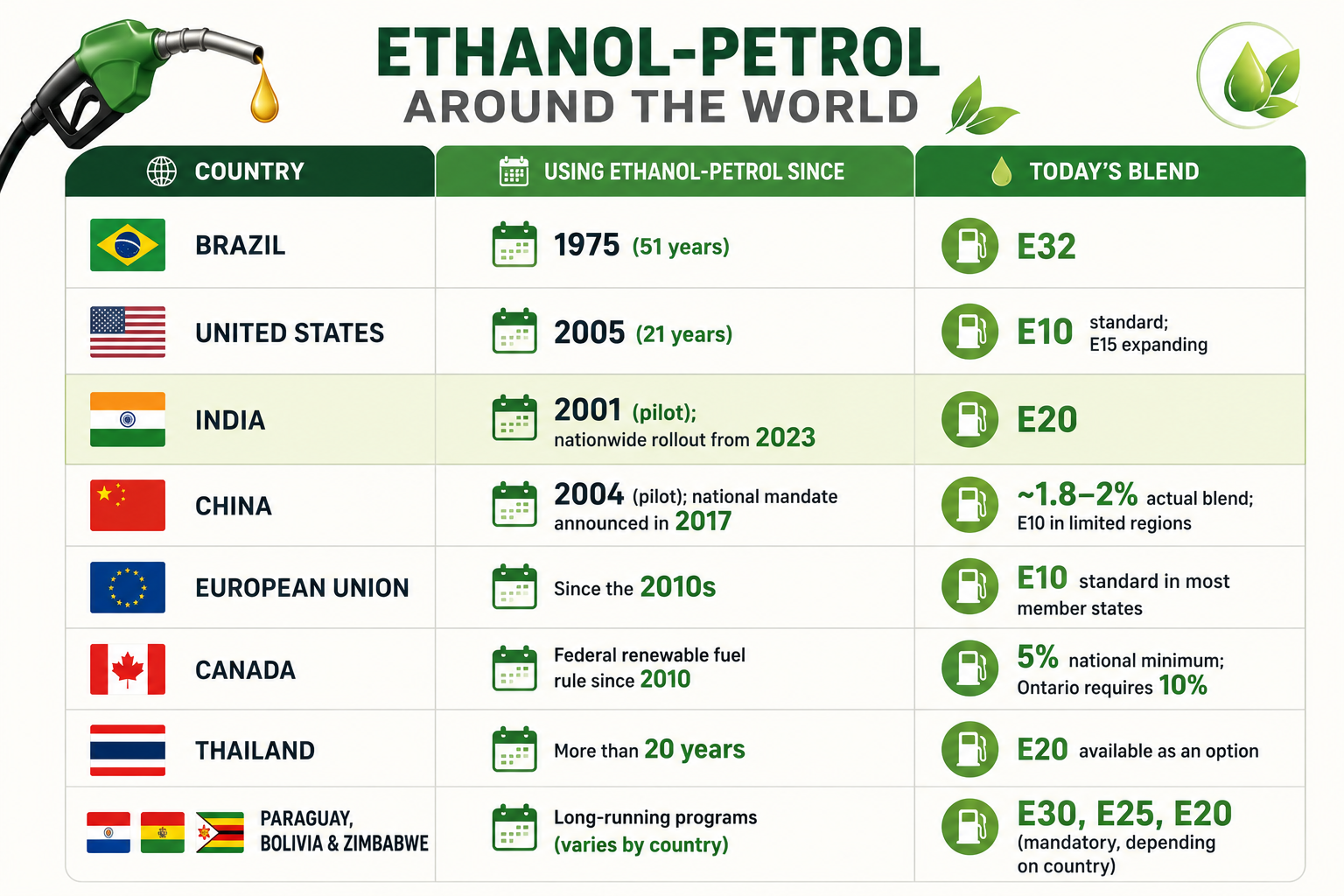
The USA started later, in 2005, with its Renewable Fuel Standard. Twenty-one years on, E10 is its standard fuel, and E15 is now growing fast, with sales jumping 23% in just one year. Both countries prove the same point: ethanol blending works at scale, over time.China tells a very different story. China began ethanol trials the same year as India, in 2001. In 2017, it announced a big target: E10 fuel across the whole country by 2020.
Yet the logic behind ethanol blending remains compelling. Every country that depends on imported crude oil is vulnerable to price shocks, geopolitical conflicts and supply disruptions. Ethanol, produced from crops such as sugarcane and maize, is renewable and can be replenished with every harvest, unlike finite petroleum reserves. That is why even countries far wealthier than India, including the United States, continue to expand ethanol blending programmes despite having adopted them decades ago. Government-backed testing by ARAI, SIAM, and the Indian Institute of Petroleum found E20 fuel "gives better acceleration, ride quality" and lowers emissions compared to E10, with no red flags on engine durability. That is the official word from the labs that actually tested it. Here's the good news many people miss. India already offers pure petrol. Just like the US. Just like other countries. It's called XP100 or Power100. Zero ethanol. Sold at pumps in major cities. In Delhi, it costs ₹160 a litre. Regular E20 costs ₹94.77. It's a premium fuel, priced like premium fuel everywhere else in the world. The system already gives you both choices.So here's the question. Not for the government. For you.You scrolled past a hundred videos calling E20 a scam. Did you check the pump price of pure petrol even once? Or did you just believe the loudest voice in your feed?