Fourteen lakh doors, one goal: No child left hungry
Visualisation
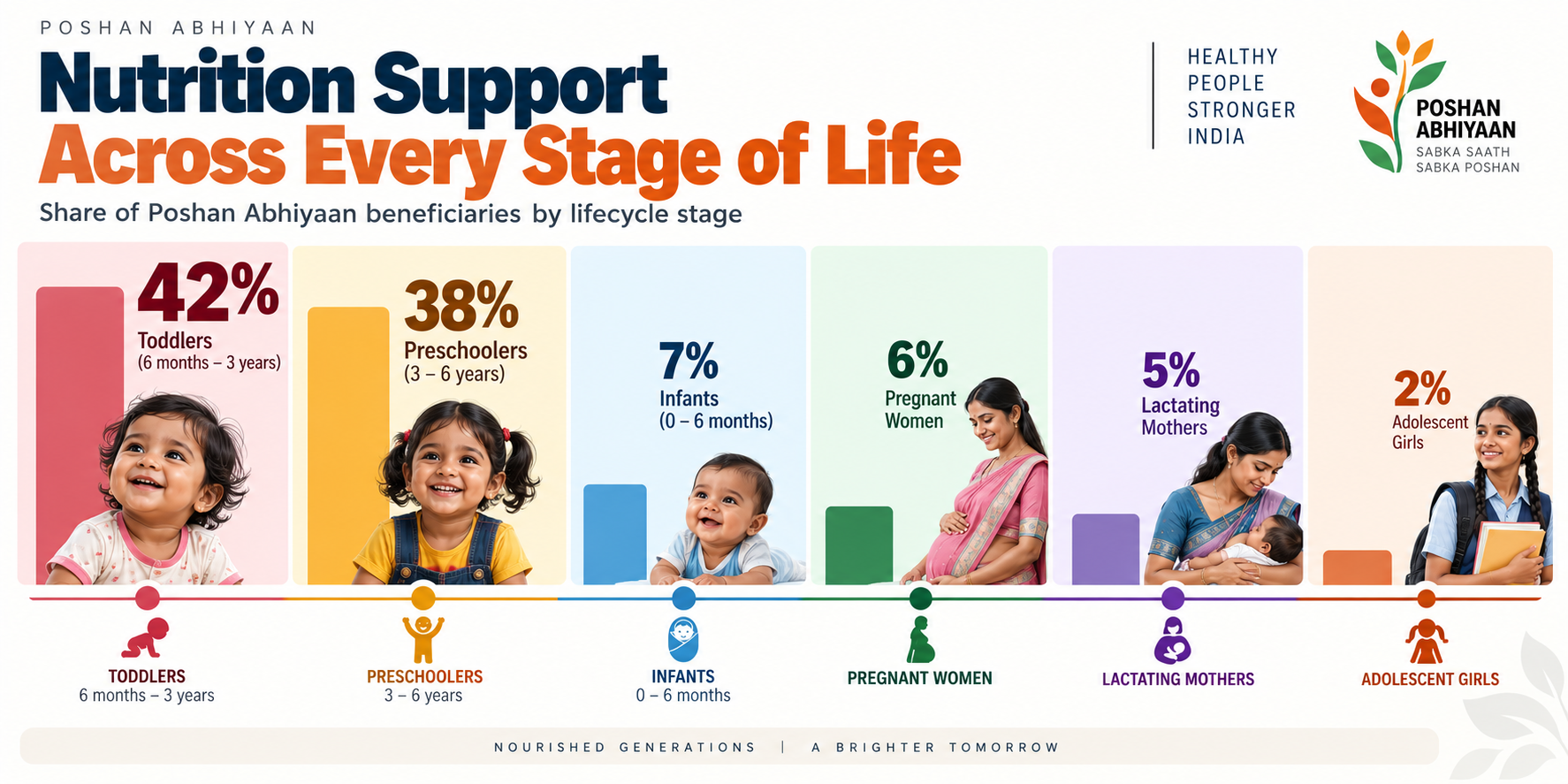
At a Glance
On September 9, Union Minister Annapurna Devi lit a ceremonial lamp at the Rudraksh Convention Centre in Varanasi and opened the ninth Rashtriya Poshan Maah. Chief Minister Yogi Adityanath was there. So were hundreds of Anganwadi workers, the women who actually run this programme in villages most of the country never visits. This year's theme for the Rashtriya Poshan Maah (National Nutrition Month) is ‘Hamari Anganwadi Hamari Jimmedari’ or ‘Our Anganwadi, Our Responsibility’. It sounds like a slogan. Underneath it sits a decade of survey data that makes a genuine claim about a large public programme: it has worked, and there is evidence for the same.
Where India started
The most useful baseline for this story is 2015-16, the year the National Family Health Survey (NFHS) fourth round was published. That year, 38.4% of Indian children under five years of age were found stunted. That was nearly two in every five children. Stunting isn't just a height problem. It signals that a child's brain development, immune system and long-term earning potential have all taken a hit that mostly can't be reversed later in life. That was the country's starting point a decade ago, right around when the current nutrition push was taking shape.
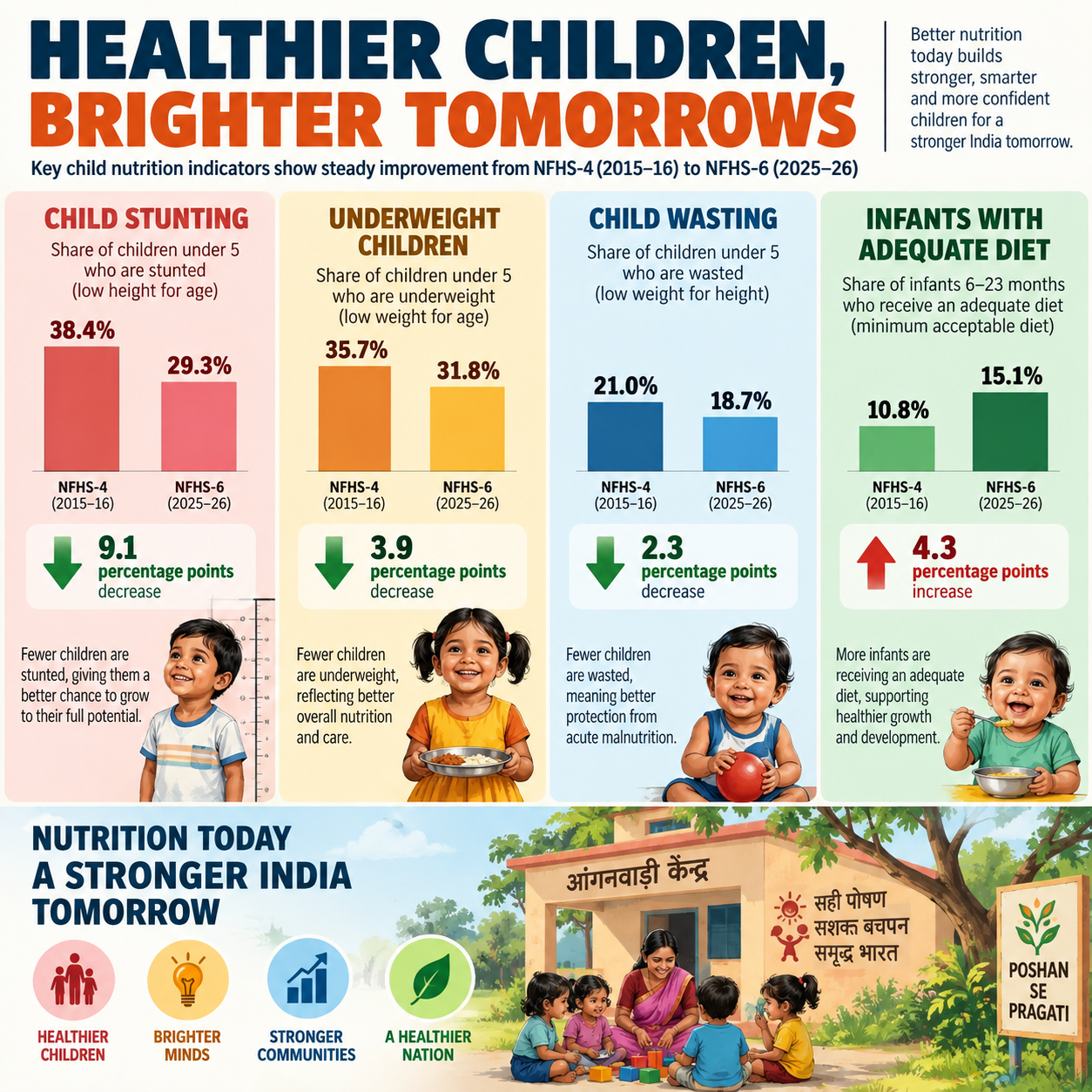
By the latest 2025-26 NFHS survey round, stunting had dropped to 29.3%, a fall of over nine percentage points in 10 years. The percentage of children found underweight fell from 35.7% to 31.8% over the same period, and the share of infants receiving a genuinely adequate diet climbed from 10.8% to 15.1%. None of these are the kind of numbers that usually move this much in a decade, especially not in a country the size of India.
From Poshan Abhiyaan to a mission that can prove itself
The programme started as Poshan Abhiyaan, launched by the Prime Minister on March 8, 2018, from Jhunjhunu in Rajasthan. It harnessed the power of the existing ICDS network of roughly 14 lakh Anganwadi centres, with hard annual targets attached: a 2 percentage point drop in stunting and underweight every year, a 3 point drop in anaemia. The programme has gone through its own version of growing up.
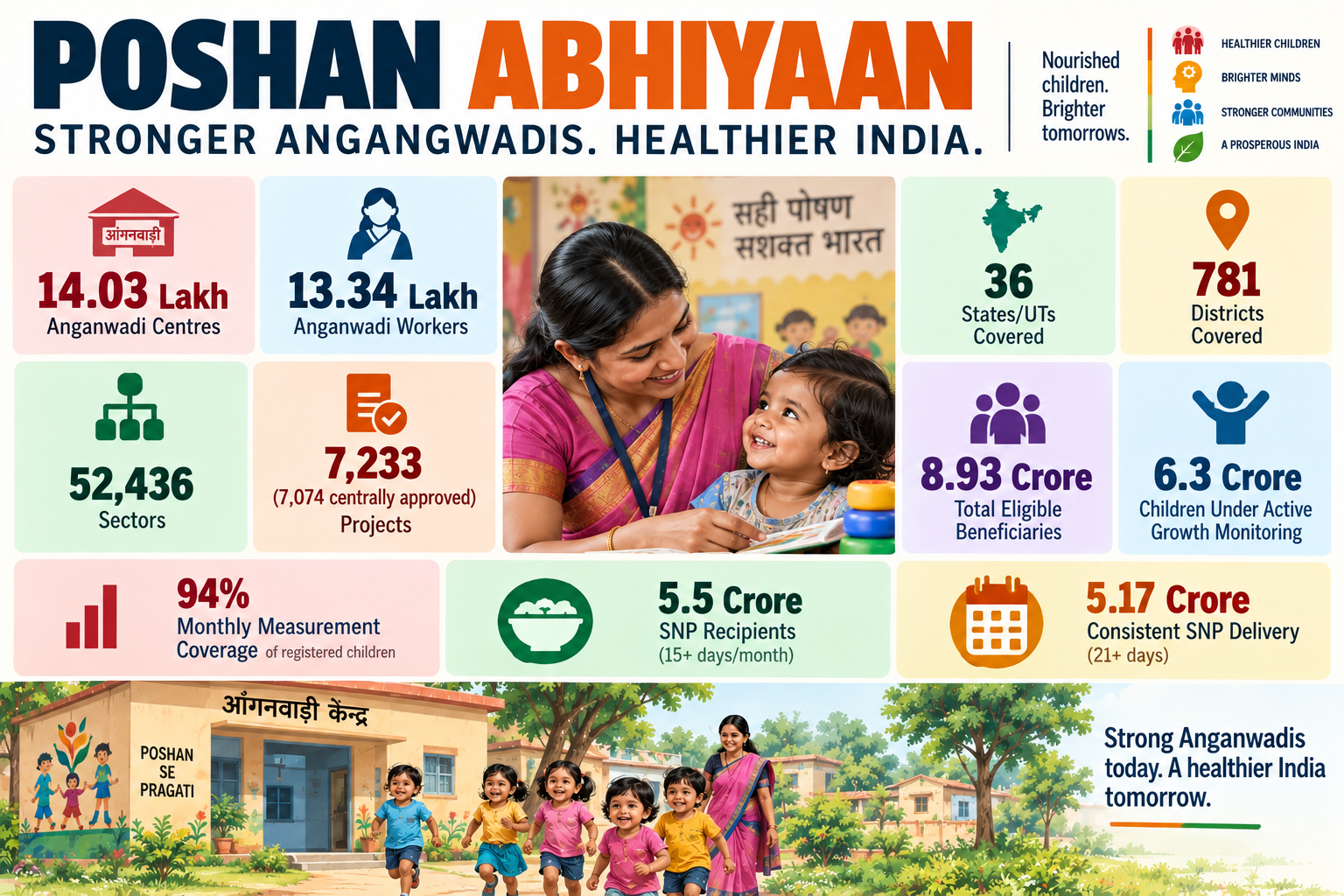
‘Mission Poshan 2.0’, which took over in 2021, didn't need a bigger beneficiary base. It needed the ability to see the one it already had. The Poshan Tracker app, rolled out that March, turned close to 9 crore beneficiaries into a live, searchable database instead of numbers gathered from scattered paper registers.
Around 11 lakh Anganwadi workers were given smartphones to feed that system directly, and another 12.5 lakh growth monitoring devices, weighing scales, stadiometers, infantometers, were procured so the numbers going in were actually measured rather than estimated. A peer-reviewed analysis published in The Lancet Regional Health has since called it the largest mobile phone-based nutrition surveillance system in the world! As of this year, it covers all 28 States and 8 Union Territories, with 8.93 crore beneficiaries registered.
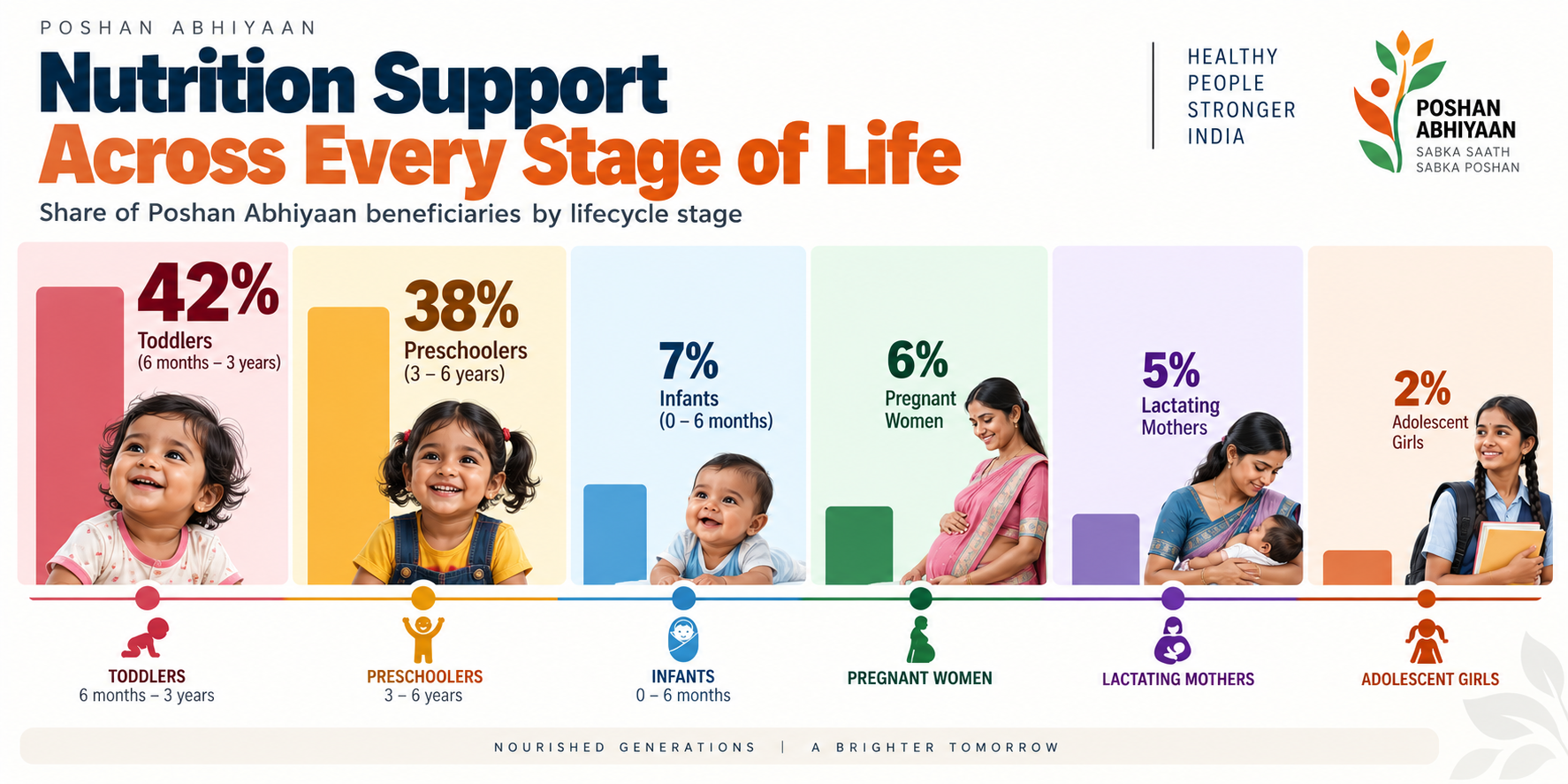
What actually changed on the ground
The old nutrition programme measured one thing: how much food went out the door. An Anganwadi worker's monthly job was basically to log how much rice and wheat had been distributed. Nobody checked protein quality. Nobody tracked micronutrients. A child who was severely malnourished and a child who was just a bit underfed got roughly the same ration.
That has been rebuilt from the ground up. A severely malnourished child today qualifies for a fortified ration carrying 800 kcal and up to 25g of protein, close to four times a standard infant's entitlement. Every ration category, whether it's a pregnant woman, a toddler or a teenage girl in an aspirational district, now comes with a fixed set of seven micronutrients: iron, zinc, calcium, folate, and vitamins A, B6 and B12, logged against a child's health ID the same day.
This year's campaign pushes that further still. Revised guidelines under Mission Saksham Anganwadi have, for the first time, formally defined what counts as a proper hot cooked meal, and every centre is now required to put up a menu board so parents can actually see what their child is being fed that week, not just take someone's word for it.
Which states carry the weight
A scale like this only means something if you know where it's actually landing. Uttar Pradesh alone accounts for 1.39 crore active beneficiaries. Bihar follows at 98.9 lakh, then Madhya Pradesh at 77.5 lakh, Maharashtra at 72.1 lakh, and Rajasthan at 63.7 lakh. West Bengal, Andhra Pradesh, Gujarat, Odisha and Karnataka round out the next tier, each carrying between 33 and 60 lakh beneficiaries, with the pattern holding down through Tamil Nadu, Jharkhand, Assam, Chhattisgarh, Punjab, Haryana and Jammu & Kashmir.
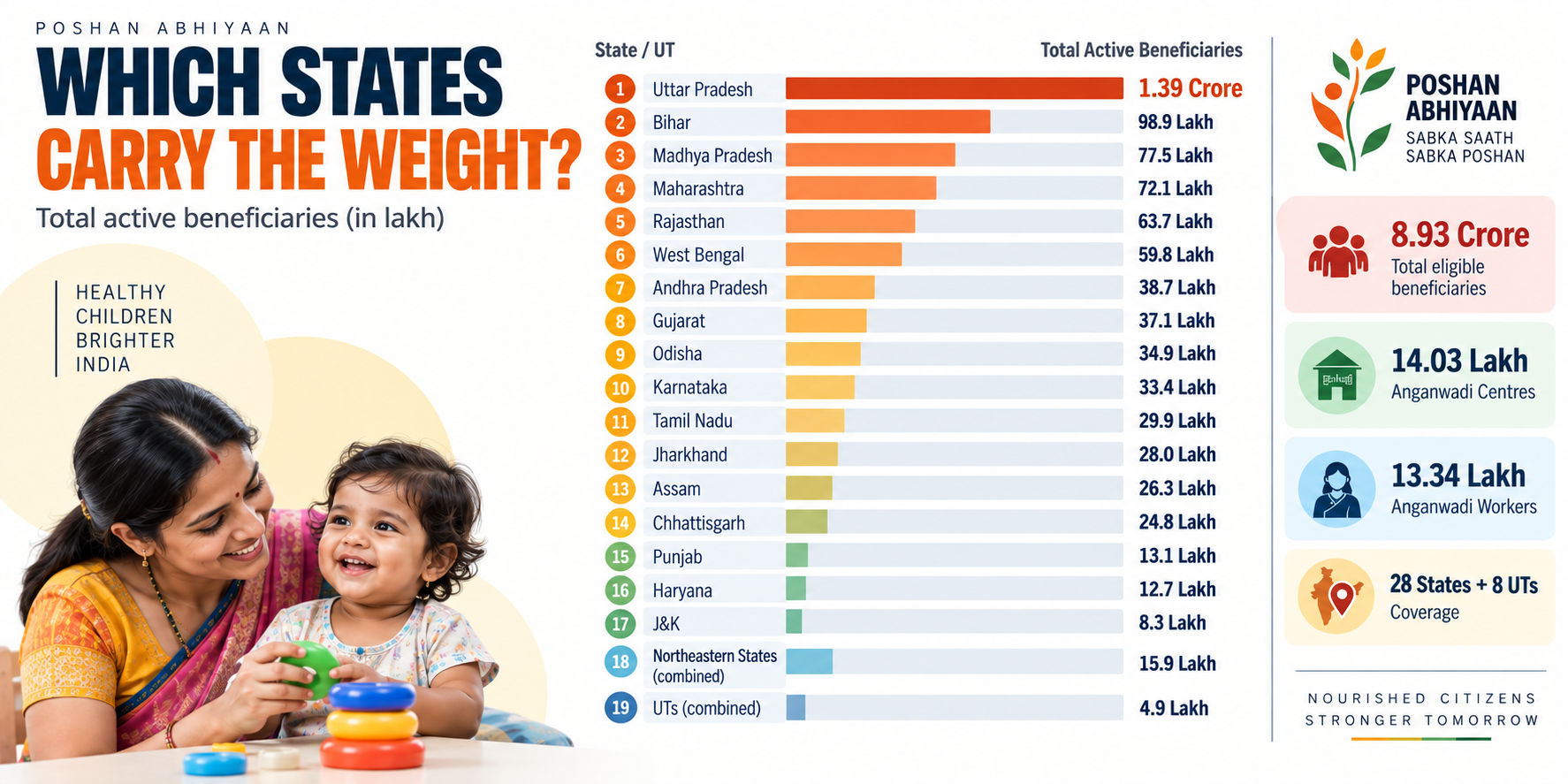
It's why Varanasi, sitting inside the state with the country's single largest number of children depending on this programme, isn't just a symbolic choice of launch venue. It's where most families now have a stake in seeing the gains hold.
A morning at one Anganwadi centre
Numbers this large stop meaning anything unless you can picture one small piece of them. So picture a single Anganwadi centre somewhere in rural Uttar Pradesh, the state that carries the country’s biggest caseload of beneficiaries.
A worker arrives early, sets up a hanging scale, and calls the toddlers one by one. Each child gets weighed, measured against a height board, and the numbers go straight into a phone app instead of a register. A mother waits outside to collect her child's take-home ration, which these days is as likely to contain fortified millets as plain rice. None of this looks dramatic. It's the same 15 minutes that has probably played out at that centre every month for years.
Difference lies in what happens to that data afterward. It doesn't sit in a drawer. It gets checked against a national growth chart, flagged if something looks off, and counted toward a district, then a state, then a national number. Multiply that one morning by 1.4 million centres running the same routine across the country, and you get a rough sense of how a national stunting rate can actually fall by nine percentage points in 10 years. It isn't magic. It's 15 minutes, repeated honestly, at a scale almost no other country attempts.
There’s more ground to cover, but direction is clear
Ten years ago, India's malnutrition numbers were the kind of statistics other countries pointed to when they wanted to explain what chronic hunger at scale looked like. Today, the country runs the largest mobile-based nutrition tracking system in the world, weighs and measures 6.3 crore children every month against WHO growth standards, and can trace a nine-point fall in stunting directly back to that discipline.
There is still ground to cover, adolescent nutrition and acute wasting move slower than chronic stunting does, and Poshan Maah exists precisely to keep pushing on the parts that haven't caught up yet. But the direction of the line is no longer in question. This September, in Varanasi, that is the story being renewed, not started.