From 26 to 101: the story behind India's Ramsar century
Visualisation
At a Glance
Before sunrise, mist still sits low over the Kamlang Tiger Reserve in Arunachal Pradesh's Lohit district. Somewhere inside it, near the small town of Wakro, lies a freshwater lake so modest, just 2.5 hectares, that it would be easy to miss on a map of India. For generations it has simply been part of the landscape, a source of water, a quiet backdrop to daily life in the villages nearby, tended without ceremony by the people and forest staff who share the reserve with it.
On August 4, 2026, that quiet changed. Glaw Lake was declared India's 101st Ramsar site, a wetland recognised by international treaty as being of global importance. It is Arunachal Pradesh's first ever entry on that list. For a state that had waited its turn while its neighbours accumulated recognition, the moment carried real weight.
Chief Minister Pema Khandu called it a defining moment in the state's conservation history, and thanked Prime Minister Narendra Modi and the Union Minister of Environment, Forest and Climate Change Bhupender Yadav for the recognition. Announcing the designation, Bhupender Yadav described Glaw Lake as more than a scenic water body, a biodiversity hotspot whose protection ensures water security, climate resilience, and the livelihoods of communities around it.
It is a fitting way to reach a hundred and one.
An old idea, revived
To understand why this number matters, it helps to look further back than 2026.
India's relationship with water bodies did not begin with the Ramsar Convention, signed in the Iranian town of Ramsar in 1971. Long before that treaty existed, Indian civilisation had already built an elaborate architecture around water conservation. The eri system of tank irrigation in Tamil Nadu, expanded and maintained over centuries, sustained agriculture across the Kaveri delta long before the term ‘wetland management’ existed. Temple tanks, stepwells, and village ponds performed a similar role across the sub-continent, treated not as incidental infrastructure but as central to the life of a settlement. It is fitting, then, that Tamil Nadu, home to this old tank tradition, is today India's leading state for Ramsar sites, with 20, one in every five nationally.
That continuity broke for a while. Colonial administration prized wetlands chiefly as land to be reclaimed for revenue and cultivation, and the habit outlived the empire. India ratified the Ramsar Convention only in 1982, and for three decades afterward, the pace of recognition stayed modest. By 2014, the country had designated just 26 wetlands, barely one a year since accession. A whole generation of officials kept the idea alive, largely unnoticed.
The turnaround
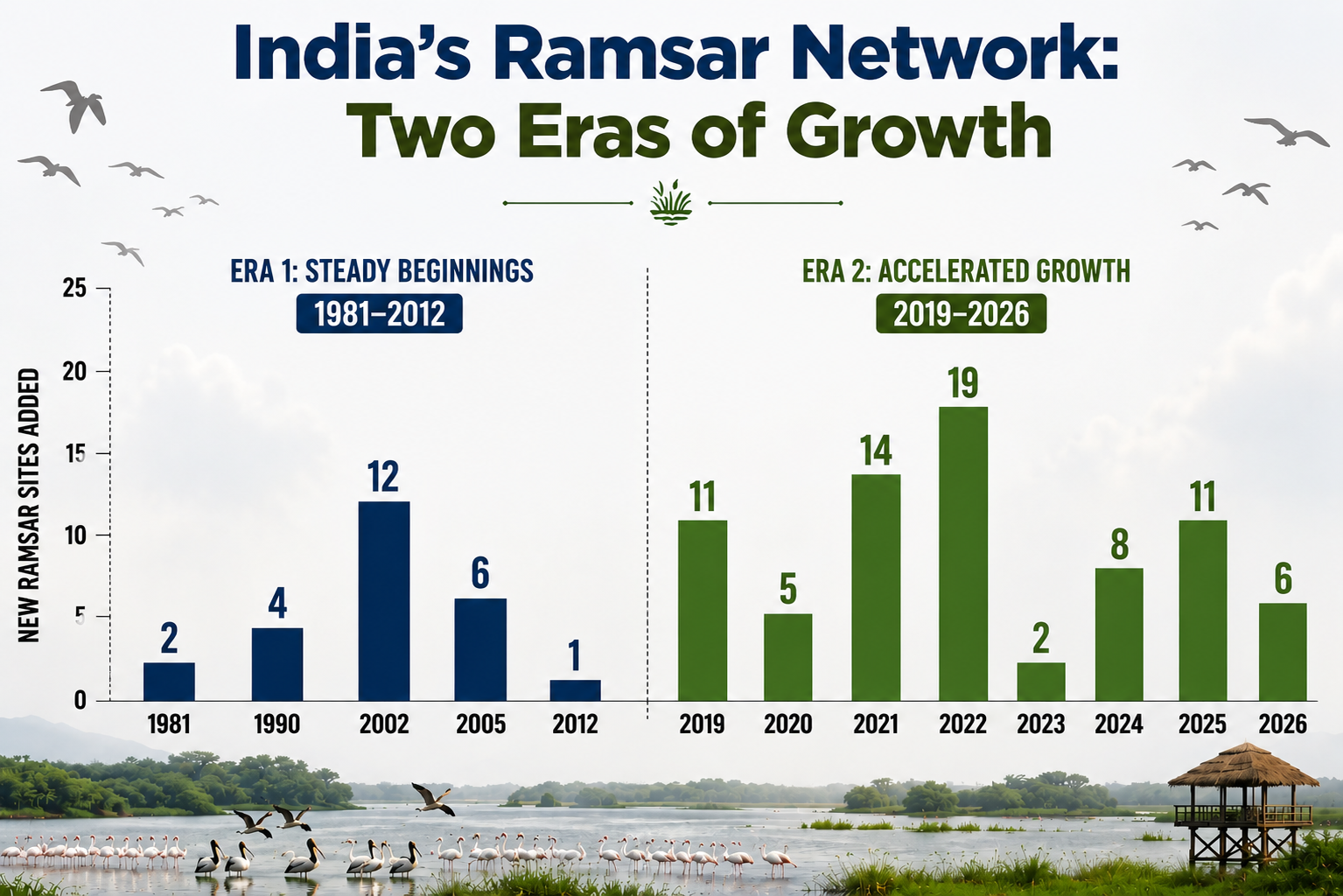
What happened next is the more striking part of the story. Between 2014 and 2026, India added 75 new Ramsar sites, taking the total from 26 to 101. That works out to roughly six new sites a year, against less than one a year in the preceding three decades.
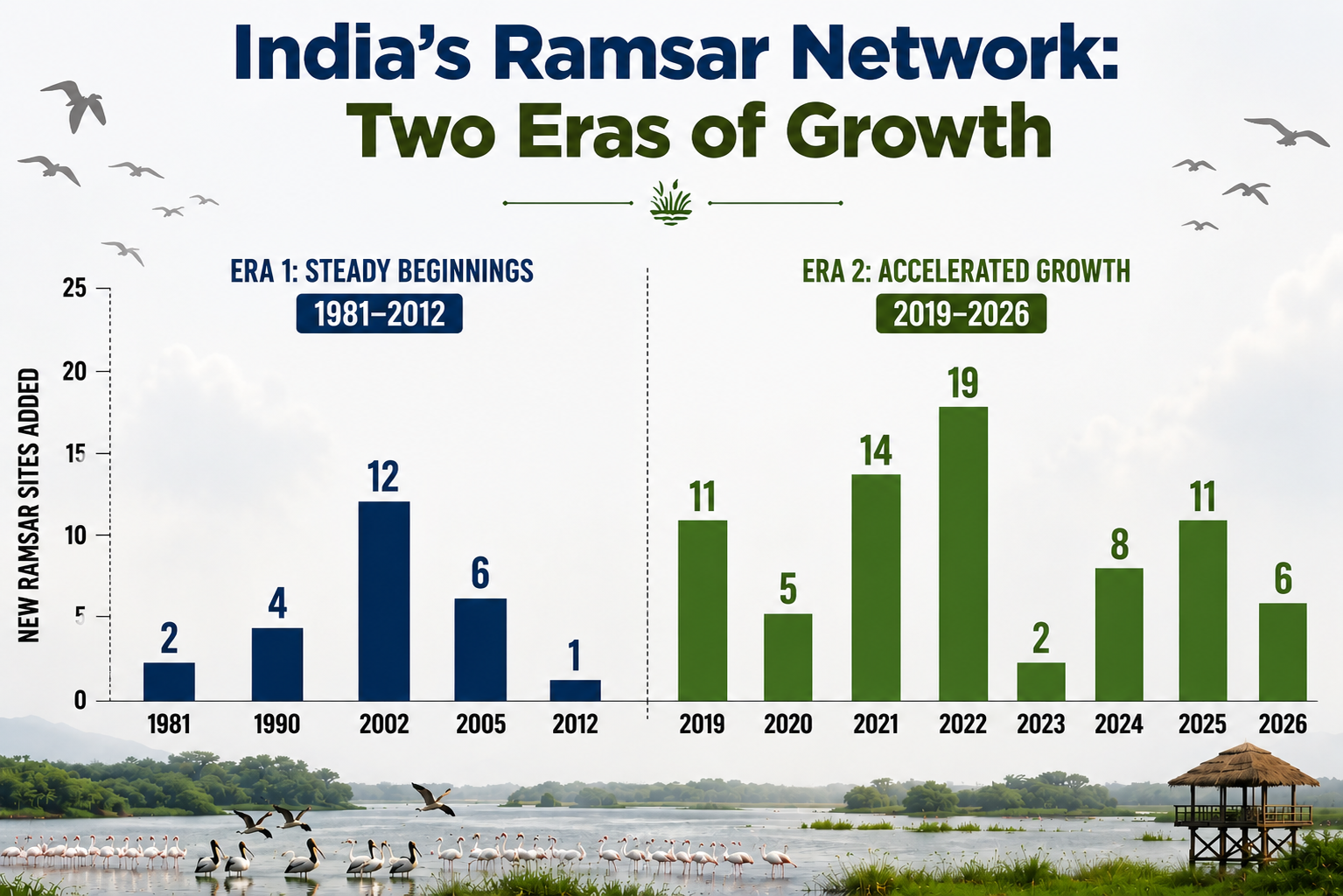
Two institutional changes underpin this shift. The Wetlands (Conservation and Management) Rules of 2017 gave state governments a clear, standardised process for identifying and nominating wetlands, replacing what had earlier been an ad hoc exercise. Wetland conservation was also woven into a wider policy architecture around water security and climate resilience. The result shows up plainly in the numbers: a nearly flat line for 30 years, followed by a steep and sustained climb.
How Tamil Nadu became India's wetland capital
Ask most people which state leads India's Ramsar list, and Odisha or Kerala usually come up first. Chilika's flamingos and Vembanad's backwaters are the images India associates with wetlands. The actual leader is quieter: Tamil Nadu, with 20 sites, one in every five nationally, nearly double the count of the state in second place (Uttar Pradesh with 13 sites).
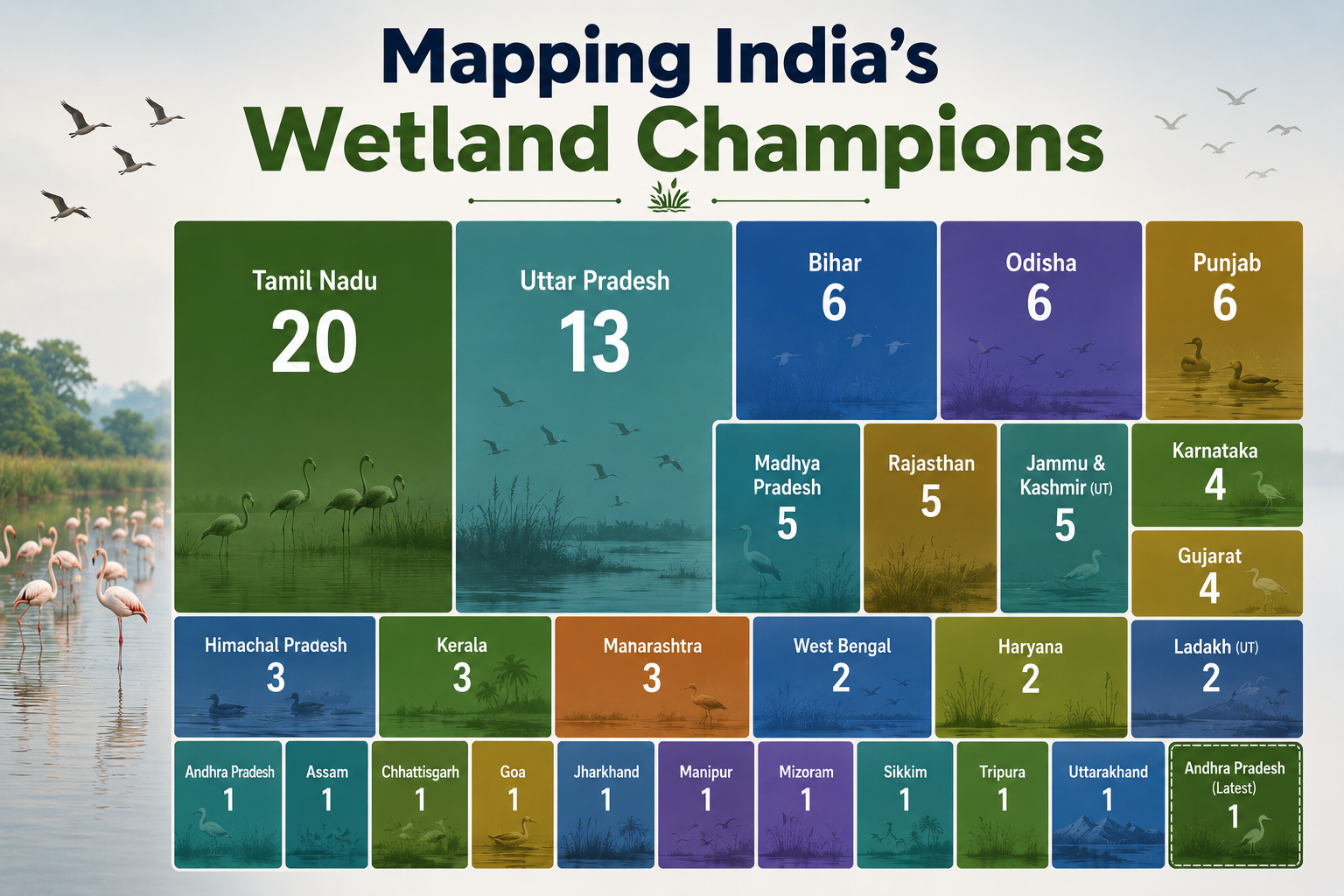
Odisha and Kerala earned their reputations the way most people encounter wetlands: as spectacle, one very large lagoon, one frequently photographed backwater system. Tamil Nadu got there by accumulation instead, decades of small, working water bodies, each unremarkable on its own, adding up to a lead no other state has matched.
Where India stands globally
A wetland qualifies for the Ramsar list by meeting any one of nine international criteria, ranging from supporting a threatened species to hosting significant populations of migratory waterbirds to sustaining fish breeding grounds. The world's first site under the convention was the Cobourg Peninsula in Australia, designated in 1974.
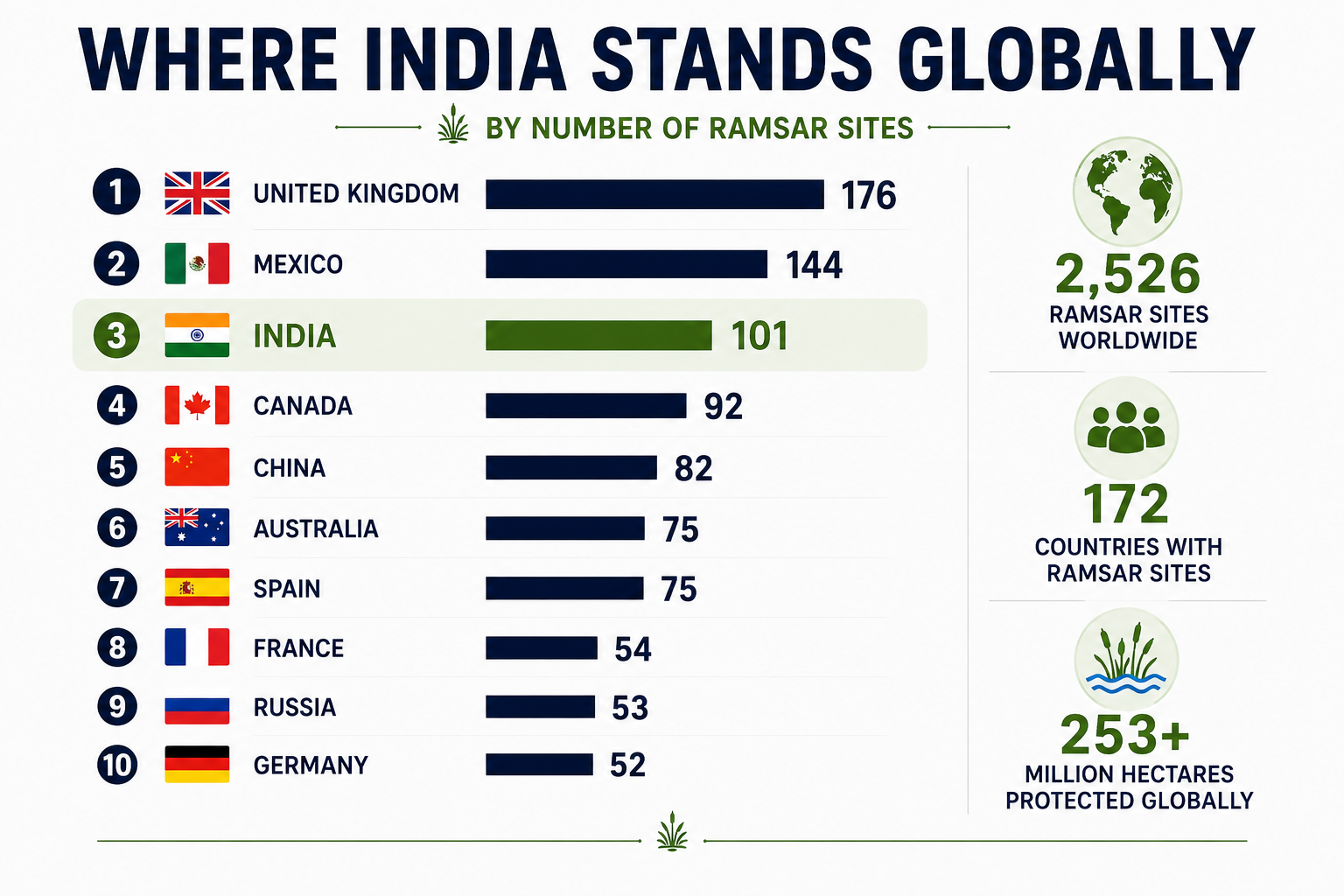
India now ranks third in the world by number of Ramsar sites, behind the United Kingdom (176) and Mexico (144), out of 172 countries and 2,526 sites worldwide. Measured by area, the comparison looks different. India's Ramsar sites cover about 13,800 square kilometres, a small fraction of the more than 253 million hectares protected globally, since countries such as Brazil and Bolivia hold a handful of vast wetlands rather than many smaller ones. India's model favours numerous, ecologically distinct sites instead, a bird sanctuary here, a high-altitude lake there, each contributing to the whole.
A varied portfolio
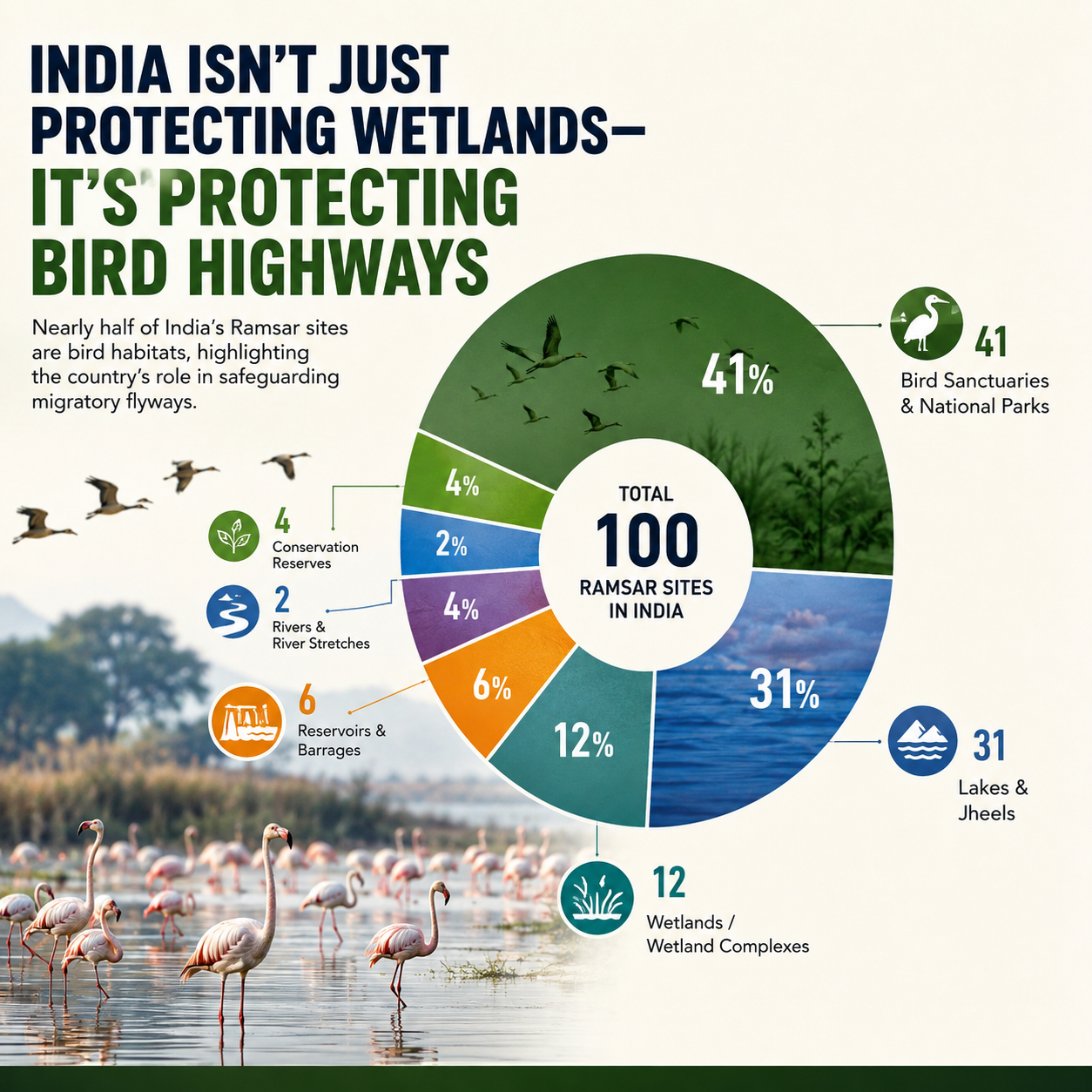
The 101 sites resist easy categorisation. Many are bird sanctuaries, hosting species such as the painted stork and the black-headed ibis. Others are cold-desert lakes in Ladakh, sitting above 4,000 metres. Coastal mangrove belts, such as Bhitarkanika in Odisha, shelter saltwater crocodile populations. Loktak Lake in Manipur carries the world's only floating national park on its surface. India’s Ramsar sites list features 27 states and union territories with Chhattisgarh, Sikkim, and Jharkhand securing their first sites only in 2025. Three states, Telangana, Meghalaya, and Nagaland, are yet to feature.
Not every site is thriving
Recognition is a beginning, not a guarantee. Keoladeo National Park and Loktak Lake are on the Montreux Record right now, the Ramsar list for wetlands in trouble. Chilika Lake was there too, once.
Chilika became one of India's first two Ramsar sites back in 1981. But the badge alone didn't save it. Silt clogged its mouth to the sea. Fresh water and salt water stopped mixing the way they should. By 1993, Chilika was on the Montreux Record. Over two lakh fishermen lost income.
Turning it around took real work, not another announcement. The Odisha government, under Chief Minister Naveen Patnaik, set up the Chilika Development Authority. In September 2000, it dredged a new mouth to the Bay of Bengal. It treated the watershed to stop the silt. It gave fishing communities new ways to earn: dolphin tours, bird safaris.By 2002, Chilika was off the list. The CDA won the Ramsar Wetland Conservation Award, the first time any Asian site had clawed its way back like this.
Coming back to Glaw Lake
By evening, the mist over the Kamlang Tiger Reserve lifts, and Glaw Lake looks much as it always has, small, quiet, unremarkable to anyone passing by. What has changed is not the waterbody but its standing in the world.
That distinction is really what this whole count is about. A designation does not, by itself, hold back a cyclone or feed a migratory bird; the mangroves and the tanks and the small lakes do that, the same way they always have. What a Ramsar listing demands is something less visible and more telling: a government willing to survey a site, document it against international criteria, commit to managing it, and then be answerable for that management for as long as the listing stands. That is a different kind of work than announcing a target or issuing a statement at a summit. It shows up years later, in whether a wetland is still healthy, or whether it has slid onto the Montreux Record the way Keoladeo and Loktak have, and in whether anyone bothers to pull it back the way Chilika was pulled back.
Twenty-six Ramsar sites in three decades, then seventy-five more in twelve, is not really a story about environmental ambition rising. Ambition is common; every government has some. It is a story about a process finally getting built and then, year after year, actually being used, the difference between a government that talks about the environment and one that does the paperwork and the fieldwork required to protect such sites. Whether the next 12 years look like the last twelve will depend less on how many new names get added to the list, and more on whether the 101 already on it, Glaw Lake included, are still worth visiting a generation from now.
Sources
Tags
Frequently Asked Questions
When did the Ramsar Convention begin, and when did India join?
The treaty was signed in 1971 in Ramsar, Iran; India ratified it only in 1982.
How does India rank globally for Ramsar sites?
Third, behind the UK (176) and Mexico (144), among 172 countries and 2,526 sites worldwide.