From decline to revival: India’s hockey story in numbers
Visualisation
At a Glance
The Hockey World Cup is back. The 16th edition will be played in Belgium and the Netherlands from August 14 to 30. For India, though, this is more than another major tournament. It is another test of how far Indian hockey has travelled in its long climb back toward the top.
There was a time when India set the standard in world hockey. That dominance faded decades ago, leaving behind both a proud legacy and a difficult benchmark. Since then, every revival has carried the same expectation: can India become a genuine world champion again? That is what makes the 2026 World Cup so compelling. The question is no longer whether Indian hockey has improved. It has. The real question is whether that progress has gone far enough for India to challenge seriously for the title.
The golden days
To understand why the 2026 World Cup carries so much weight, you have to look beyond the tournament itself and back to the era when India defined world hockey.
Long before the World Cup was even created, India had already built an extraordinary international record. Between 1928 and 1980, the men's team won eight Olympic gold medals, establishing a standard few sporting nations have matched. For much of the twentieth century, hockey was more than India's most successful team sport. It was one of the clearest expressions of Indian excellence on the world stage.
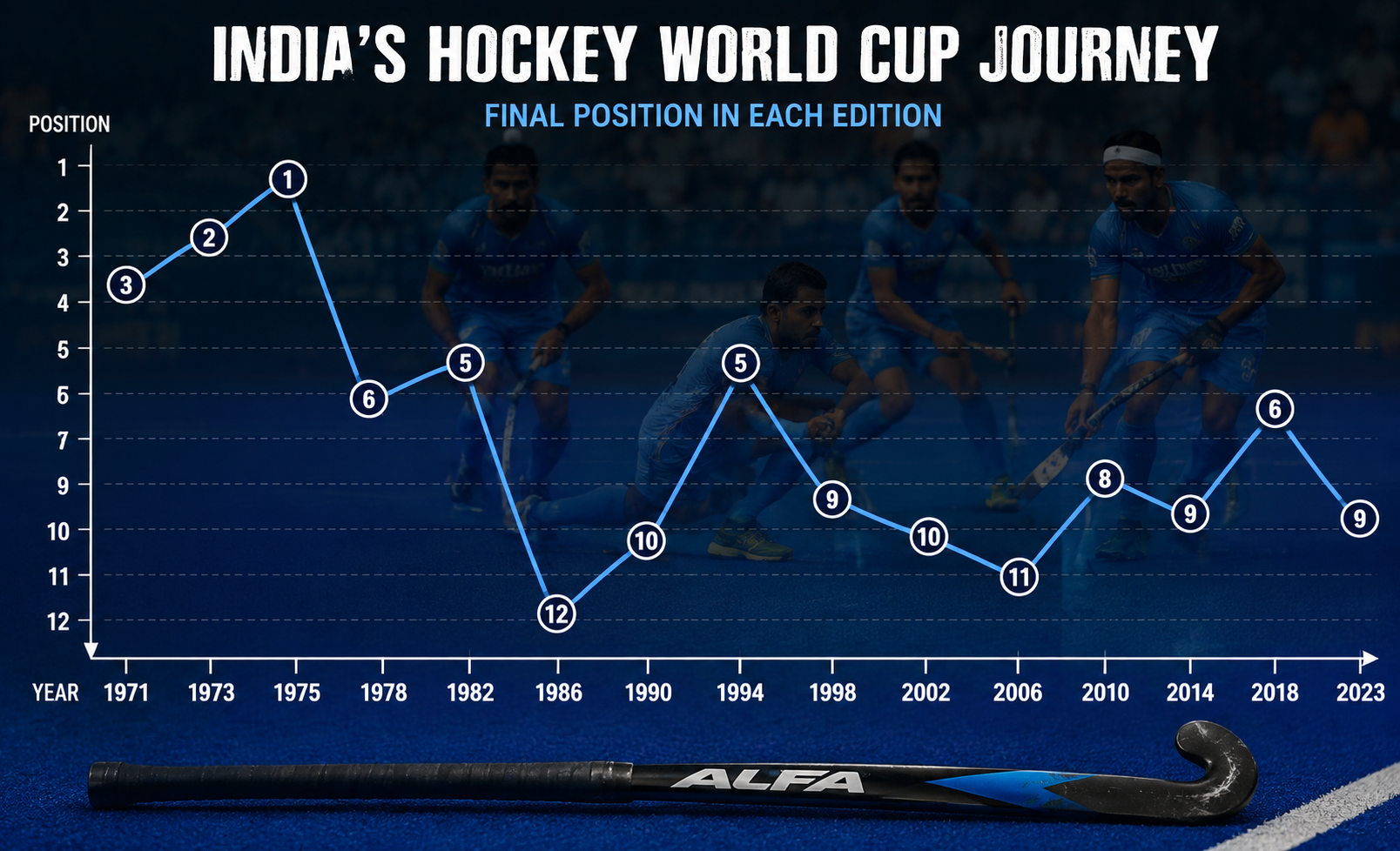
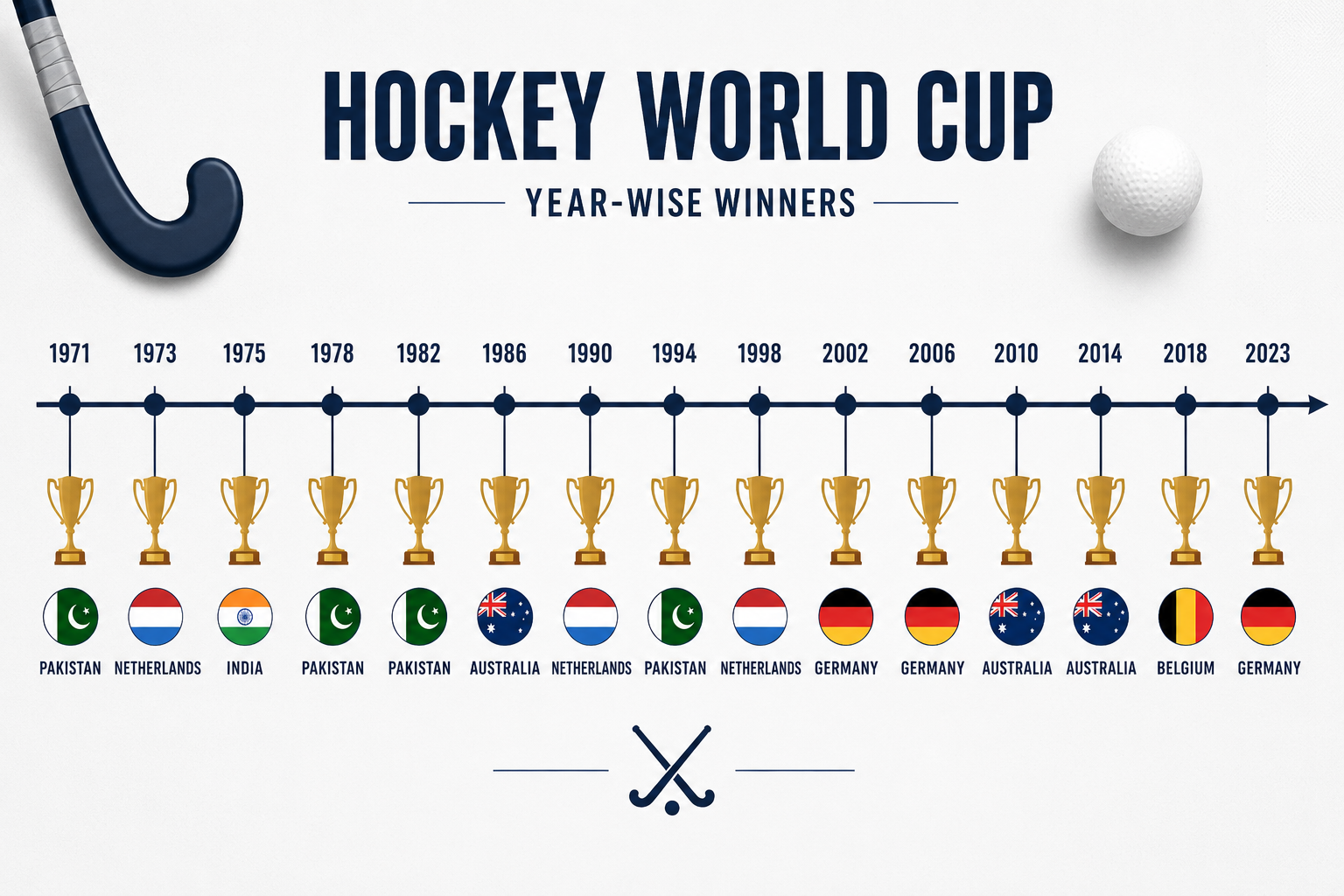
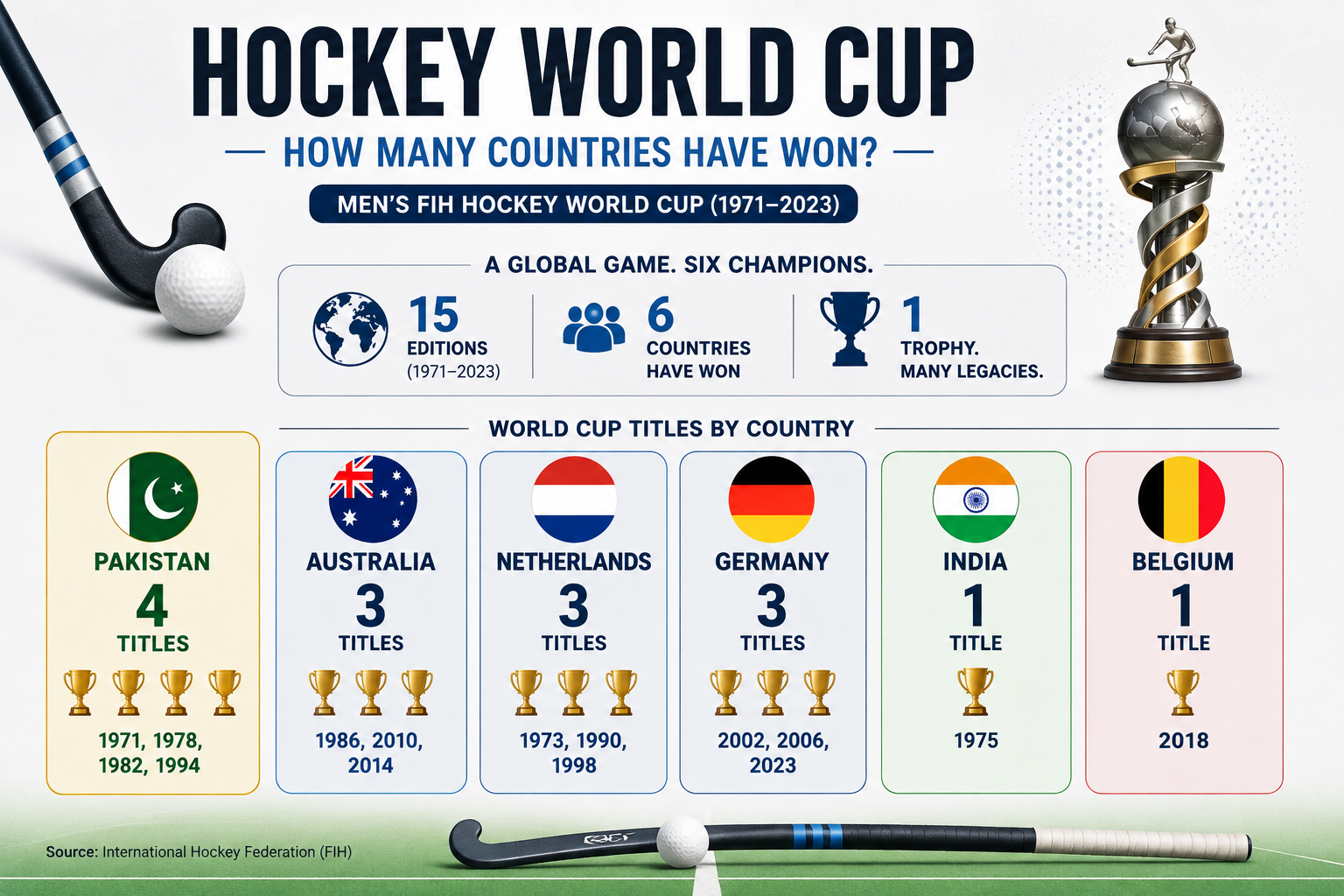
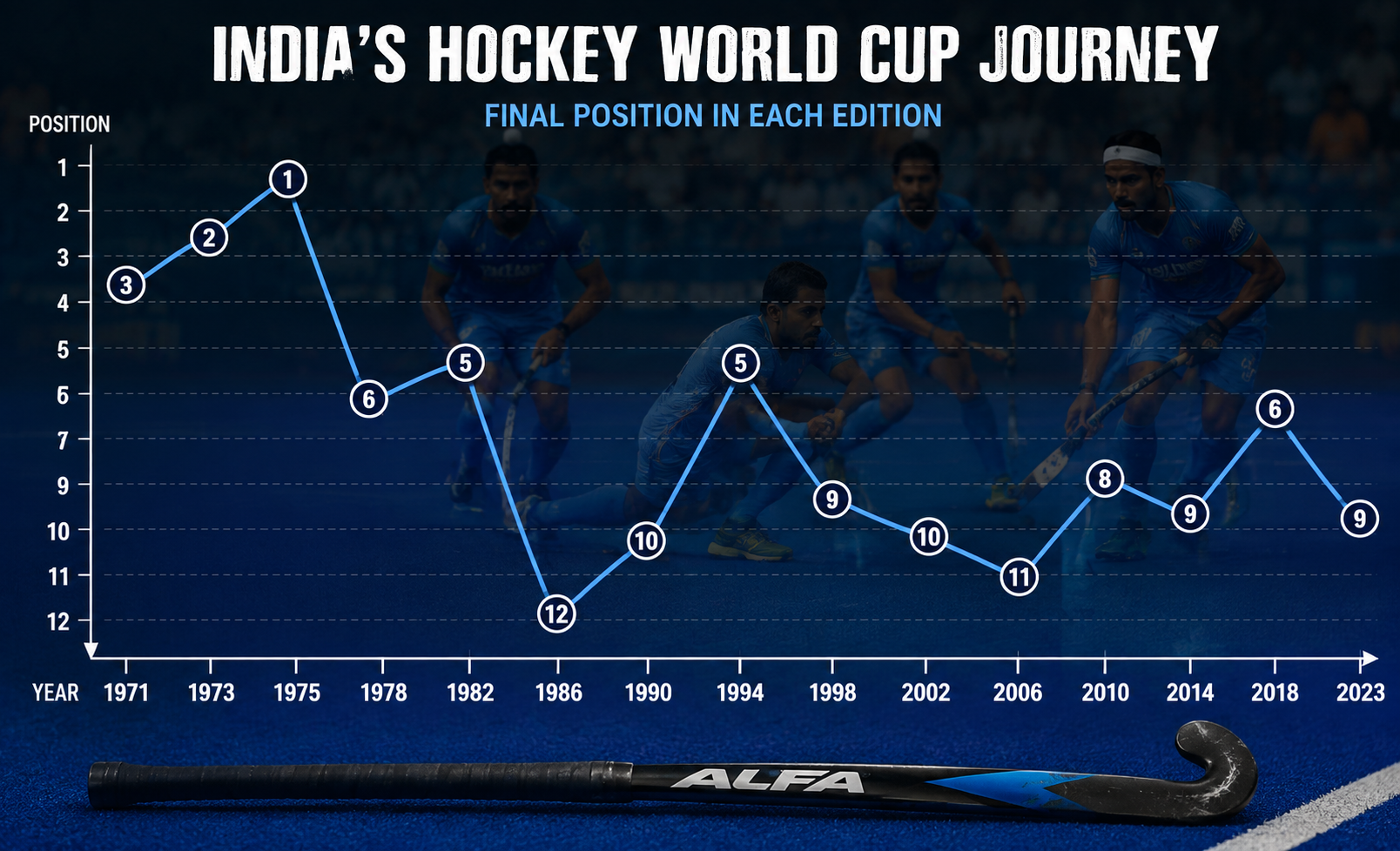
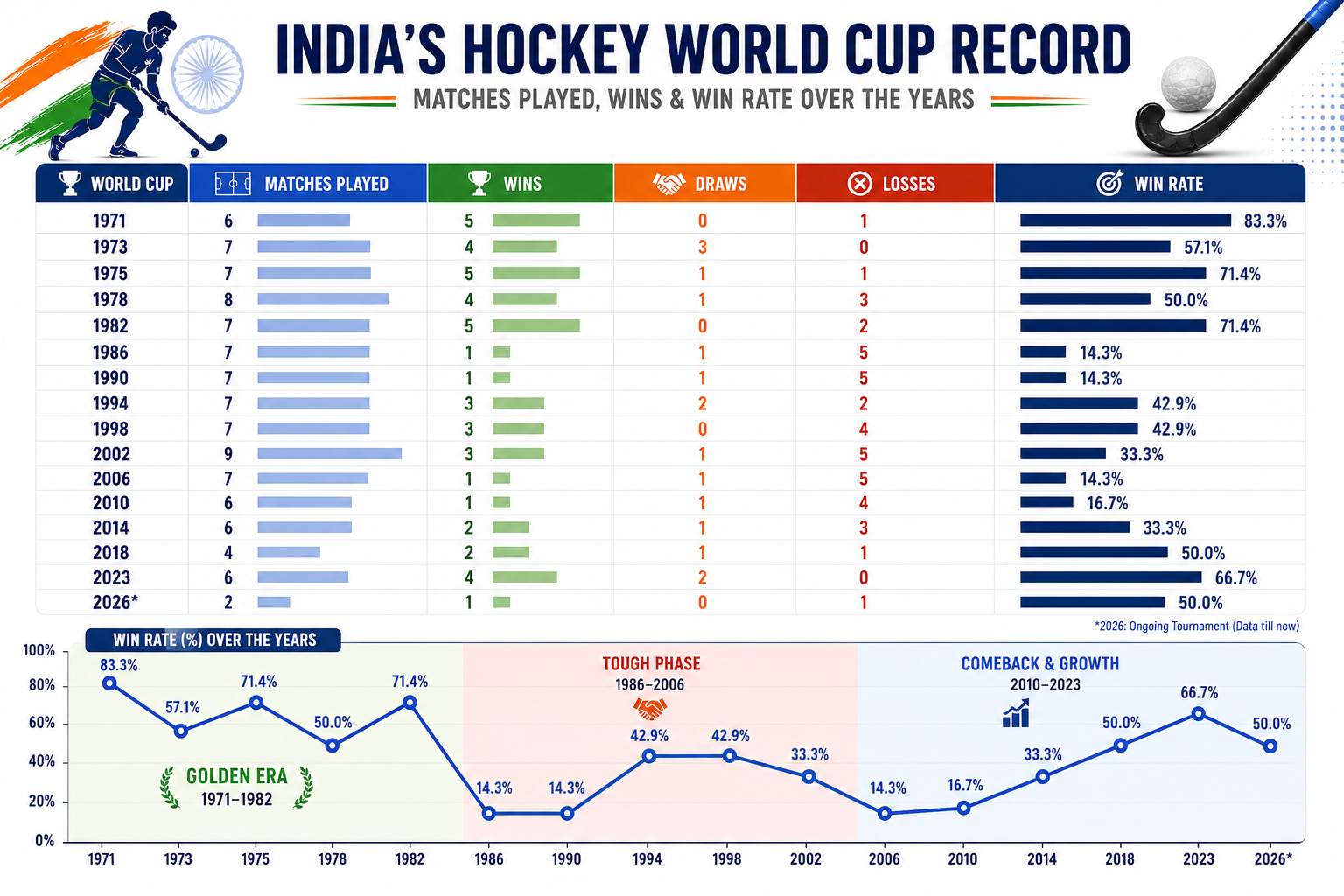
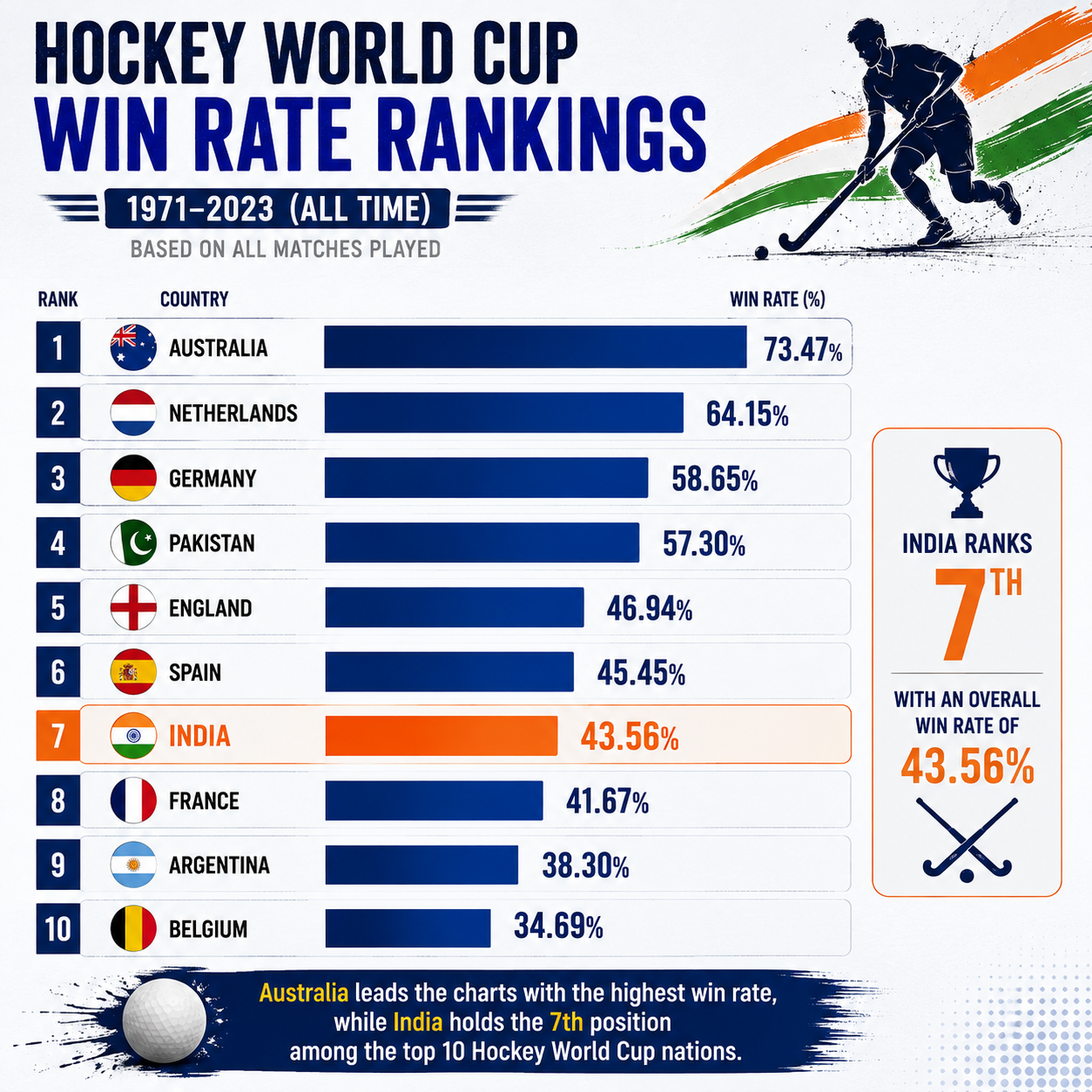
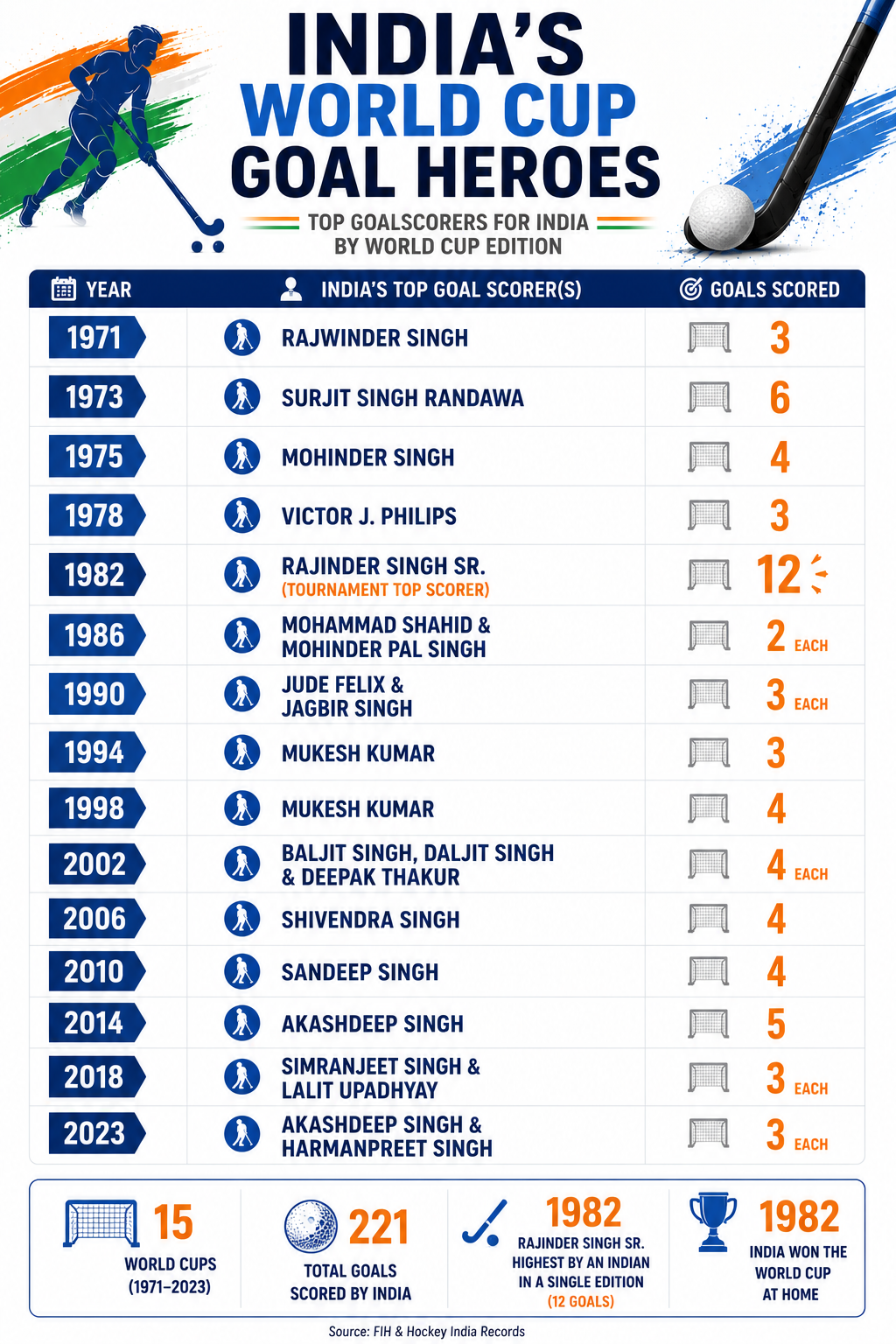
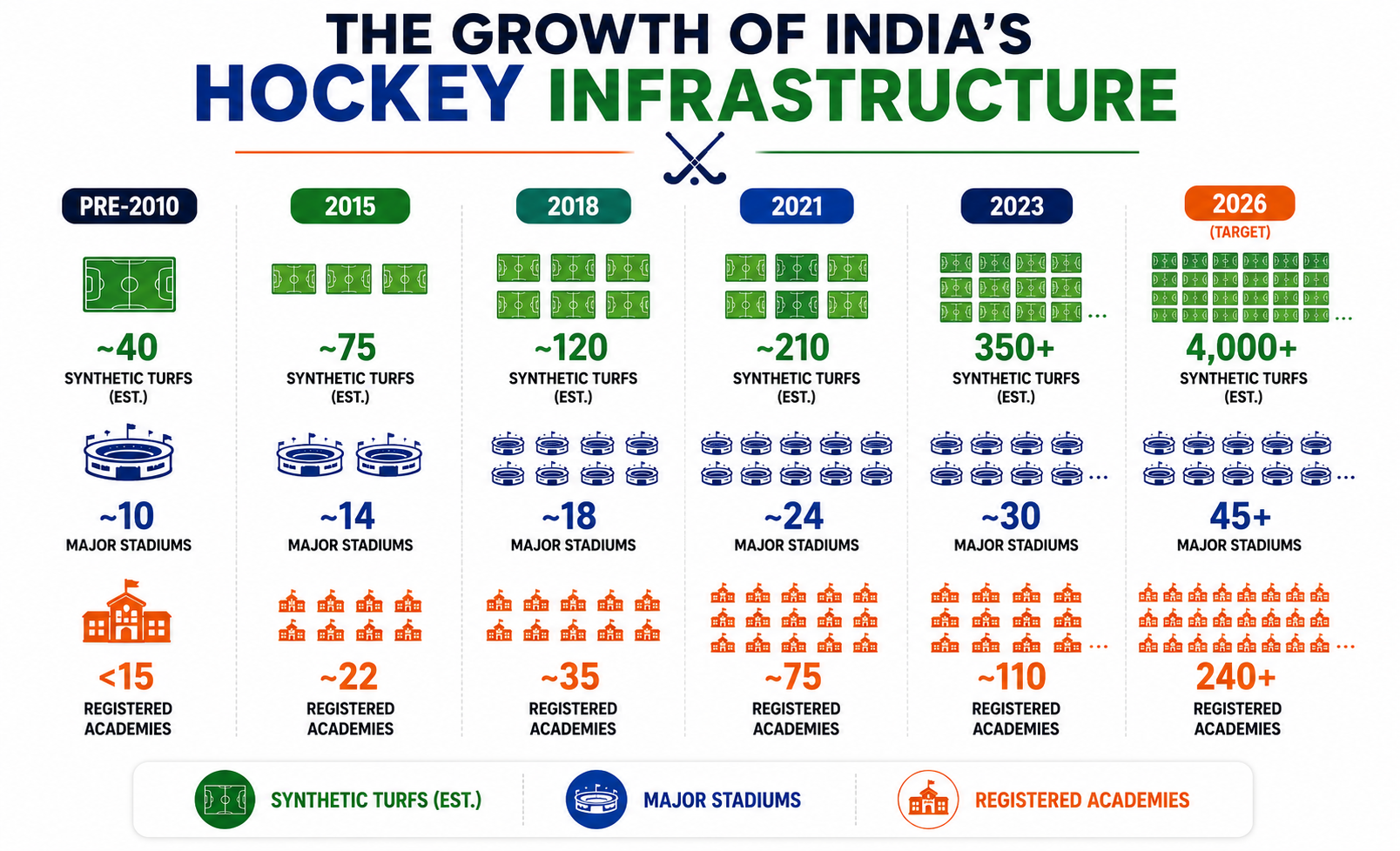
When the Hockey World Cup arrived in 1971, India entered it with the weight of an already formidable reputation. The team finished third in the inaugural edition, went one better with silver in 1973, and finally lifted the trophy in 1975. That remains India’s only World Cup title. The record since then tells its own story. Pakistan leads the all-time list with four titles, while Australia, Germany and the Netherlands have won three each. Belgium has also lifted the trophy. India, despite its extraordinary Olympic legacy, has never repeated the triumph of 1975. Nearly half a century later, that victory still stands alone — and that long wait is at the heart of India’s World Cup story. Then things changed, slowly enough that people almost didn't notice. After 1982, India's position started dropping. Over the next three decades, the team never finished better than 5th place, and in 1986, it finished as low as 12th. Its win rate, how often it actually won matches at the World Cup, fell from around two-thirds in the golden years to under 30% through the 1990s and 2000s. Chart updated till August 18. The decline did not happen for one reason. The game itself was changing. As hockey moved from natural grass to artificial turf, speed, stamina and structured movement became increasingly important, reducing the advantage India had long enjoyed through close control and exceptional stickwork. At the same time, countries such as Australia, Germany and the Netherlands were building stronger domestic systems, with competitive leagues feeding players, coaching expertise and resources into their national programmes. India struggled to make the same transition. Investment, infrastructure and long-term player development failed to keep pace with the leading hockey nations. Matters were made worse by years of administrative disputes and instability. While rivals were strengthening the foundations of their game, Indian hockey was too often occupied with problems off the field. Leaning on one player One statistic from that difficult period deserves more attention. At the 1982 World Cup, Indian forward Rajinder Singh Sr. scored 12 goals in a single tournament, a remarkable individual return at a time when the national team was already losing ground internationally. No Indian player before or since has come close to matching that tally. It remains one of the clearest reminders that even during Indian hockey’s decline, flashes of extraordinary individual brilliance never disappeared. It is an extraordinary record, but also a revealing one. For too long, Indian hockey depended on moments of individual brilliance rather than a system capable of producing depth across the team. When the standout performances faded, so did the results. The comeback, when it finally came, would not depend on finding another Rajinder Singh. It would depend on building a structure strong enough to succeed without one. That bigger build has a name: Khelo India, the government's sports development programme, which started scaling up hockey infrastructure around 2018.Since then, the numbers have moved fast. India's dedicated hockey centres have grown from 15 to 94. Registered academies have jumped from 35 to 240. Synthetic turf grounds, the very thing that left India behind decades earlier, have gone from around 40 nationwide to more than 4,000 today. The results are beginning to reflect that progress, even if the breakthrough has not arrived yet. Across the last two World Cups, India has won 58% of its matches, compared with 43% in the editions immediately before Khelo India began. In 2023, it won two-thirds of its games, its best World Cup win rate since 1982. And yet, India finished ninth. That contradiction says a lot about modern tournament hockey. Strong performances across several matches can be wiped out by one poor knockout game. India played better hockey than its final position suggested, but the ranking was what remained. That is the question heading into 2026.India carries eight Olympic gold medals, one World Cup title, decades of decline, and now a rebuilding project mature enough to be judged by results rather than promise. The investment is visible. The improvement is visible. What is still missing is the result that changes the conversation: a deep World Cup run. That is why this tournament matters. Not simply because India might win a medal, but because 2026 will show whether the team can consistently compete with the world's best, away from home and under knockout pressure.If it can, the long rebuild will finally have something tangible to show for it. If it cannot, the question that has followed Indian hockey for decades will remain unanswered.The long slide
Khelo India: How Things Changed
So, has India rebuilt enough?
Sources
Tags
Frequently Asked Questions
How many World Cup matches has India played?
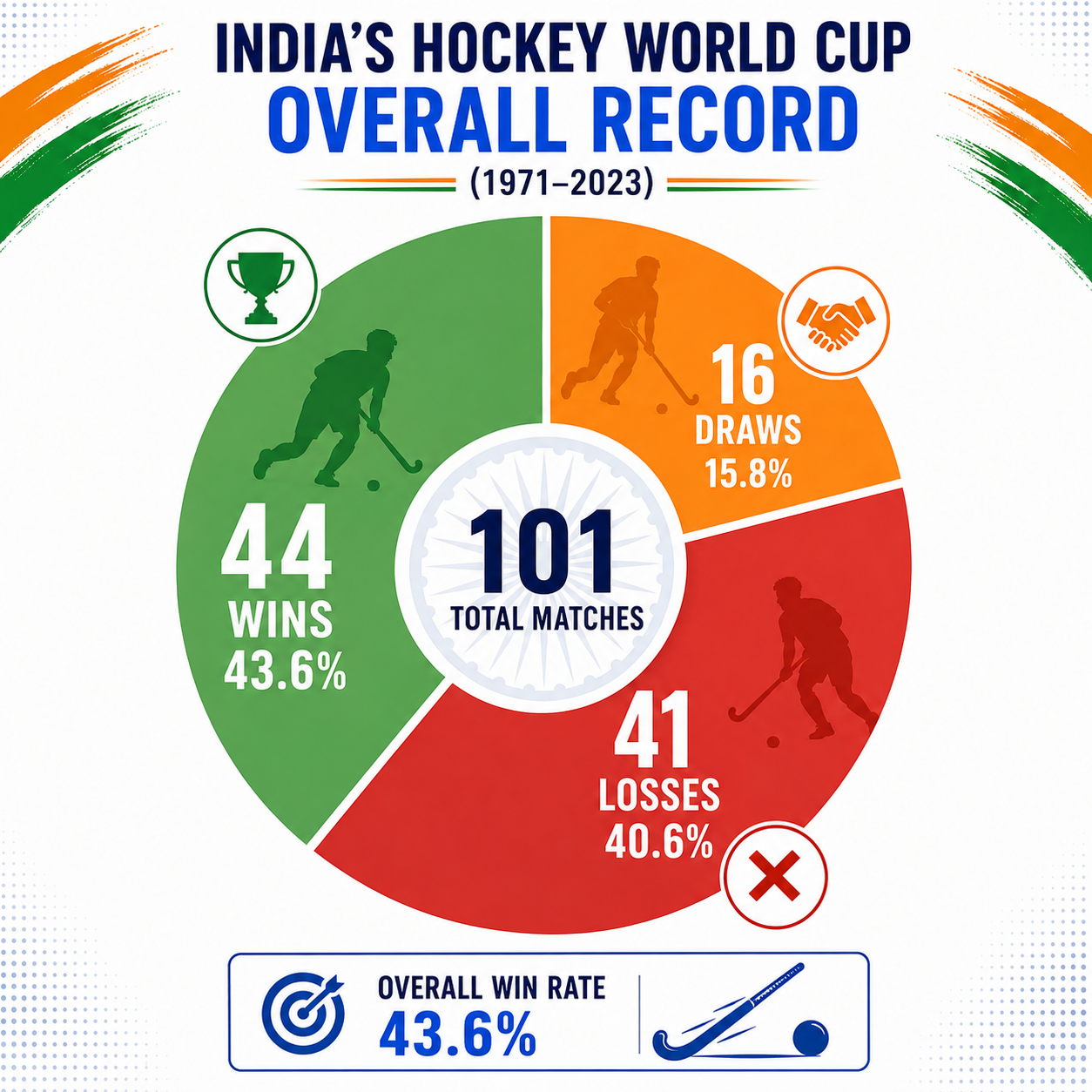
Between 1971 and 2023, India played 101 matches, winning 44, drawing 16 and losing 41. India scored 221 goals and conceded 190.
When did India last win a World Cup medal?
India's last men's World Cup medal remains the 1975 gold medal.
Who has won the most Men’s Hockey World Cup titles?
Pakistan, Australia and the Netherlands are among the tournament's most successful teams, while Germany has also been a major champion.