How the West Asia war is testing India’s oil supply chain
Visualisation
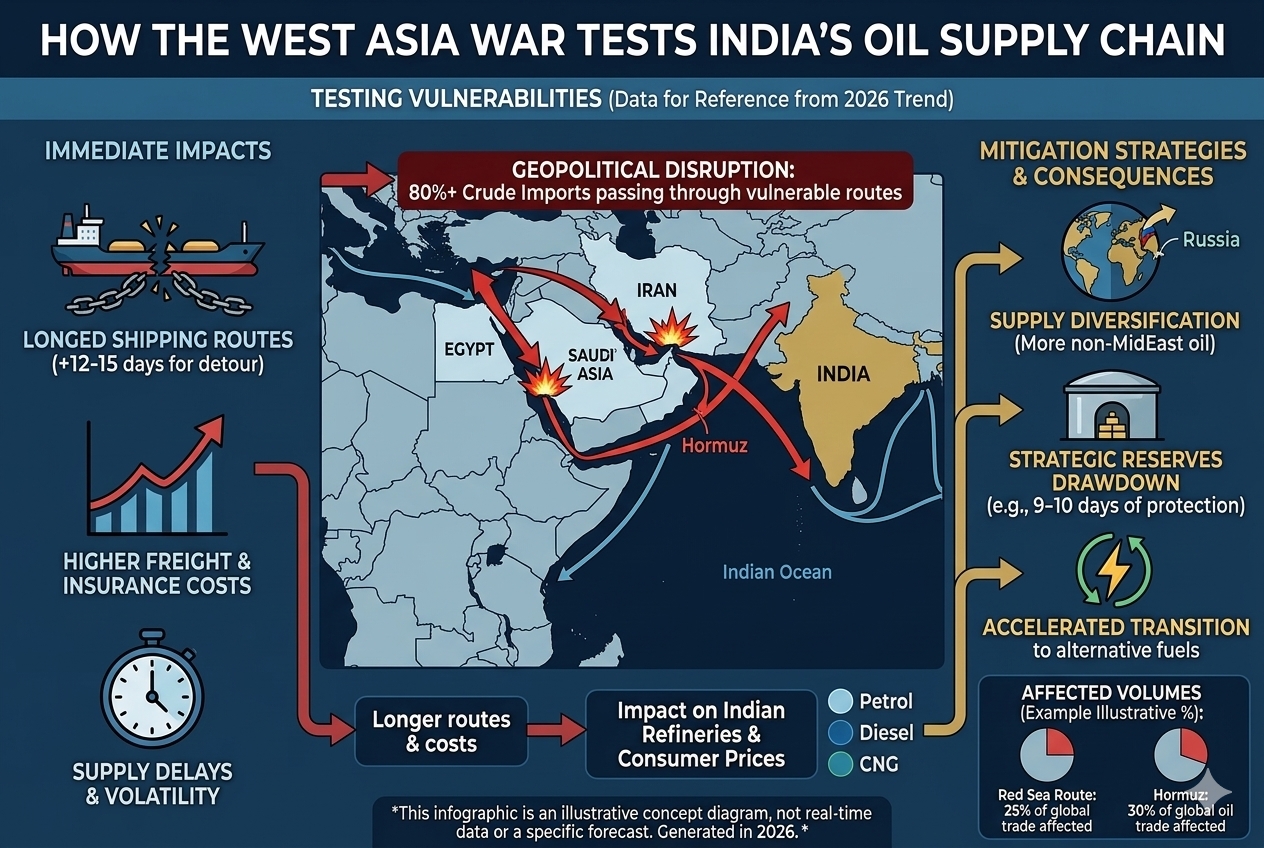
At a Glance
The biggest economic risk from the West Asia war was never confined to the petrol pump. For India, the real vulnerability lies deeper — in the long chain that begins with imported crude, passes through shipping routes and refineries, and eventually affects transport costs, manufacturing, inflation, the rupee, and the country’s foreign-exchange position.
That vulnerability became visible when the conflict disrupted shipments through the Strait of Hormuz, one of the world’s most important energy chokepoints. The International Energy Agency estimates that around 20 million barrels of oil a day, roughly a quarter of global seaborne oil trade, normally passes through the Strait. About 80% of that flow is destined for Asia. India and China together accounted for 44% of crude exports passing through the Strait in 2025.
For India, this created a problem of both price and logistics. India imports nearly nine-tenths of the crude oil it consumes. Petroleum remains one of the country’s largest import categories, making any sustained rise in international crude prices a direct threat to the import bill and the demand for dollars.
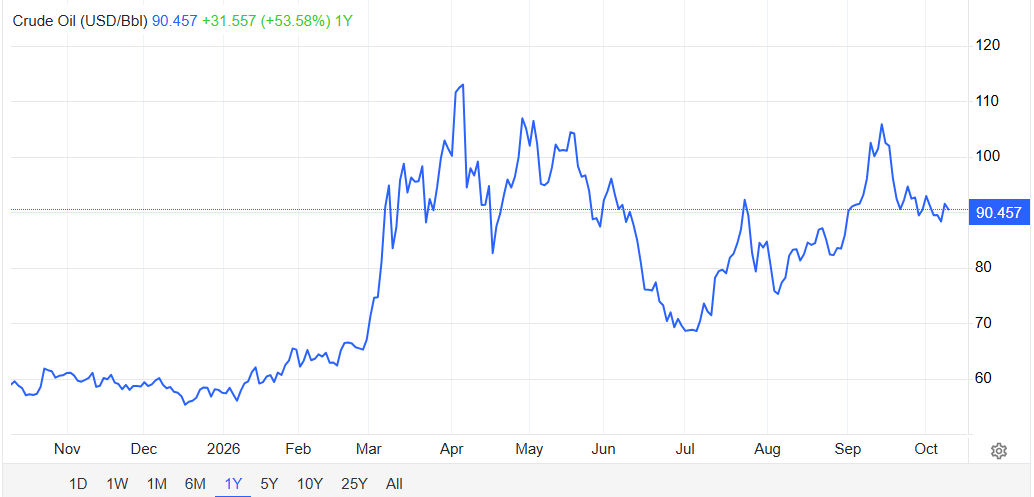
source - https://tradingeconomics.com/commodity/crude-oil
India changed the route before the shock became a shortage
The most important response was diversification. When supplies through Hormuz were disrupted, Indian refiners did not depend entirely on Gulf barrels. They increased purchases from Russia, Latin America, Africa, and other suppliers. In April, overall crude imports were about 4.4 million barrels per day, while Russia remained the largest supplier at around 1.6 million barrels per day.
By May, India’s crude imports had recovered to 5.27 million barrels per day. Russia supplied about 1.92 million barrels per day, or 36.5% of the total, while the UAE increased supplies substantially. India also turned to Venezuela, Brazil, Angola and Nigeria as refiners searched for barrels outside the disrupted Gulf routes.
The composition continued to change. In June, Russian crude reached a record 2.61 million barrels per day, accounting for more than half of India’s crude imports that month.
By September, however, West Asian supplies had begun recovering. Imports from the region rose 74% month-on-month to 2.10 million barrels per day, although they remained well below the pre-war share. Russian crude fell to about 35.3% of India’s imports.
This changing basket is significant. India was not simply buying less oil; it was changing where and how it bought oil.
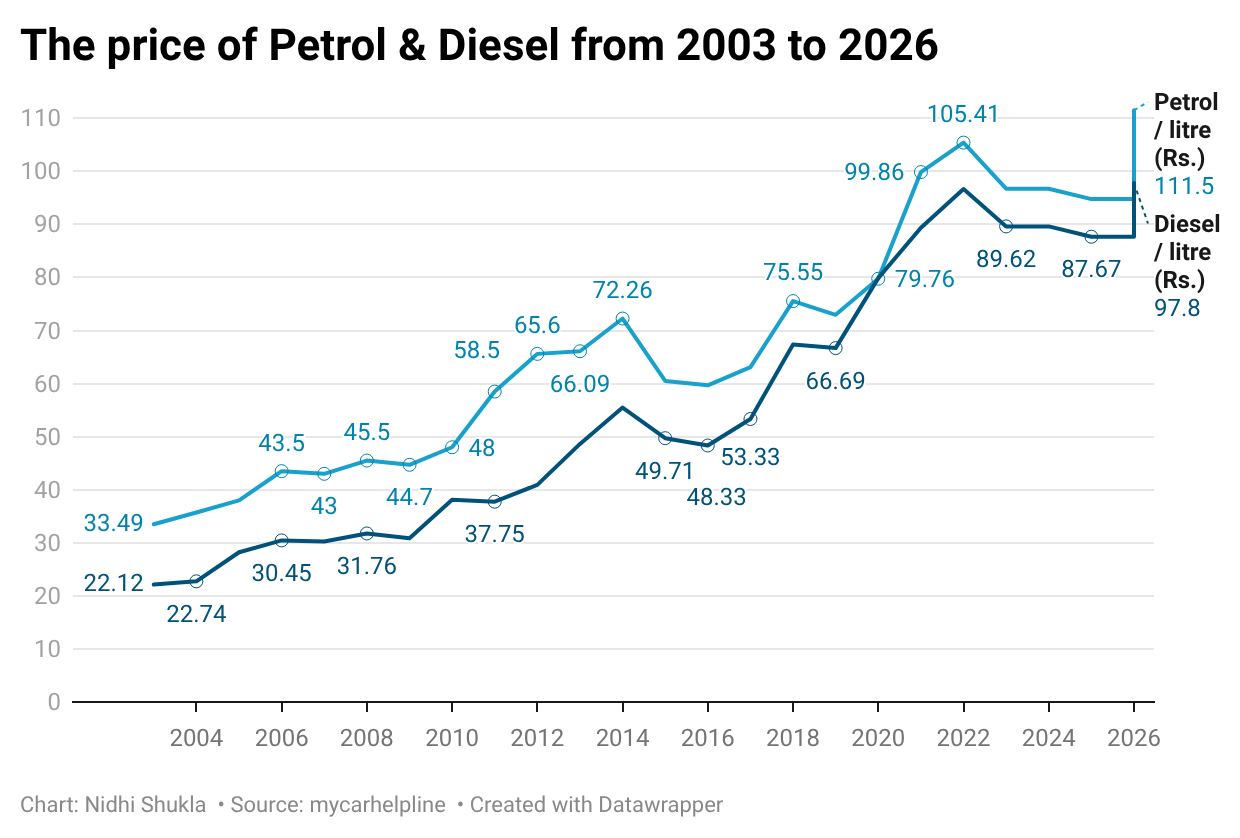
https://www.datawrapper.de/_/87WDD/?v=2
The price shock travelled through the supply chain
The first impact of an oil shock is on the crude import bill. The second is on freight, insurance, and refinery economics. The third eventually reaches every business that moves people or goods.
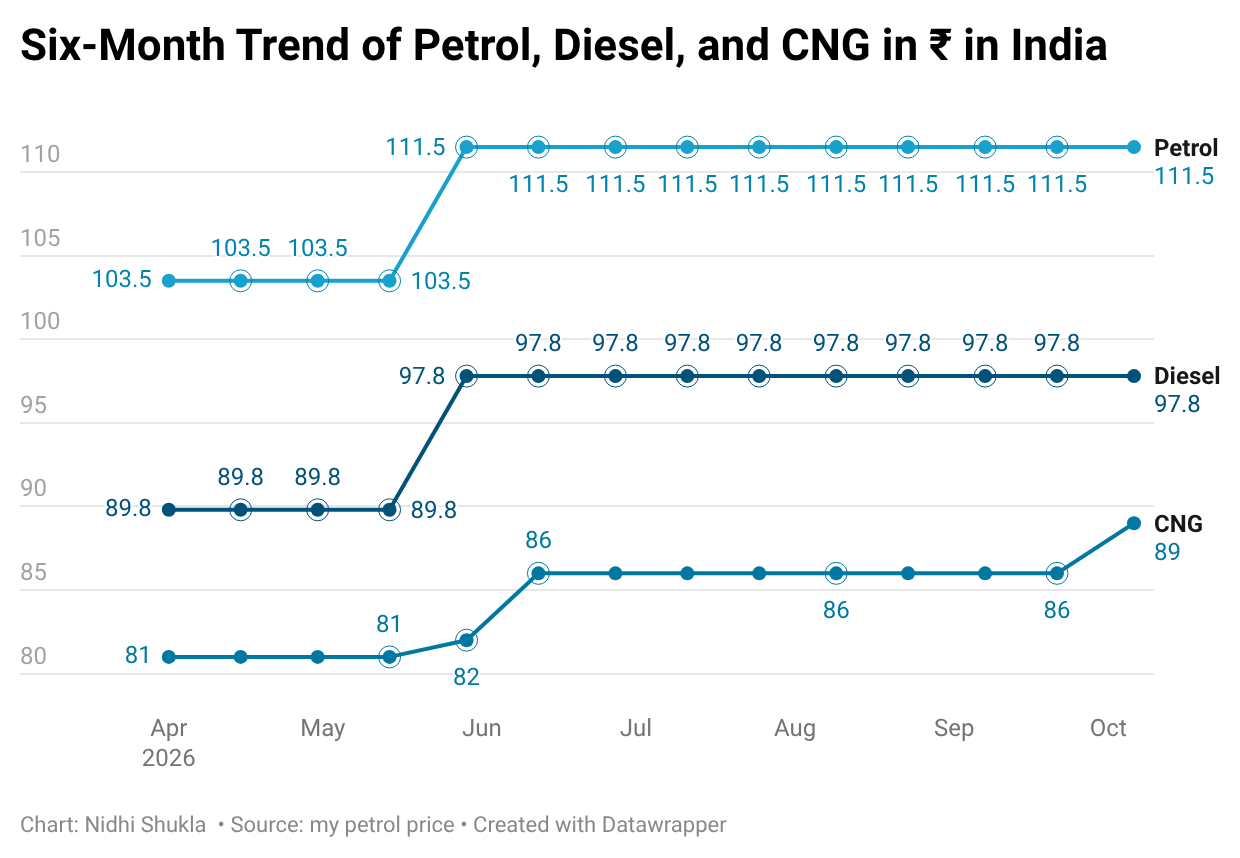
https://www.datawrapper.de/_/1n0Kv/
The March shock demonstrated the scale of the risk. International crude prices rose from around $70 to nearly $122 a barrel in a matter of weeks. The Union government responded by cutting excise duty on petrol and diesel by ₹10 a litre to absorb part of the pressure on oil marketing companies, while keeping retail prices unchanged.
That intervention helped prevent an immediate pass-through to consumers. Petrol and diesel prices subsequently remained broadly stable even as global crude prices moved sharply. By October, however, state-run oil companies were still carrying substantial losses because domestic pump prices had not fully reflected international costs.
The distinction matters: stable pump prices do not mean that the oil shock has disappeared. Part of the cost has simply been absorbed elsewhere in the system.
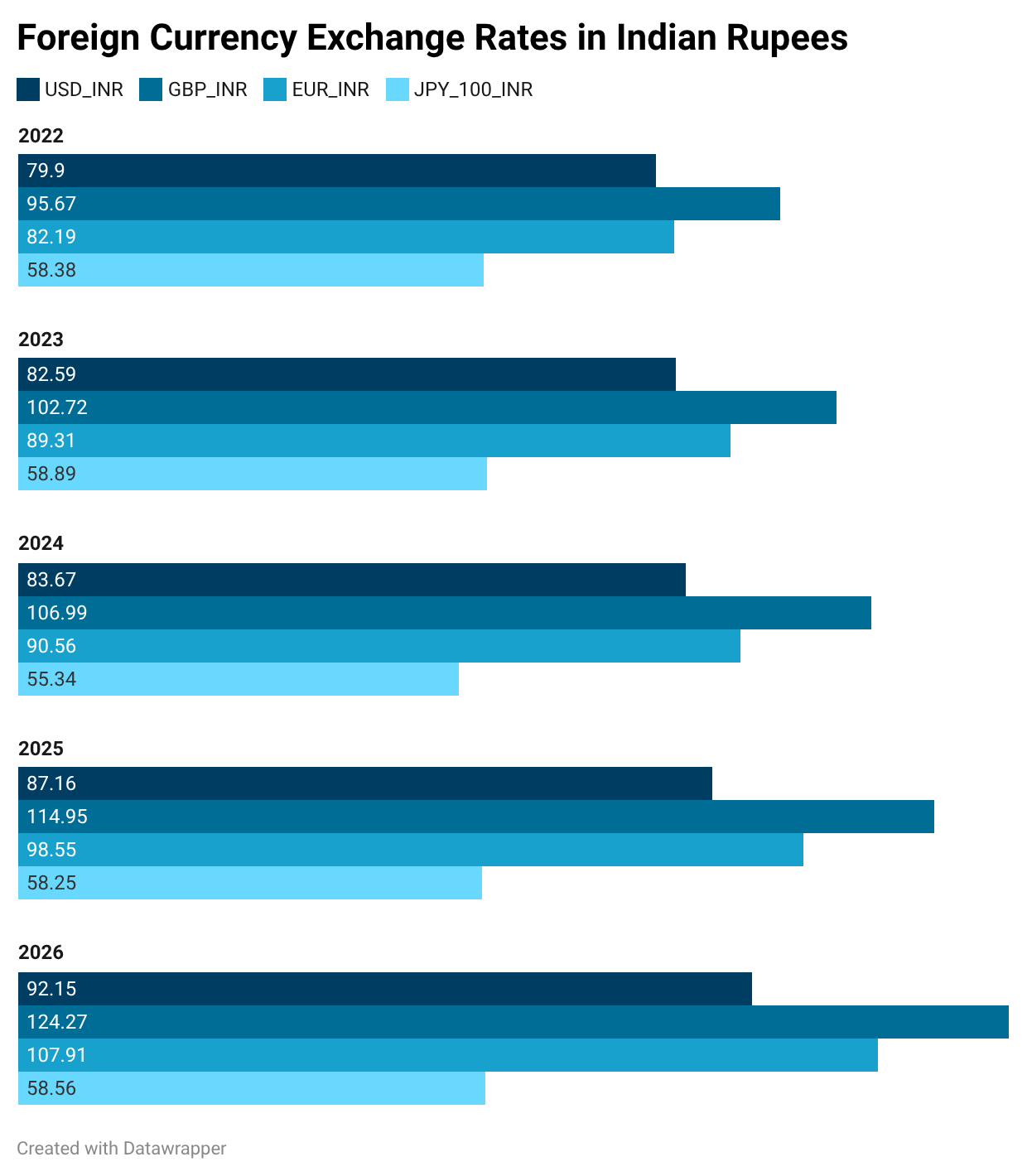
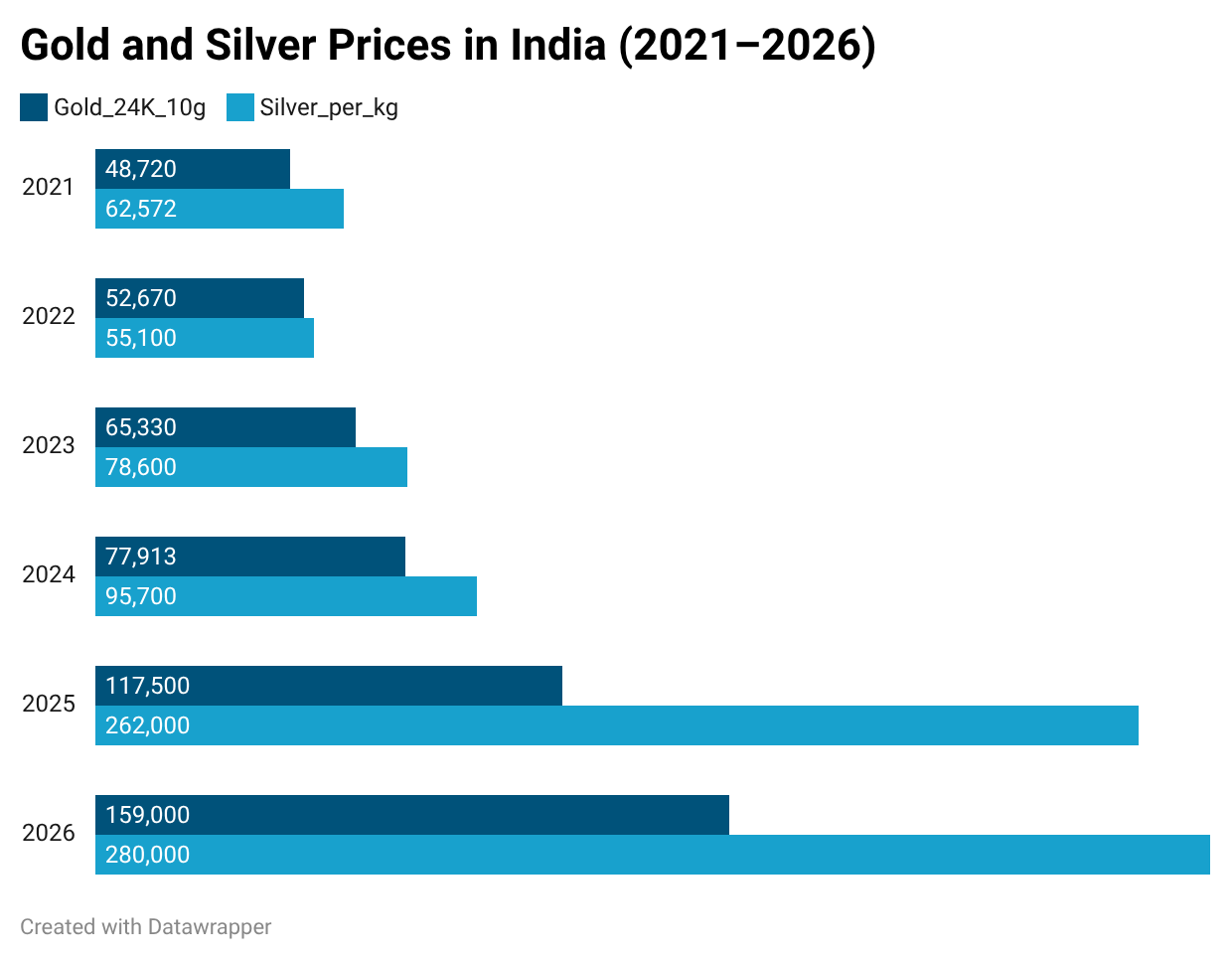
Why the rupee matters Every additional dollar spent on imported crude increases India’s external financing requirement. If oil becomes more expensive, importers need more dollars to buy essentially the same physical quantity of energy. That can put pressure on the rupee, particularly when global investors are simultaneously moving money towards safer assets during a geopolitical crisis. The effect is therefore cumulative. A weaker rupee makes imported crude more expensive in domestic currency. Higher crude costs raise transportation and production expenses. Those costs can then feed into goods and services across the economy. This is why an oil disruption is ultimately a foreign-exchange story as much as an energy story. Against this background, Prime Minister Narendra Modi’s May 10 appeal to citizens was less about petrol prices alone and more about conserving foreign exchange. He asked people to use public transport, carpool and revive work-from-home practices where possible. He also urged restraint in non-essential foreign travel and gold purchases. “In the current situation, we must place great emphasis on saving foreign exchange,” Modi said. The argument is straightforward: if households and businesses can reduce avoidable consumption of imported fuel, India needs fewer dollars to pay for energy. The same logic applies to other imported goods. The government has simultaneously tried to strengthen the supply side. Refineries have operated at high capacity, crude inventories have been maintained, and LPG production has been increased. India not only imports raw oil materials but also imports metals to make gold and silver for the Indian market. The gold and silver prices have also increased in the Indian market because the metals' values have risen due to global conflict. In 2021, the price of gold was 48,720 rupees, and it increased to 1,59,000 rupees for 10g in 2026. The silver price increased as well. In 2021, it was valued at 62,572 rupees for 1kg. Now it has a value of 2,80,000 rupees for 1kg. Modi’s appeal was about the import bill
The West Asia war has exposed the limits of assuming that global commodity markets will always function normally. India’s response has therefore been a combination of supplier diversification, alternative shipping routes, refinery utilisation, strategic management of domestic prices and foreign-exchange conservation. The September numbers provide an important indication of where the situation stands now. West Asian crude is returning, Russian supplies remain substantial and alternative suppliers continue to provide flexibility. The Strait of Hormuz is also seeing increased flows, although the recovery remains fragile and oil prices remain elevated. For India, the immediate objective is not to eliminate its dependence on imported oil — that cannot happen overnight. It is to ensure that a disruption at one chokepoint or from one group of suppliers does not become a national economic crisis. The war has therefore turned oil security into a broader economic question: how much foreign exchange India spends, how efficiently it moves energy through the supply chain, and how much unnecessary demand it can eliminate at home. Macroeconomic stability. It will improve alternative investment in India. Demand might shift toward domestic assets like real estate, rather than physical gold. Demand and supply play a major role in the market. If the Indian market demands goods that India needs to import from Western countries in this conflict situation, it will affect the whole nation directly. If all Indians come together and utilise the resources in limited amounts, it will help the government to reduce imports from Western countries. It not only reduces imports but also increases the value of the rupee. This can help India's growth.The larger lesson is supply-chain resilience
Sources
Frequently Asked Questions
How is the West Asia conflict impacting global crude oil prices?
The West Asia conflict has triggered high volatility in global energy markets due to severe threats and disruptions along vital shipping corridors. International crude prices previously experienced a massive price shock, spiking from around $70 to nearly $122 a barrel in a matter of weeks. While the situation has seen brief periods of consolidation, prices remain highly sensitive to geopolitical developments. As of October 9, 2026, WTI crude oil trades below $91 per barrel at $90.45, while Brent crude is positioned at $102.69 per barrel. Ongoing tensions, such as intensified attacks on tankers navigating the critical Strait of Hormuz chokepoint, continue to keep the global oil supply chain fragile and energy costs elevated.
How has India managed to keep domestic petrol and diesel prices stable despite global shocks?
To protect consumers from direct inflation, the Union government actively absorbed the initial price shock by cutting the excise duty on petrol and diesel by ₹10 a litre. This tactical intervention allowed retail domestic pump prices to remain broadly stable even as international crude oil values fluctuated wildly. However, because domestic retail rates have not fully risen to reflect actual global costs, state-run oil marketing companies continue to shoulder substantial underlying financial losses. This system indicates that while pump prices have visually flatlined, the economic impact of the oil shock has not disappeared; it has simply been structurally reassigned within the state framework.
Why is the West Asia oil disruption considered a foreign exchange crisis for India?
Because India imports nearly nine-tenths of the crude oil it consumes, any sustained spike in international oil prices directly expands the national import bill and drives an aggressive domestic demand for US dollars. When crude oil becomes more expensive, Indian refiners require substantially more foreign exchange to acquire the exact same physical volume of energy. This dynamic weakens the Indian rupee (USDINR stands at 96.93 as of October 2026), making all subsequent crude imports even costlier in local currency terms. Consequently, Prime Minister Narendra Modi issued a national appeal for fuel conservation and reduced consumption of other luxury imports like gold—which spiked from ₹48,720 in 2021 to ₹1,59,000 per 10g in 2026—specifically to stabilize macroeconomic health and protect India's foreign exchange reserves.