India has a great journey to have a legacy in the solar panel market
Visualisation
At a Glance
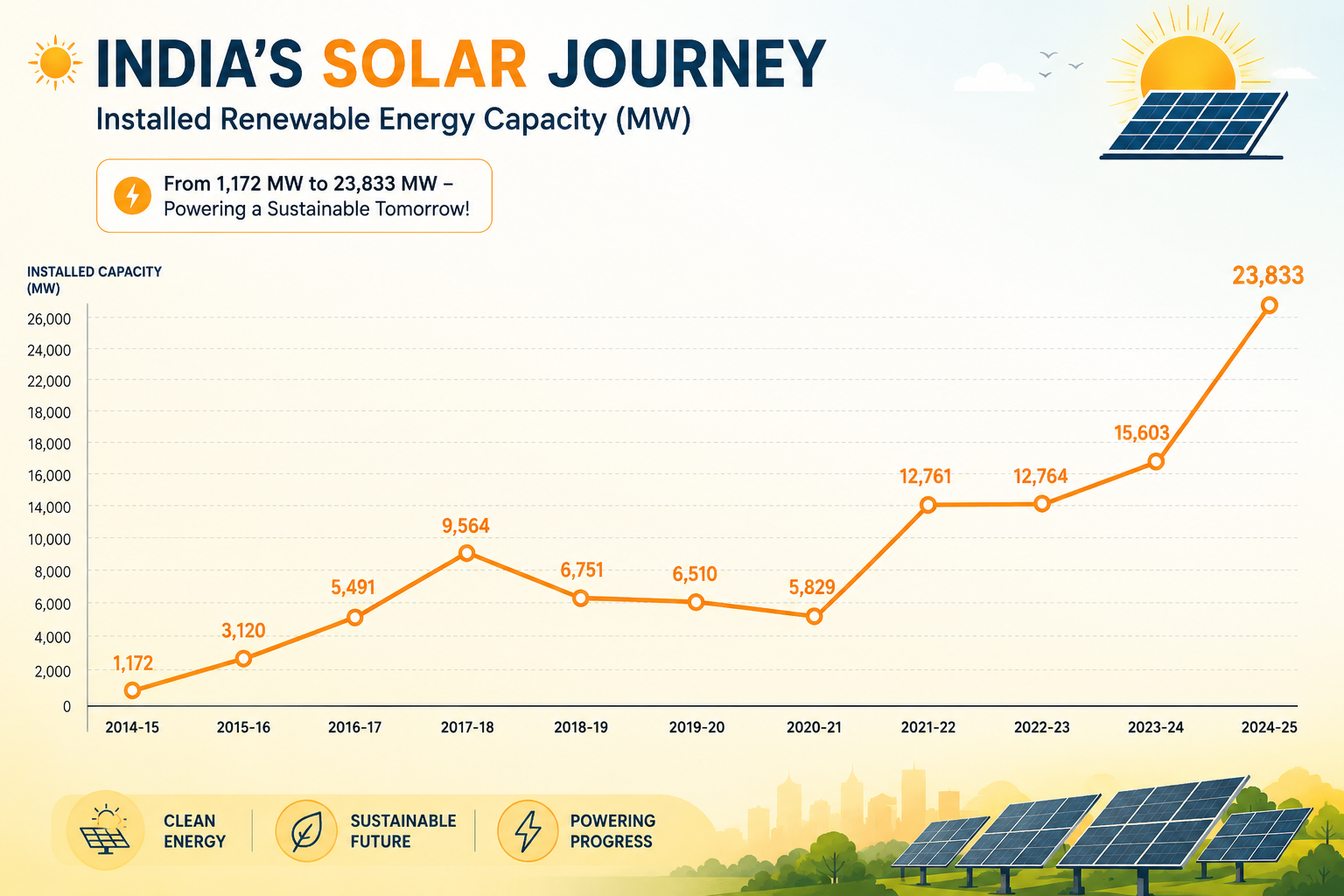
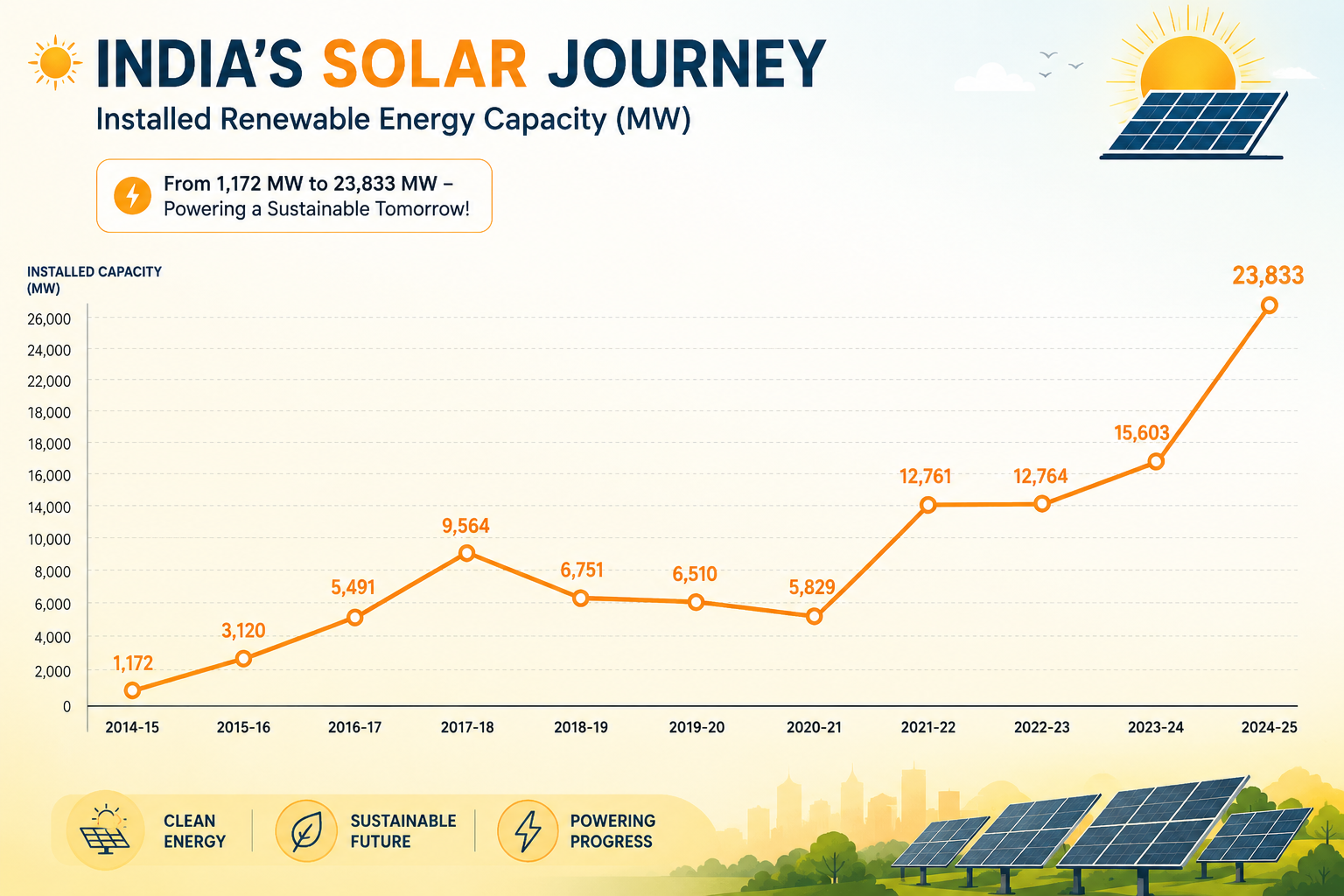
Have you ever seen a shining solar panel on some random house's roof, on a railway station, or on a street light and thought that installing solar panels has become common across India? Yes, it is that common now, but it was not in the same way before. India's solar panel journey has inspired the world. Central Electronics Limited (CEL) is a government company that made the first solar panel in India in 1977. After a year, India’s first solar model was made. In 1979, India achieved its first solar power demonstration plant. By 1980, India had become the world's 4th largest solar module manufacturer in the world. Between 1991-93, India's first utility-scale pilot solar power plants were installed in Aligarh and Ghosi, Uttar Pradesh. It did not have a smooth journey, as always. Faced a massive crisis in 1990 due to financial issues, cheap imports, and a lack of technological advancement at that time. In Public Sector Undertakings (PSUs) like Central Electronics Limited (CEL), the decision-making power has been divided into multi-layered ministry approvals. This step slows the process. impossible to match the rapid, agile product cycles of private tech competitors. Before 1990, PSUs could not invest in continuous research and development. But when global players entered the Indian market with advanced components, local public units were left with outdated manufacturing setups. In the early 1990s, private companies purchased low-cost solar panels from the global market. CET couldn’t afford the cost of selling. CET's manufacturing lines became unviable. Central Electronics Limited's severe financial collapse, with its net worth dropping by 90% and the reduction of its equity base reduced to ₹66 million. Local buyers preferred cheaper alternatives, leaving CEL’s high-cost, legacy production lines completely sidelined. Due to persistent financial unviability and lack of technology upgrades, the government officially classified CEL as a Sick CPSE (Central Public Sector Enterprise). This lack of profitability ultimately led the government to slate CEL for 100% strategic disinvestment and privatisation by 2022. In 2014, CEL officially launched production on an enhanced, automated integrated facility. The solar cell and module manufacturing capacity is 40 MWp. CEL achieved a national technological milestone by commissioning India's first solar power plant utilising high-efficiency Interdigitated Back Contact (IBC) modules. At the same time, CEL partnered with the Confederation of Indian Industry (CII) to launch a "Manufacturing Excellence” initiative on its new automated module line. This helped to cut factory waste and increased labour productivity by 50%; it changed the whole perspective from loss-making to profit-making. As a result, the solar panel MW increased fantastically, and in a decade, it reached a 1,933.53% growth. In 2019, the government attempted to sell the company but failed. The government of India officially relaunched the 100% strategic sale process of CEL in February 2020. CEL's net worth increased from ₹50 crore in March 2017 to ₹80.76 crore by March 2020. It received three preliminary expressions of interest (EOIs) by July 2020. In response to the February disinvestment announcement, employees of the union formally filed a written petition in the Delhi High Court in 2020. They were against the privatisation of the profit-making public sector. Despite supply-chain disruptions caused by nationwide lockdowns, CEL's Solar Business Division managed to float several critical national tenders in late 2020. The sale of the cell was put on hold till 2022. The government had initially approved the sale of CEL’s full ownership to Nandal Finance for ₹210 crore. After the announcement, the CEL employees’ union fiercely protested the deal. They questioned and argued that CEL was a highly profitable asset. In September 2022, the winning bidder, Nandal Finance, was hiding a massive secret. They had an active legal case against them in the National Company Law Tribunal (NCLT) because they were facing insolvency and bankruptcy, which means they were technically running out of money and unable to pay their own debts. The government found a massive violation of disinvestment guidelines. After that, instead of being put back up for sale or slipping into financial trouble, the company proved its worth as a public asset and achieved its most successful era to date. Central Electronics Limited (CEL) has proven that the government sector works very well. It can have the best output for the nation. Solar panels offer many benefits worldwide.