India was practising sustainability long before it became a global idea
Visualisation
At a Glance
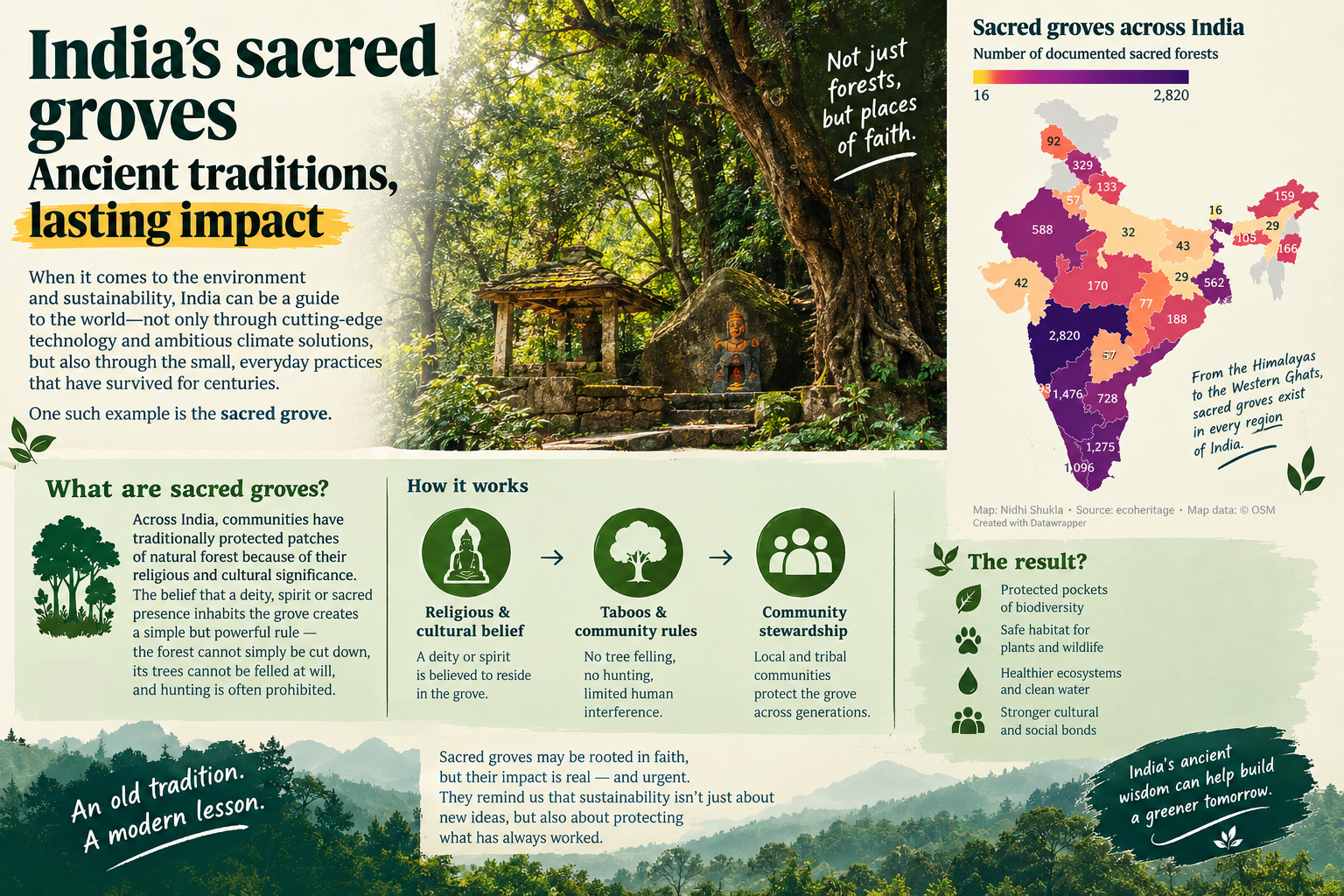
When it comes to the environment and sustainability, India can be a guide to the world—not only through cutting-edge technology and ambitious climate solutions, but also through the small, everyday practices that have survived for centuries. In many parts of the country, tribal and local communities have developed ways of living with nature rather than simply using it.
One remarkable example is the sacred grove.
Across India, communities have traditionally protected patches of natural forest because of their religious and cultural significance. The belief that a deity, spirit or sacred presence inhabits the grove creates a simple but powerful rule: the forest cannot simply be cut down, its trees cannot be felled at will, and hunting is often prohibited. What may appear to outsiders as an old religious tradition has, in practice, created protected pockets of biodiversity.
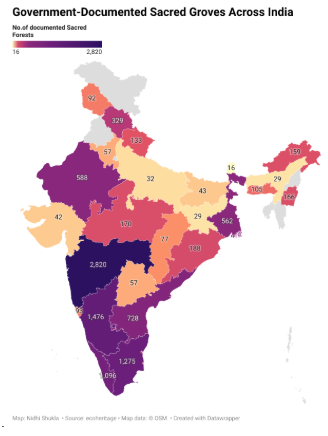
These groves act as reservoirs for rare plants and animals and can be found in remarkably different landscapes, from the forests of the Western Ghats to the dry regions of Rajasthan. Government-linked assessments put the number of documented sacred groves at around 14,000, while experts believe the actual number could be as high as 100,000. Many remain scattered across remote rural and forested areas.
Their names change with geography and culture. In Karnataka, they are known as Devarakadu; in Kerala, Kavu or Sarpa Kavu; in Maharashtra, Devrai or Deorai; in Meghalaya, Law Kyntang; and in Rajasthan, Orans. Different names, different traditions, but a remarkably similar principle: some parts of nature are not ours to exploit.
There is another extraordinary example in Meghalaya, where communities have learned not merely to protect nature, but to build with it.
The Jingkieng Jri, or living root bridges, are grown rather than constructed. The Khasi and Jaintia communities train the aerial roots of the Indian rubber fig tree (Ficus elastica) across streams and valleys, gradually guiding and strengthening them until they become sturdy bridges. The process can take 15 to 30 years. But unlike a conventional bridge, the living structure can continue to grow stronger with age and, with proper care, survive for centuries.
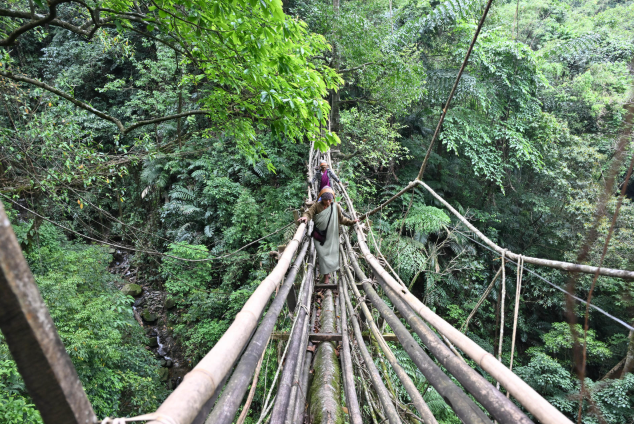
Using the living roots of ficus trees, the Khasi create natural bridges that have helped generations navigate Meghalaya’s rainforests. Photo credit: UNDP India
The famous Double-Decker Root Bridge at Nongriat offers perhaps the most dramatic illustration of this tradition. Reaching it involves descending roughly 3,000–3,500 stone steps into a forested valley. What awaits at the bottom is not a monument built from concrete and steel, but a piece of living architecture created through generations of patience and ecological knowledge.
This is perhaps the larger lesson hidden in these traditions. Sustainability does not always have to mean futuristic technology, expensive infrastructure or complicated systems. Sometimes it can mean protecting a forest because it is sacred, or patiently guiding a tree for decades until it becomes a bridge.

India's environmental wisdom is not confined to laboratories. In many places, it is still alive—in forests, villages, and communities that have learned to make nature a partner rather than a resource to be exhausted.
One head for a tree
In 1730, when Maharaja Abhai Singh of Jodhpur needed wood to build a palace, his soldiers arrived at Khejarli, a Bishnoi village near Jodhpur, to cut khejri trees. Amrita Devi, a Bishnoi woman, stood in their way. She and her three daughters sacrificed their lives trying to protect the trees.
Their sacrifice inspired the villagers. Following their religious tradition of protecting nature, Bishnois began hugging the trees to stop the soldiers from cutting them. One after another, they gave their lives. By the end, 363 Bishnois had been killed.
Amrita Devi’s words became a lasting environmental credo: “Sir sant rhey, to bhi sasto jaan” — “If a tree is saved even at the cost of one’s head, it is a cheap bargain.”
The Bishnoi tradition of protecting nature continues today. More than 1,000 young volunteers associated with the Bishnoi Tiger Force patrol the Thar region to protect wildlife. Amrita Devi’s legacy is also honoured through the Amrita Devi Bishnoi National Award for Wildlife Conservation, instituted by the Government of India for outstanding work in wildlife and nature conservation.
For the Bishnois, protecting nature is not an environmental campaign. It is a way of life.

Ancient practices in India have always had deep meaning. It has always been connected to a better society and rooted in nature. India has faced many challenges, but they have never affected its roots because they are so deep and hard to damage.
Other methods
These traditions are not isolated examples. Across India, communities have developed ingenious ways of managing land, water and agriculture, often with little more than local knowledge passed down through generations.
Zabo farming
In Nagaland, the traditional Zabo farming system brings together rainwater harvesting, forestry, livestock and agriculture. Rainwater is collected from forested hill slopes and channelled into ponds, where it is stored before being used to irrigate paddy fields. Animal waste adds nutrients to the fields, creating a nearly circular farming system in which water, livestock and agriculture work together rather than separately.
The Apatani way — farming without wasting water
In Arunachal Pradesh, the Apatani people have developed a remarkable system of wet-rice cultivation that combines paddy farming with fish rearing. Carefully designed channels allow water to flow from one terrace to another, while nutrient-rich water supports both crops and fish. The system uses land and water efficiently and has sustained the Apatani community for generations.
Kuttanad – farming below sea level
In Kerala’s Kuttanad, farmers have mastered the unusual challenge of growing rice in a region where large parts of the land lie below sea level. An intricate network of bunds, canals, and water-management systems keeps the fields protected from surrounding water while allowing cultivation. It is a striking example of how communities can adapt to nature rather than trying to overpower it.
Reference: Rooted in reverence: India's environmental consciousness lives in its traditions https://beyondthefyp.com/infopack/rooted-in-reverence-indias-environmental-consciousness-lives-in-its-traditions
Sources
Reference: Rooted in reverence: India's environmental consciousness lives in its traditions https://beyondthefyp.com/infopack/rooted-in-reverence-indias-environmental-consciousness-lives-in-its-traditions
Frequently Asked Questions
1. What are sacred groves, and what are they called across different Indian states?
Sacred groves are patches of natural forest traditionally protected by local communities due to their deep religious and cultural significance. The belief that a deity or spirit inhabits the grove creates a powerful rule against hunting and felling trees. Government-linked assessments document around 14,000 sacred groves, though experts estimate the actual number could reach 100,000.
2. How are the living root bridges of Meghalaya created, and why are they unique?
The living root bridges, known locally as Jingkieng Jri, are grown rather than constructed by training the aerial roots of the Indian rubber fig tree (Ficus elastica) across streams and valleys. Developed by the Khasi and Jaintia communities, the entire process takes 15 to 30 years of patience and ecological guidance. Unlike conventional concrete or steel bridges, these living structures grow stronger with age and can survive for centuries.
3. What was the historic sacrifice of the Bishnoi community in 1730?
In 1730, 363 members of the Bishnoi community sacrificed their lives to protect sacred khejri trees from being cut down by royal soldiers. Led by a brave woman named Amrita Devi, the villagers hugged the trees to shield them from the axes. This historic event gave rise to a lasting environmental credo: “If a tree is saved even at the cost of one’s head, it is a cheap bargain.” Today, the Government of India honours this legacy through the Amrita Devi Bishnoi National Award for Wildlife Conservation.