India’s aviation sector takes off, provides wings for every State
Visualisation
At a Glance
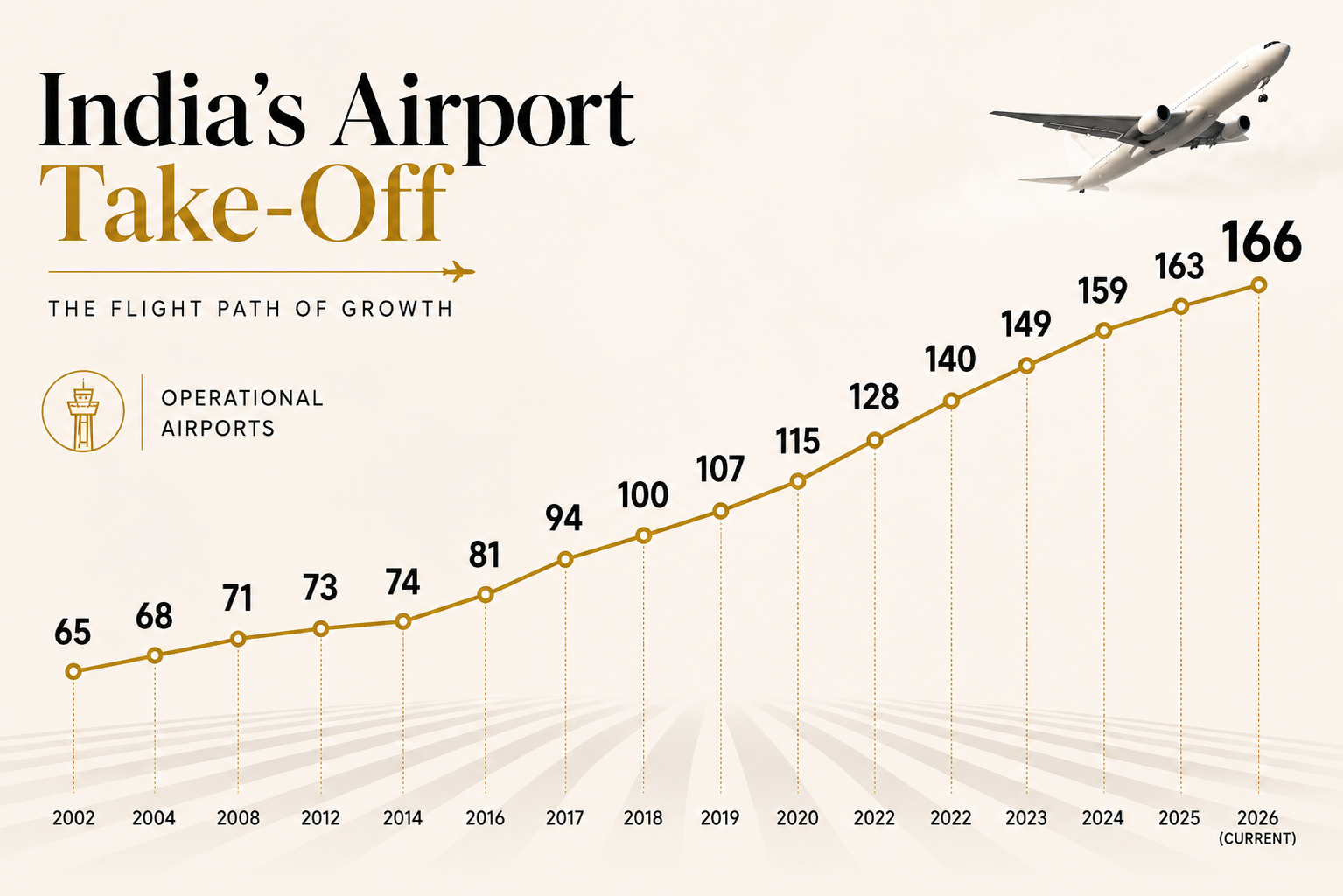
Think about the last time you booked a flight. Maybe it was for a wedding, a work trip, or just a weekend away. It probably felt easy. Ordinary, even. You picked a date, picked a seat, and forgot about it until the day you flew. That ease is new. For a long time, flying in India meant flying between a handful of big cities. If your state wasn't one of them, you took a train, or a bus, or you didn't go at all. Whole regions sat far from any runway. On a map of Indian aviation, they were blank spaces, quiet corners the flight paths never touched. Look at that same map today, and the blank space has shrunk. Towns that never had a flight now have one. States that waited decades for their first airport finally got it. The sky over India used to have gaps. It doesn't now, not like it used to have. In 2002, India had 65 operational airports. For over a decade after that, the number barely moved. Growth was slow and careful, and it mostly landed in cities that already had an airport. Delhi got busier. Mumbai got busier. Smaller states waited. Then, after 2014, the pace changed, and it changed sharply. A government scheme built specifically for regional connectivity became the engine behind it, with one clear goal: make flying possible for smaller towns, not just the usual handful of metros. The scheme – Ude Desh Ka Aam Nagarik (UDAN) – gave a boost to regional air connectivity while expanding the airport infrastructure. Old airstrips that had sat quiet for years were dusted off and reopened. Places like Kushinagar, a small town in Uttar Pradesh known mostly for its Buddhist pilgrimage sites, got an international airport of its own. Kalaburagi in Karnataka, a mid-sized industrial town, got a runway too. None of these places were obvious choices. That was the point. By 2026, India had 166 operational airports, two-and-a-half times what it had at the start of the century, and most of that growth happened in about a decade. Growth like this never lands evenly, and this one didn't either. States like Maharashtra, Uttar Pradesh, and Gujarat added airport after airport, and it makes sense that they did. They had the size, the demand, and often the political weight to move fast. But the more moving part of this story belongs to the states that got their very first airport, not their fifth or their tenth. Sikkim is one of them. Tucked into the scenic Himalayas, it went without a runway of its own for most of its history. Getting there by air meant landing somewhere else and driving the rest of the way, often for hours along mountain roads. Then Sikkim got an airport built into that same mountain terrain, in itself a feat of engineering. For the first time, the state had a way in and out that didn't depend on anyone else's roads. Arunachal Pradesh tells a similar story. Its capital region finally got a proper commercial runway, giving the state its first real link to the rest of the country by air, instead of a long drive through neighbouring states. These moments matter more than they might sound. A new airport in a place that already has five is convenient. The first airport in a place that had none is the beginning of air connectivity. It opens up tourism that never had a way in. It shortens journeys that used to eat up whole days. Most of all, it's the moment a place stops being hard to reach. Beyond these two states, the pattern repeats itself quietly across the north-east and other far-flung corners of the country. Small towns that once relied on a single long road now have a second option, one that runs through the sky instead of through hills and river crossings. While all this was happening inside India, something else was happening at the edges. More airports were earning international status, meaning flights could now land there directly from outside the country, not just connect through Delhi or Mumbai first. Kochi's airport became known for running entirely on solar power, a small but telling detail about the kind of infrastructure India was choosing to build. Kannur, a Kerala town with a large population working abroad in the Gulf, got direct international flights of its own, cutting out what used to be an exhausting extra leg through a bigger city. So really, it's one story pointed in two directions at once: India linking its own towns together, and India opening more doors to the world outside. Step back far enough, and this stops being a story about runways and terminals inside one country. India now runs one of the largest state runned airport networks in the world, sitting behind only China, and ahead of much larger, wealthier economies like Brazil and Mexico. Twenty years ago, that would have sounded unlikely. Two very different eras
Who joined the map

Building outward and inward at once

Where India stands now

The gaps that used to define India's skies are closing. What used to be blank space on the map is filling in, runway by runway. And the places that waited the longest often turn out to have the best stories to tell.