India’s Green and Blue Economy powers the next phase of growth
Visualisation
At a Glance
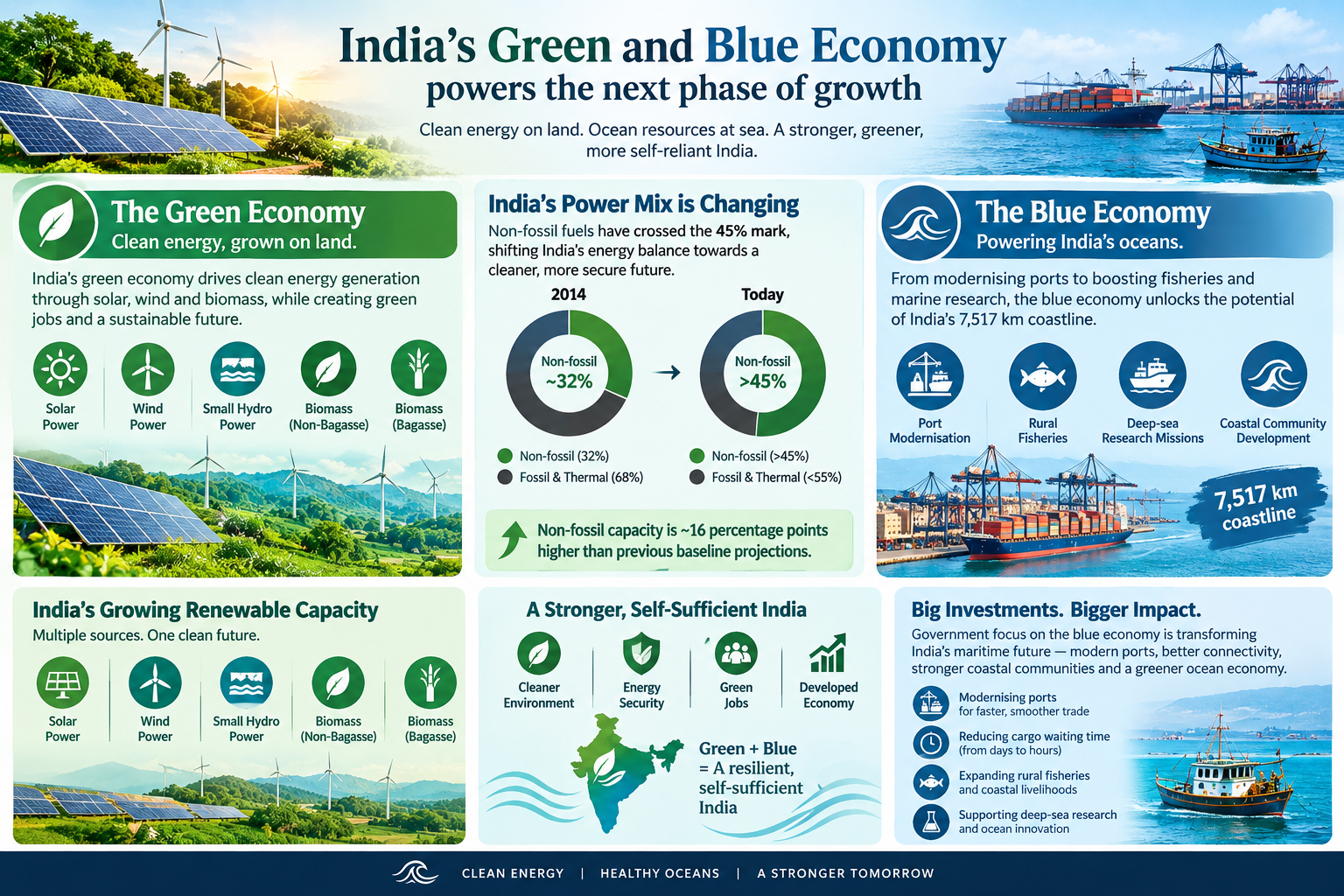
Every factory floor, data centre, and electric vehicle in modern India relies on a single vital force: sustainable energy. Moving away from the era of expensive, finite fossil fuels, India is fundamentally redefining how it powers its future. This transition relies on two interconnected forces: the Green Economy, which drives clean energy generation on land through solar, wind, and biomass, and the Blue Economy, which taps into ocean resources, coastal trade, and offshore marine energy. Combined, this dual strategy protects the environment while building a resilient, self-sufficient nation. Over the past decade, India’s power grid underwent a decisive structural inversion. In 2014, thermal and fossil-fuel infrastructure overwhelmingly dominated the power sector, leaving non-fossil capacity at a distinct minority. Fast forward ten years: aggressive infrastructure deployment has pushed non-fossil sources past the tipping point. Today, non-fossil and renewable installations account for over 45% of total installed grid capacity, surpassing historical non-renewable dominance and edging nearly 16 percentage points higher than previous baseline projections. This shift represents more than an environmental metric; it is the structural foundation for India’s transition toward a developed, energy-secure economy. 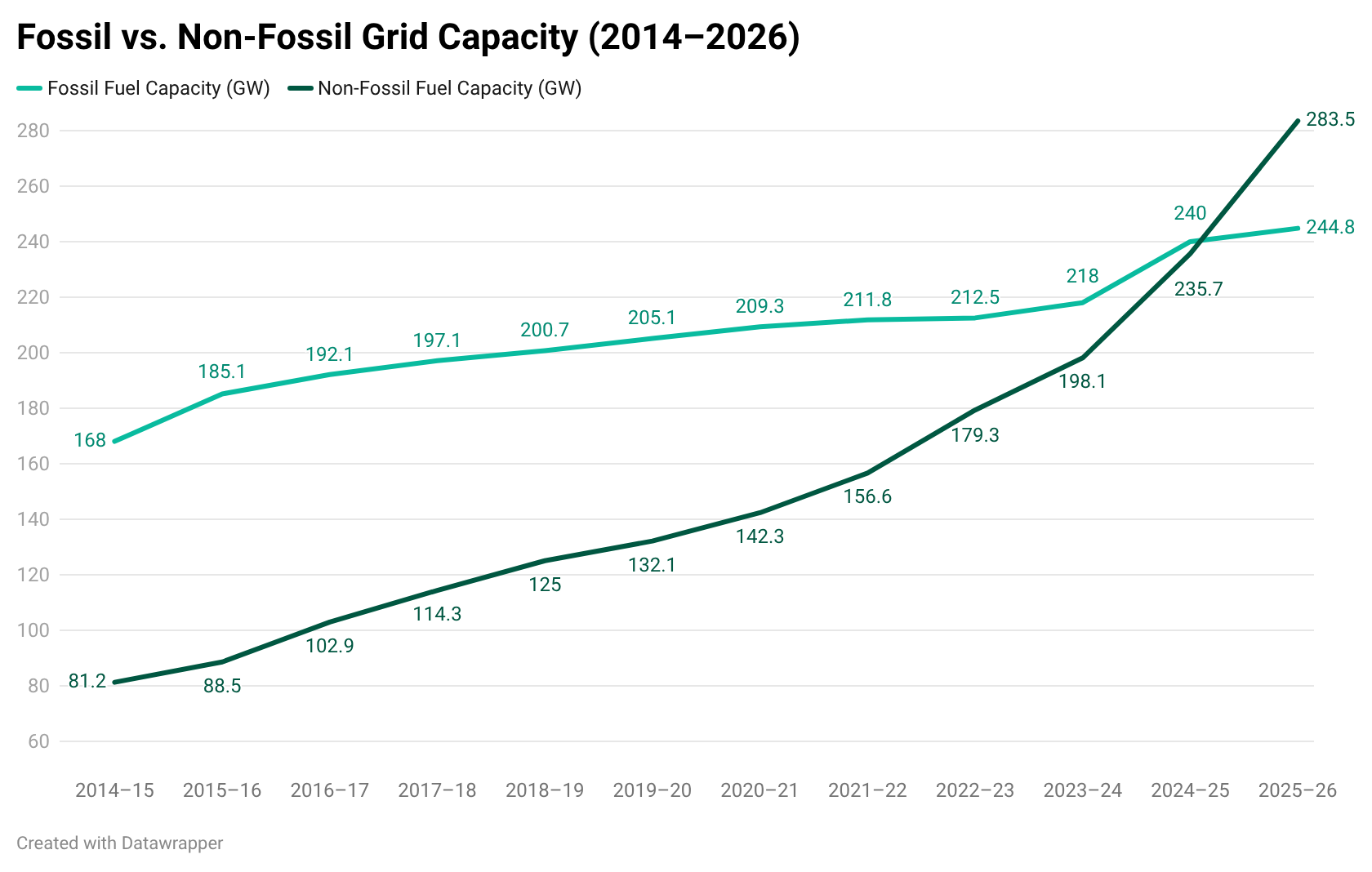
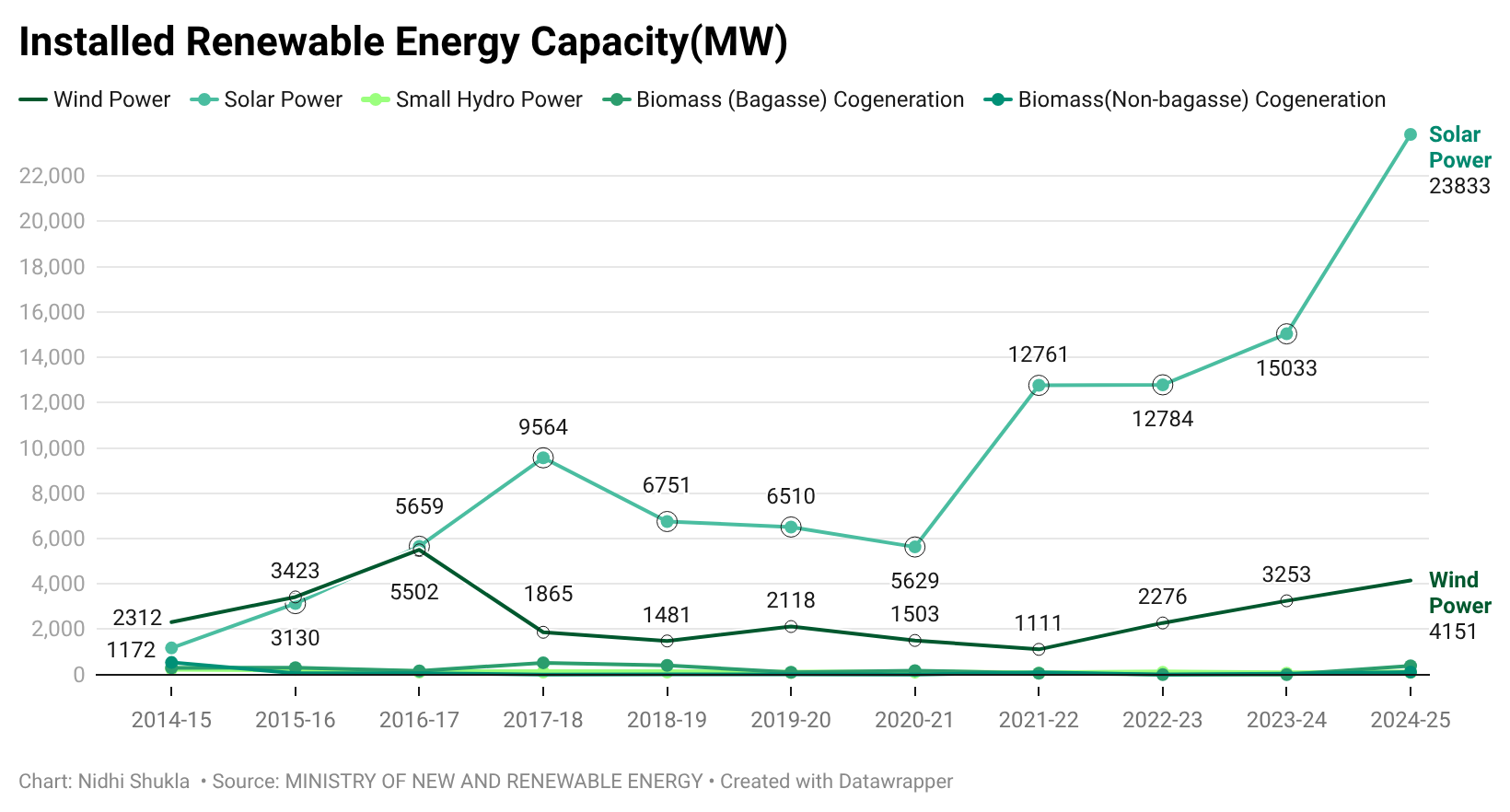
Not only does one form of renewable energy generate energy, but many methods like Wind Power, Solar Power, Small Hydro Power, small hydro power, Small Hydro Power, Biomass (Non-Bagasse), and biomass( Bagasse). In every form of renewable energy, India is growing.
https://www.datawrapper.de/_/oVdRJ/
The government places renewable energy at the heart of the Green Economy and Blue Economy stream, the sixth pillar of the Sapt Dhara. It is the strategic blueprint aimed at transforming India into a developed economy, a roadmap unveiled by Prime Minister Narendra Modi. This transition is critical as emerging national priorities, including semiconductor fabrication, artificial intelligence and large data centres, demand enormous amounts of electricity. To meet this demand, India is leveraging targeted Production Linked Incentive (PLI) schemes and strategic customs waivers to build domestic industrial capacity. This push has already scaled domestic solar module manufacturing capacity to 172 GW and solar cell production past 42 GW. By shifting from energy dependence to self-reliance, India is insulating its domestic economy from global energy shocks, driving rapid electric vehicle adoption, creating millions of skilled manufacturing jobs, and positioning itself as a net exporter of clean energy solutions. The Sapt Dhara vision places the Green and Blue Economy among its key priorities. The Blue Economy focuses on the sustainable use of ocean resources to support economic growth, livelihoods and marine conservation. It covers sectors such as fishing, tourism, shipping, and offshore renewable energy, while balancing economic activity with environmental protection. Its importance extends well beyond coastal communities: around 80% of global trade by volume moves by sea, making healthy and well-managed oceans critical to global trade and food security.
https://www.datawrapper.de/_/AOrdr/
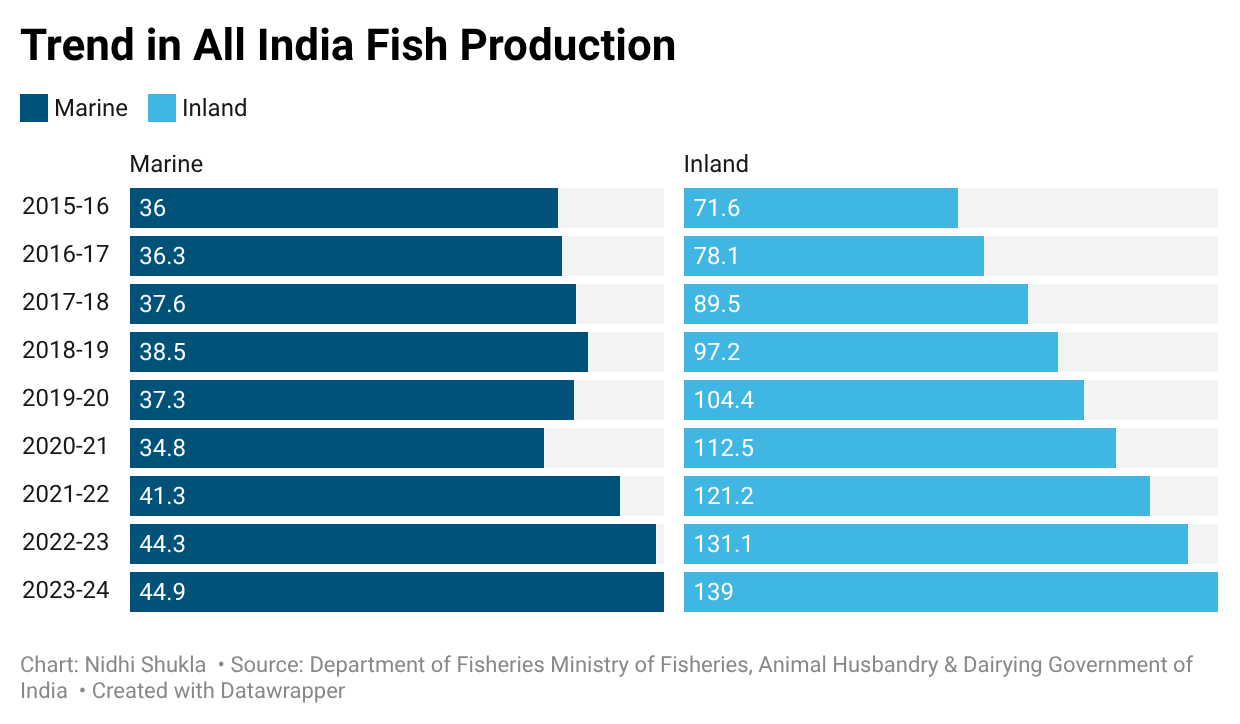
In India, the government's fish production capacity has more than doubled in a decade. The production has grown under the Pradhan Mantri Matsya Sampada Yojana. The production has risen from 95.79 lakh tonnes in 2013-14 to 197.75 lakh tonnes in the 2024-25 fiscal year.
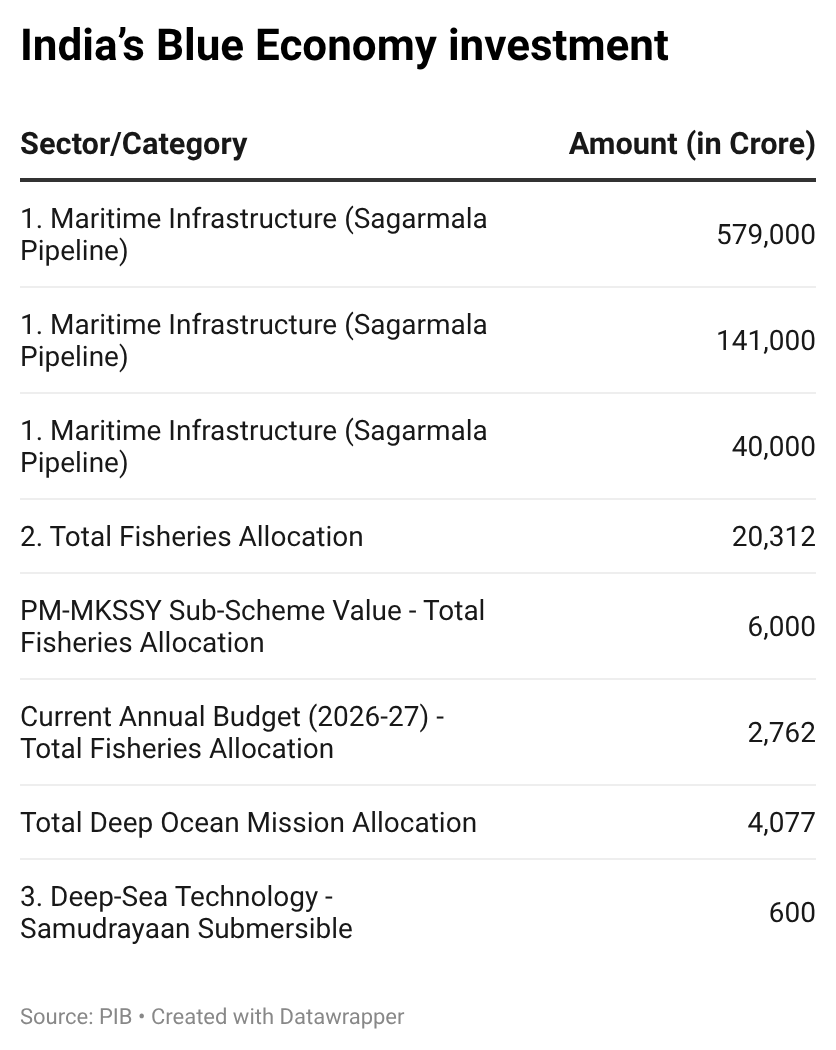
https://www.datawrapper.de/_/KoN75/ The government has invested in the blue economy for India's maritime expansion, focusing on port modernisation, connectivity and coastal community development. India has invested so massive amounts in the blue economy to grow and transform its 7,517-kilometre coastline by modernising ports, expanding rural fisheries, and launching deep-sea research missions. These funds are used to cargo ships used to waste days at sea waiting to unload. Better docks and automated ports cut that waiting time from 96 hours down to 49.5 hours, making trade much cheaper for businesses. By giving better equipment to rural fishers, India's total fish production hit an all-time high of 197.75 lakh tonnes. This massive surge boosted local jobs and brought in a record ₹73,890 crore by selling seafood to other countries. India has always been a growing economy, but sustained growth cannot come from a single sector or be measured only by advances in areas such as technology. In a diverse country like India, people work across a wide range of professions, businesses and livelihoods, each with different needs and aspirations. If economic policy focuses too narrowly on a few sectors, the benefits of growth may not reach everyone. The Green and Blue Economy can help broaden this growth by creating opportunities across different sectors, supporting businesses, generating jobs, and opening new sources of income for people across the country.
Sources
https://www.pib.gov.in/PressReleasePage.aspx?PRID=2250039®=48&lang=2 https://unctad.org/news/shipping-data-unctad-releases-new-seaborne-trade-statistics https://www.pib.gov.in/PressReleasePage.aspx?PRID=2267666®=3&lang=1
Frequently Asked Questions
Q1: What is the dual strategy India is using to power its transition to sustainable energy?
India is utilizing a dual strategy that combines the Green Economy and the Blue Economy. The Green Economy focuses on driving clean energy generation on land through solar, wind, biomass, and hydro power. The Blue Economy taps into ocean resources, modernizing coastal trade, expanding rural fisheries, and developing offshore marine energy. Together, they form the structural foundation for India's transition toward a developed, energy-secure nation.
Q2: How much has India's grid capacity changed over the past decade?
India’s power grid has undergone a major structural inversion. In 2014, the power sector was overwhelmingly dominated by thermal and fossil-fuel infrastructure. Over the next ten years, aggressive infrastructure deployment pushed non-fossil and renewable installations to account for over 45% of the total installed grid capacity, surpassing historical non-renewable dominance.
Q3: What concrete economic benefits has India achieved through its investments in the Blue Economy?
Investments in the Blue Economy have significantly improved India's maritime trade and coastal livelihoods:Port Efficiency: Better docks and automated ports have cut cargo ship waiting times from 96 hours down to 49.5 hours, making trade much cheaper for businesses.Fisheries & Exports: Total fish production hit an all-time high of 197.75 lakh tonnes (more than doubling from 95.79 lakh tonnes in 2013-14), boosting local jobs and bringing in a record ₹73,890 crore through seafood exports.