India’s manufacturing rise shows up in the numbers
Visualisation
At a Glance
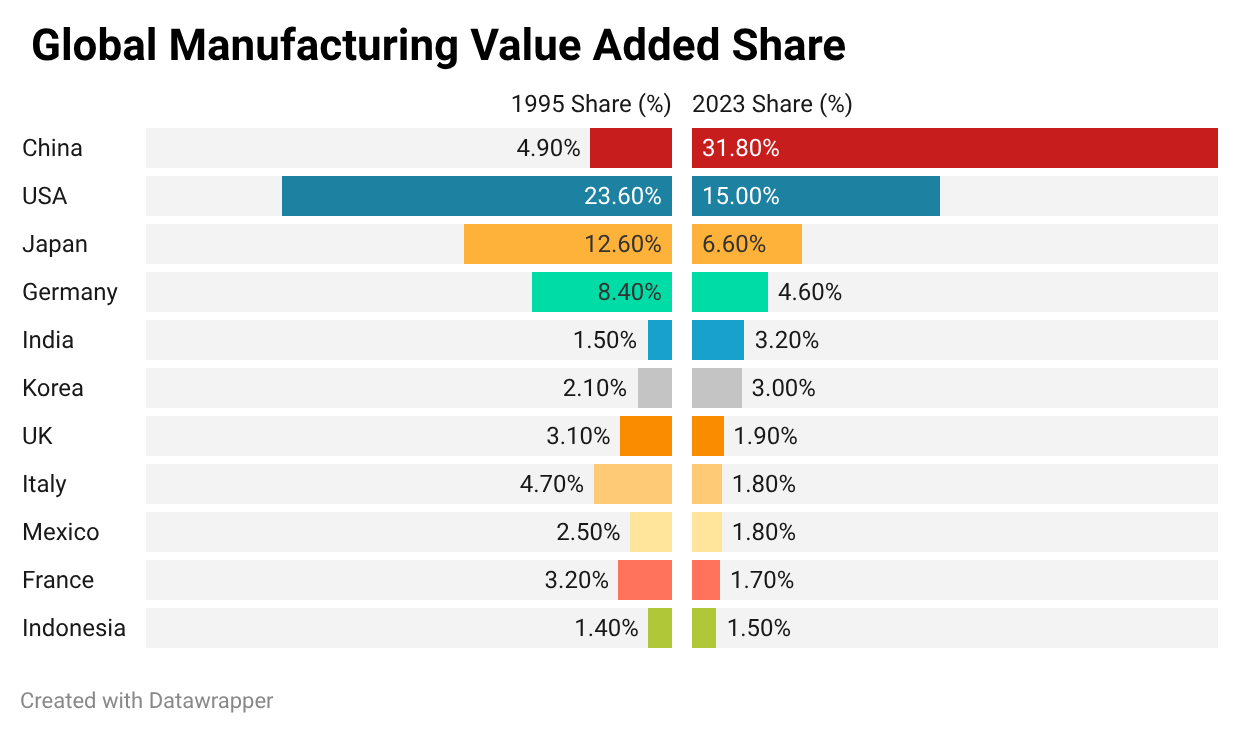
India’s manufacturing rise is no longer a story of potential. It is visible in the numbers. A country that accounted for just 1.50% of global manufacturing value added in 1995 now holds a 3.20% share, placing it among the world’s top five manufacturing economies in 2023.
That change reflects more than a larger industrial base. It points to a shift in India’s position in global manufacturing, supported by investment, expanding production capacity, and policies aimed at bringing more industries into the country.
India’s growing share of global manufacturing
The global manufacturing landscape has changed significantly over the past three decades. Established industrial economies have seen their shares of global manufacturing value added decline, while India has expanded its presence.
In 1995, India ranked 14th globally, with a 1.50% share of manufacturing value added. By 2023, it had moved into the top five, doubling its share to 3.20%. The change becomes clearer when compared with other major manufacturing economies. The United Kingdom’s share fell from 3.10% to 1.90%, Italy’s from 4.70% to 1.80%, and France’s from 3.20% to 1.70%. Germany’s share declined from 8.40% to 4.60%. The United States, still the world’s largest manufacturing economy, saw its share fall from 23.60% to 15.00%.
https://www.datawrapper.de/_/elKyd/
These figures show a change in relative position. India’s share has grown while several established manufacturing economies have lost ground. The country is now a more significant part of the global industrial economy than it was three decades ago.
The next question is, what helped drive that expansion?
https://www.datawrapper.de/_/b9Qhb/
Manufacturing capacity requires capital. Factories, machinery, technology, and supply chains need sustained investment before they can deliver results.
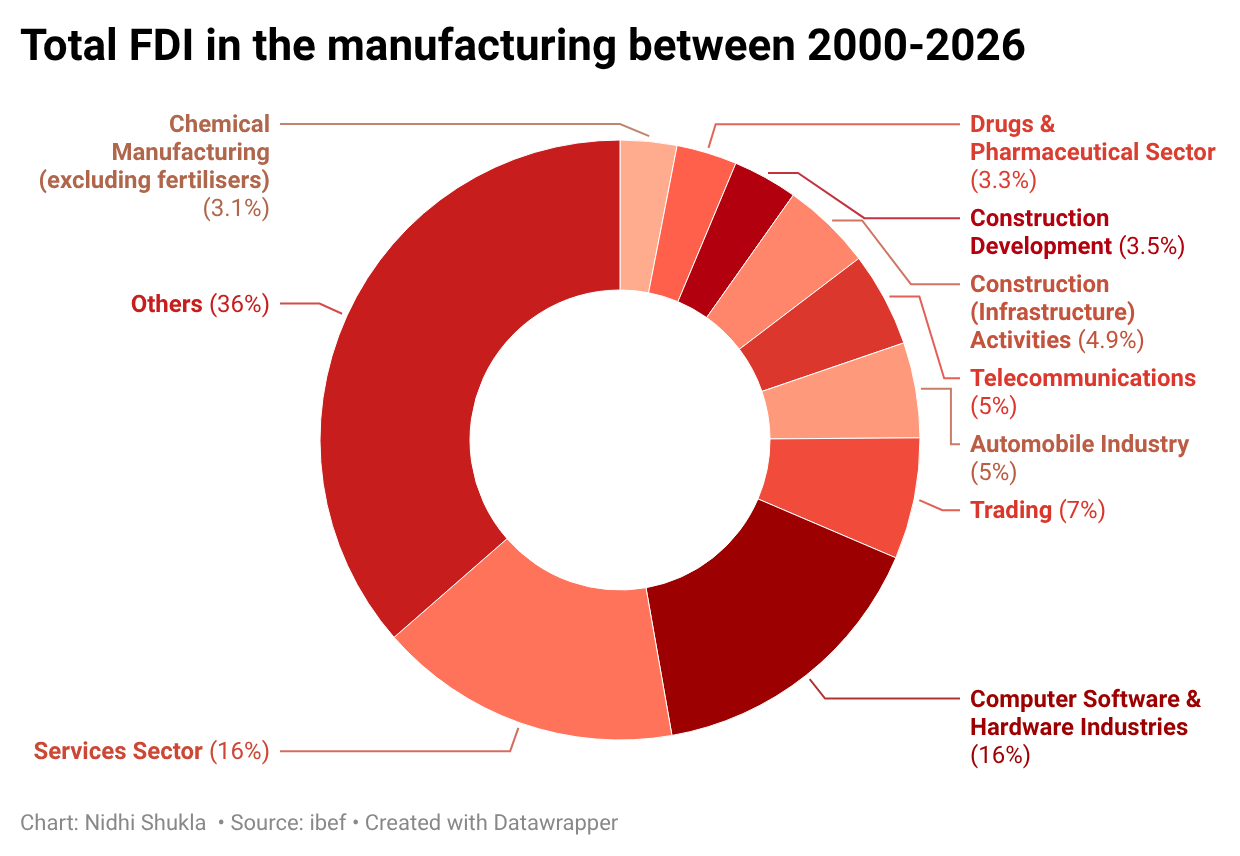
Foreign direct investment has been an important part of that process in India. In 2000-01, FDI inflows stood at $4,029 million, or ₹38,074 crore. Over the following two decades, the flow expanded substantially.
A major increase came in 2006-07, when FDI rose by 155% in a single year to $22,826 million, equivalent to ₹2,15,684 crore. In 2014-15, inflows reached $45,148 million, or ₹4,27,506.41 crore.
The highest annual inflow in the figures provided came in 2021-22, at $84,835 million, equivalent to ₹8,03,642 crore.
Investment remained strong in the years that followed. FDI inflows in 2024-25 stood at $80,615 million, or ₹7,63,660 crore, 13% higher than the previous year.
From April 2000 to June 2025, India received cumulative FDI of $1,097,090 million, equivalent to ₹10,366,403.41 crore.
https://tradingeconomics.com/india/manufacturing-value-added-us-dollar-wb-data.html
Investment opens the door to high-tech manufacturing
The rise in investment has given India the capital and capacity to expand across manufacturing sectors. One of the clearest examples is electronics, where policy support has helped attract production and strengthen domestic manufacturing.
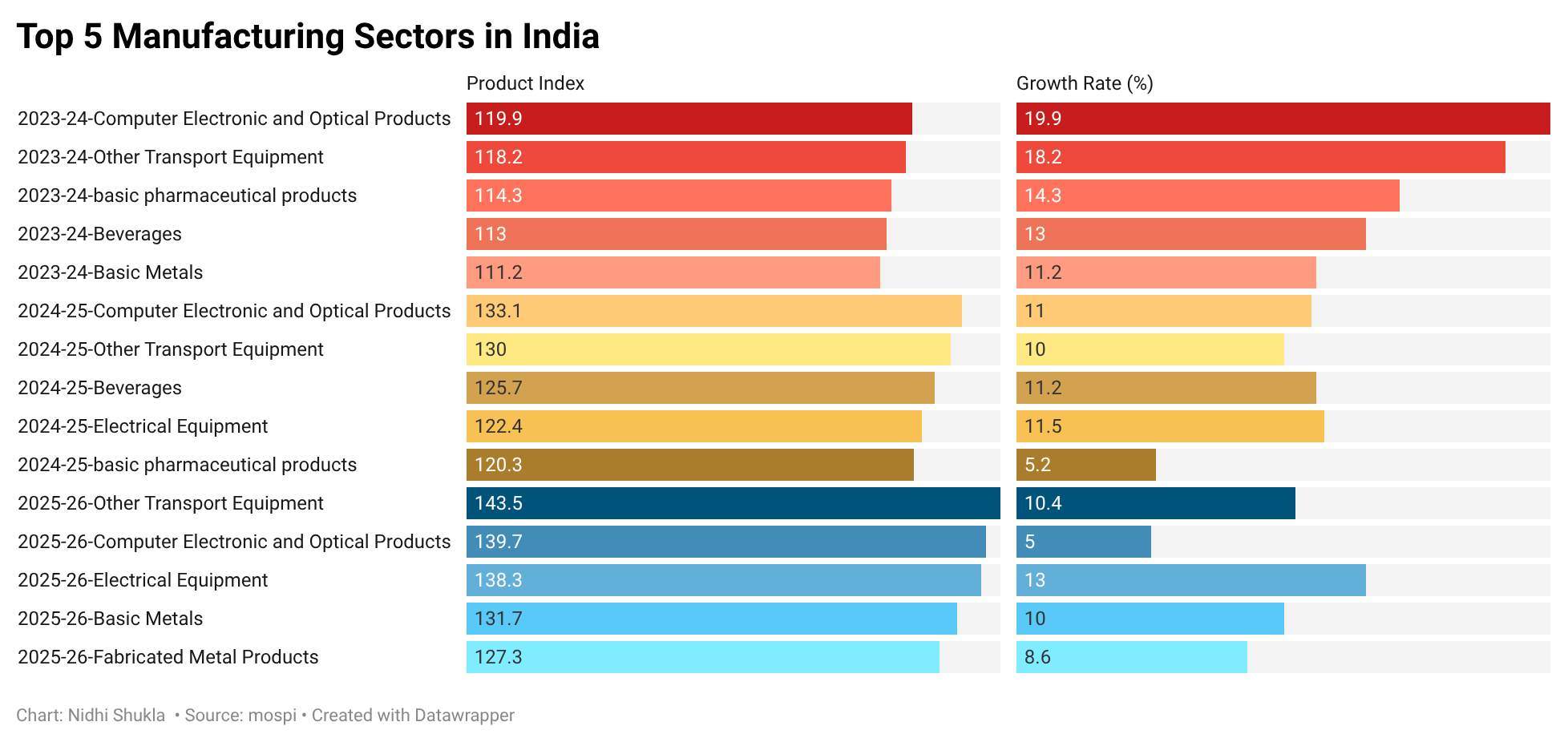
In 2023-24, computers and electronic products recorded growth of 19.90%, making them one of the fastest-growing manufacturing segments in the figures provided. The Production Linked Incentive (PLI) scheme, introduced by the Ministry of Electronics and Information Technology, played an important role in this expansion. By linking incentives to production, the scheme encouraged companies to manufacture in India and expand their operations.
The impact is particularly visible in mobile phone manufacturing. India has grown into one of the world’s major mobile phone manufacturing bases, supported by expanding production capacity and a stronger electronics supply chain.
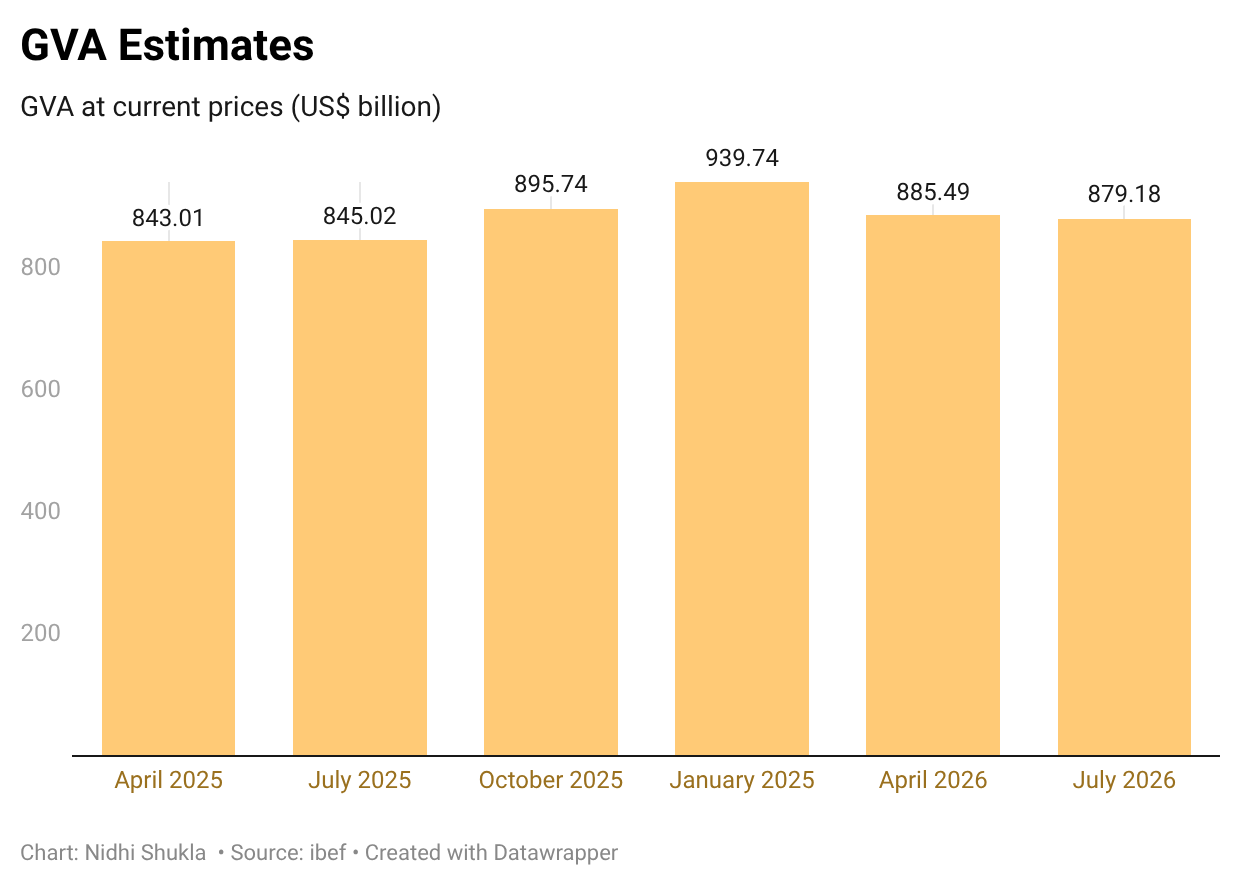
The broader economy also grew strongly. GDP rose by 7.8% in the first quarter of 2026-27, compared with 6.9% in the first quarter of 2025-26, according to the supplied figures. Manufacturing is an important part of this economic expansion, although GDP growth reflects the performance of the entire economy and cannot be attributed to manufacturing alone.
https://www.datawrapper.de/_/o0OZl/
Policy support changes the manufacturing mix
Investment has also opened up opportunities across several manufacturing sectors. In 2023-24, computers and electronic products recorded 19.90% growth, making high-tech manufacturing one of the strongest performers in the data.
The expansion coincided with the introduction of the Production Linked Incentive (PLI) scheme by the Ministry of Electronics and Information Technology, which provided incentives to companies to increase production in India. The policy push helped accelerate mobile phone manufacturing and strengthened India’s position as one of the world’s major mobile phone manufacturing bases.
The broader economy also grew strongly. GDP grew by 7.8% in the first quarter of 2026-27, compared with 6.9% in the first quarter of 2025-26. Manufacturing was an important part of the growth story.
Manufacturing growth spreads across sectors
https://www.datawrapper.de/_/gVp0i/
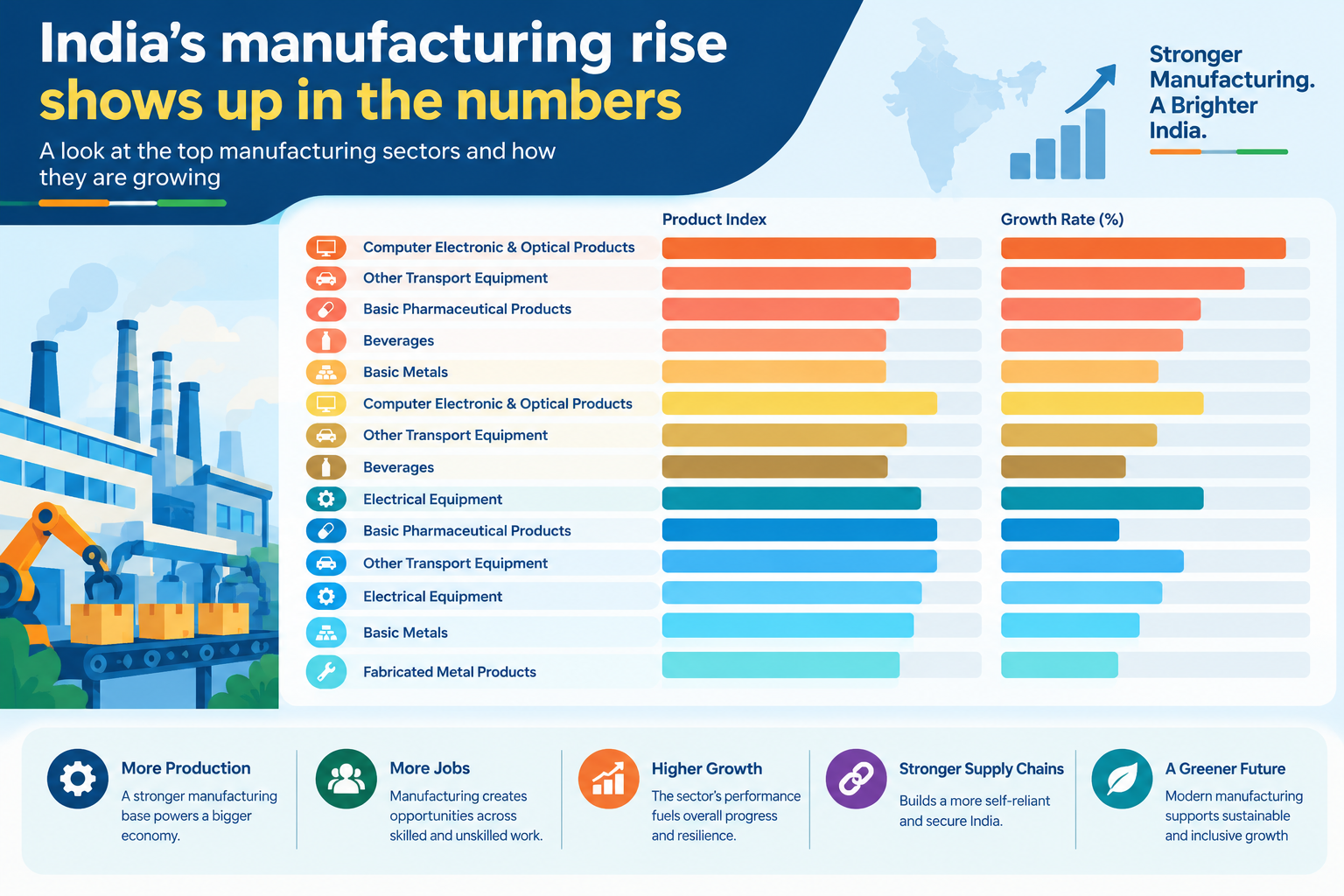
In 2024-25, electronics manufacturing remained strong and recorded the highest production level. Other sectors also performed well, with electrical equipment growing by 11.50% and beverages by 11.20%.
The pattern shifted further in 2025-26, when transport equipment and heavy industries gained momentum. Production of transport equipment, including trains and vehicles, reached its highest level. Electrical equipment emerged as the fastest-growing sector, recording 13.00% growth. The Ministry of Railways supported the expansion of train manufacturing, including Vande Bharat, while the Ministry of Heavy Industries supported the development of domestic electric vehicle battery manufacturing.
Taken together, these figures show how manufacturing growth has spread from electronics and consumer products to electrical equipment, transport and heavy industry. The change has taken time. India’s manufacturing expansion is the result of sustained investment and policy support over more than a decade, rather than a sudden jump in production.
India’s manufacturing shift is a long-building story
India’s manufacturing rise becomes clearer when the numbers are viewed together. FDI has expanded, electronics has grown rapidly, and production has widened into electrical equipment, transport and heavy industry.
GDP growth also strengthened, reaching 7.8% in the first quarter of 2026-27, compared with 6.9% a year earlier.
The longer trend is more significant. India’s share of global manufacturing value added rose from 1.50% in 1995 to 3.20% in 2023. This shift has been built over years through investment, expanding production, and policy support.
The data point to a manufacturing base that is growing not just in size, but also in range and scale.