India’s nutrition turnaround is powering a healthier future
Visualisation
At a Glance
India’s undernutrition drops, but obesity soars, demanding better diets and active lifestyles alongside government food welfare schemes.
Nutrition is the fundamental fuel of human civilisation. Just as oil drives an engine or capital powers a business, proper nourishment sustains human life and fuels national progress. When a majority of citizens are healthy, a nation prospers without the overwhelming burden of healthcare expenditures, transforming its population into productive human capital.
The human body operates much like an active industrial plant: food serves as the raw material. During digestion, food breaks down into essential nutrients that enter the bloodstream to repair cells, build muscle, and power cognitive functions. Without these building blocks, the body runs out of fuel, leading to chronic fatigue, weakened immunity, delayed recovery, stunting in children, and severe conditions like anemia or cardiovascular distress.

https://www.datawrapper.de/_/Kkk1l/
The double burden: Undernourishment gives way to rising obesity
Data from the National Family Health Survey (NFHS) highlights a major structural transition in India's public health landscape over the past two decades. India has made substantial strides in curbing undernourishment: the proportion of underweight women dropped from 36% in 1998 to 19.7% in 2024. Male undernutrition followed a similar downward trajectory, falling from 34.2% in 2005 to match women at 19.7% in 2024.
However, solving one crisis has given rise to another. Overweight and obesity rates have surged across both genders. 30 out of every 100 women and 27 out of every 100 men are now classified as overweight or obese in 2024, a stark contrast to 1998, when only 10.6% of women fell into this category. Excess body fat places continuous mechanical and biochemical stress on vital organs, drastically raising the risk of type 2 diabetes, stroke, hypertension, and various cancers.
The rise in overweight and obesity highlights the growing importance of regular physical activity and healthier lifestyles. A lack of exercise, combined with poor dietary habits, can contribute to excess weight and increase the risk of multiple chronic diseases.
The changing scale of Body Mass Index
When analysing adult body mass indexes nationwide, the middle weight spectrum is shrinking as extremes shift. While roughly half the adult population sits within a healthy BMI range, the remaining half is split almost equally between undernutrition and excess body weight. This dual threat presents a complex challenge for public health policy: programs must fight nutritional deficiencies without exacerbating lifestyle-driven weight gain.

https://www.datawrapper.de/_/bi8Qj/
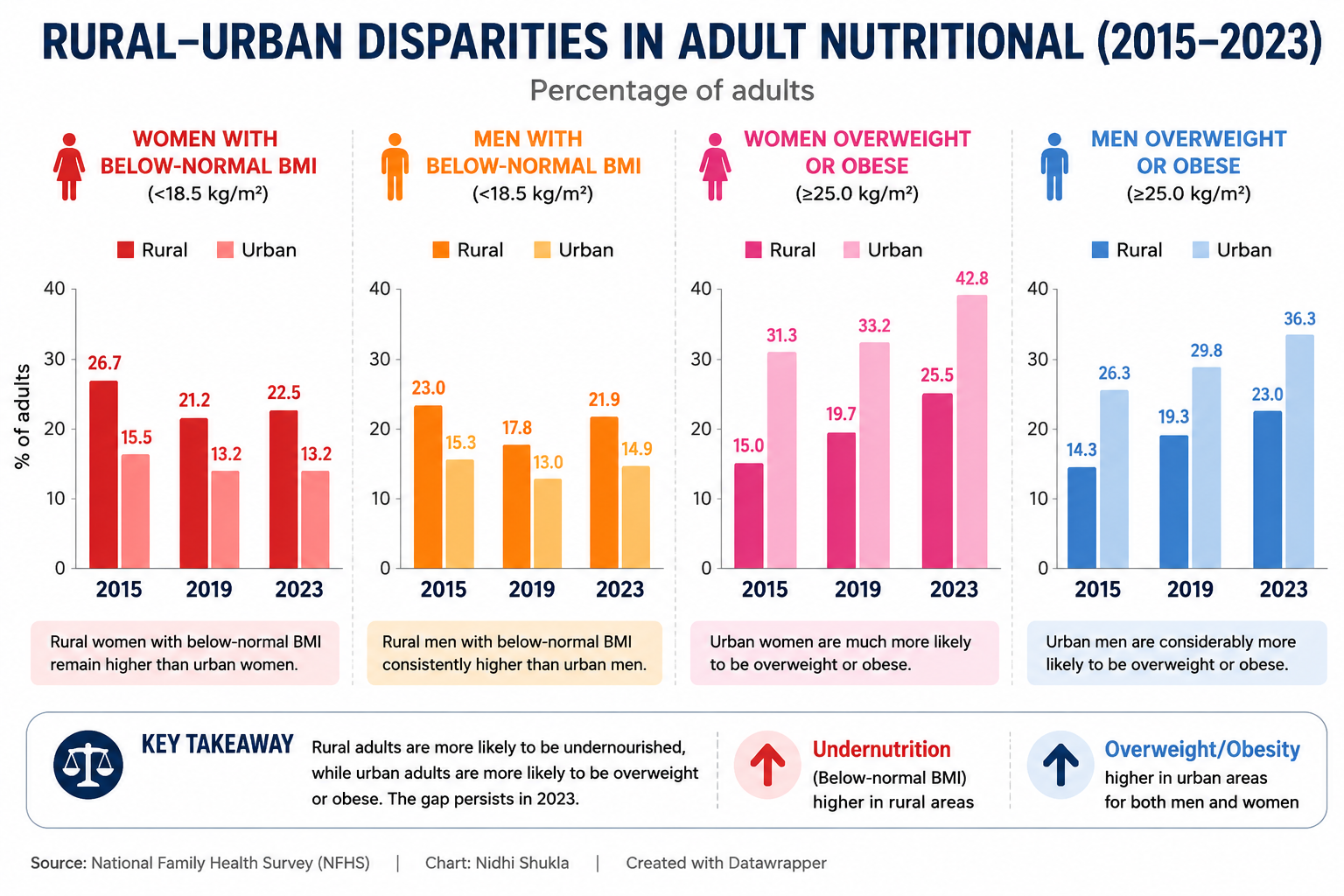
Urbanisation, sedentary lifestyles and regional disparities
Nutritional challenges in India are split heavily along geographic lines. Rural regions continue to bear the heavier burden of micronutrient deficiencies and undernutrition. Conversely, urban centres face a ra pid spike in obesity.
Between 2015 and 2019, undernutrition rates dropped significantly from 26.7% to 13.2%, before stabilising due to economic and social disruptions brought on by the COVID-19 pandemic. However, urban obesity exploded over the same timeframe. The percentage of overweight urban women rose incrementally from 31% in 2015 to 33% in 2019, before jumping to an alarming 42.8% in 2024. Decreased daily physical movement, desk-bound work, and altered urban diets are driving this sudden increase among both men and women.
https://www.datawrapper.de/_/AraWt/
State interventions
The government has made substantial investments in tackling hunger and improving nutrition across India. Through schemes such as PMGKAY and the National Food Security Act (NFSA), more than 81 crore people receive free food grains each month to meet their basic nutritional needs. The PM POSHAN scheme complements this effort by providing hot, cooked meals to schoolchildren, supporting their growth and overall health.
The Rice Fortification Programme further strengthens this nutrition network by providing fortified rice to beneficiaries under various government schemes. Fortified rice is enriched with essential micronutrients such as iron, folic acid, and vitamin B12, helping address nutritional deficiencies and reduce the burden of anaemia among vulnerable populations.
To protect vulnerable populations and build human capital, the Indian government leverages massive social safety nets. https://www.datawrapper.de/_/2utId/
Hidden hunger: Caloric intake vs. quality
While social welfare schemes successfully address caloric shortfalls, "hidden hunger" – a lack of essential vitamins and minerals – persists across income levels. Access to raw calories prevents starvation, but true physical efficiency requires micronutrient-dense foods. Cheap, high-calorie, low-nutrient diets remain a central bottleneck to improving national health output.
Idea Sources = https://www.dataforindia.com/obesity/
Sources
Tags
Frequently Asked Questions
What is India's "double burden" of malnutrition?
It is the simultaneous coexistence of undernutrition and surging obesity. While adult underweight rates dropped to 19.7% by 2024, overweight and obesity rates spiked sharply, affecting 30% of women and 27% of men.
How do rural and urban nutrition trends differ?
Rural areas still struggle primarily with undernutrition and micronutrient deficiencies. In contrast, urban centers are facing an obesity crisis driven by sedentary lifestyles and poor diets, with urban overweight women reaching 42.8% by 2024.
How is the government tackling these issues?
Through massive welfare networks. The PMGKAY feeds over 81 crore people, PM POSHAN provides school meals, and the Rice Fortification Programme replaces normal rice with grains enriched with iron, folic acid, and vitamin B12 to fight anemia.