India’s public distribution system is reaching further – the numbers show where
Visualisation
At a Glance
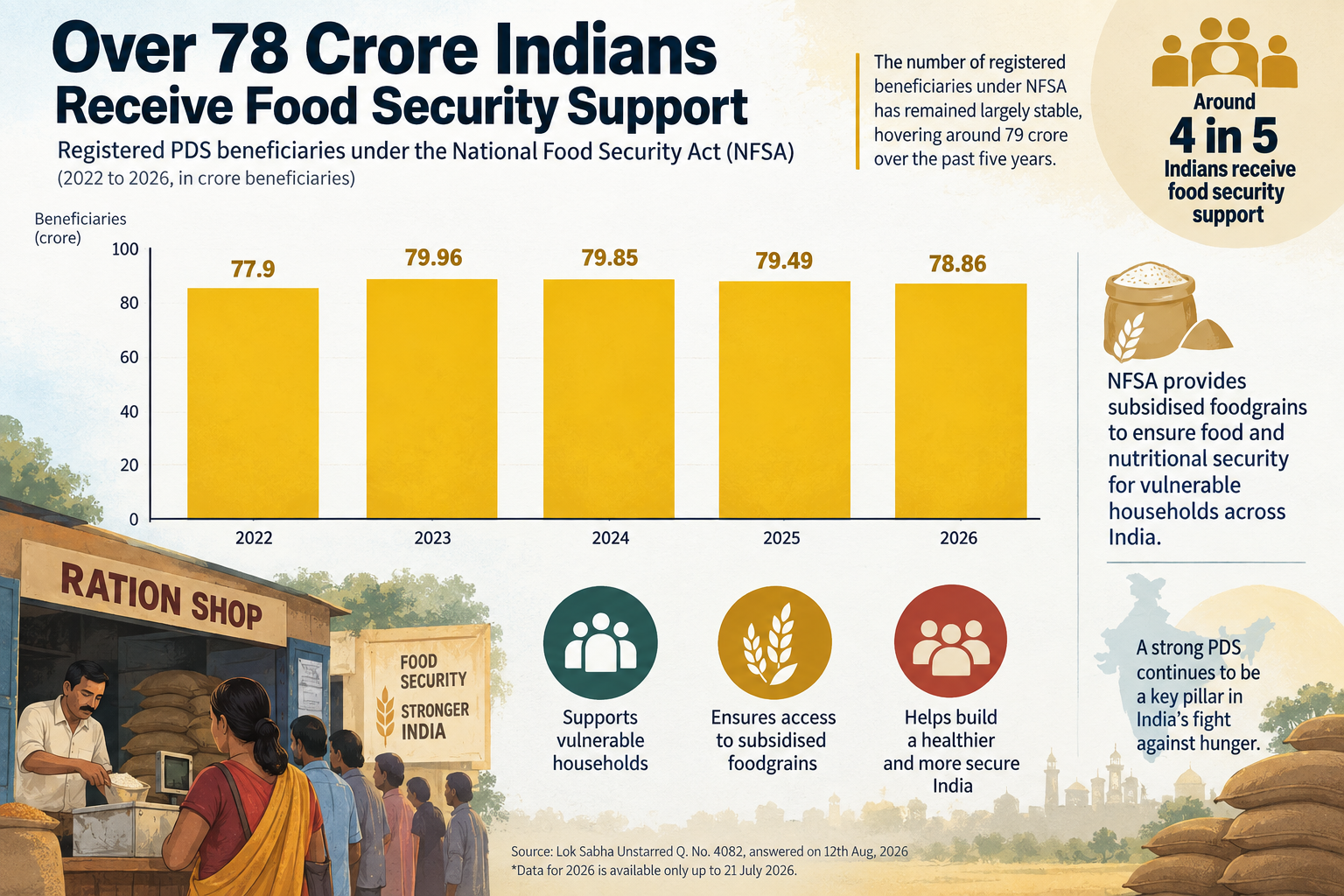
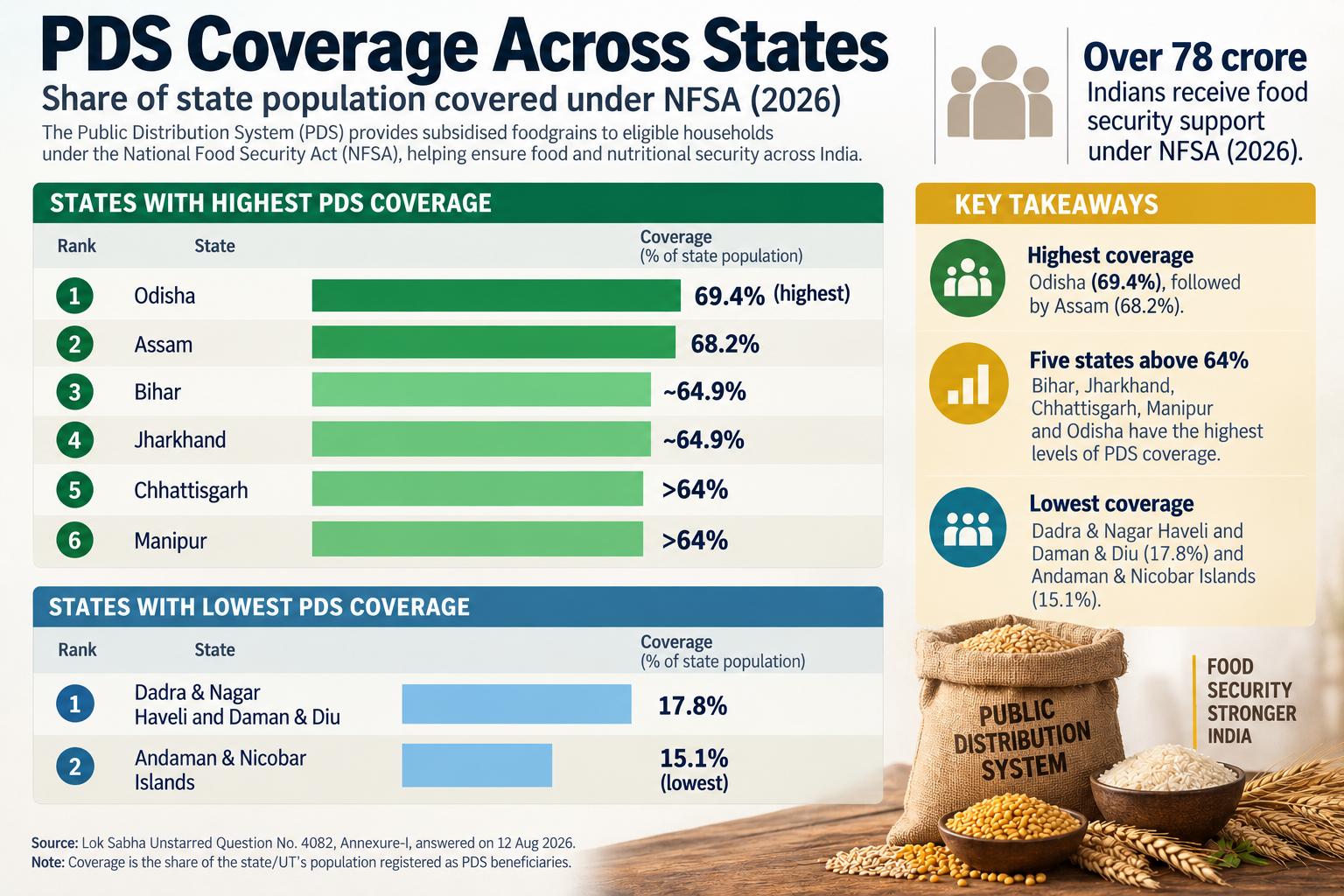
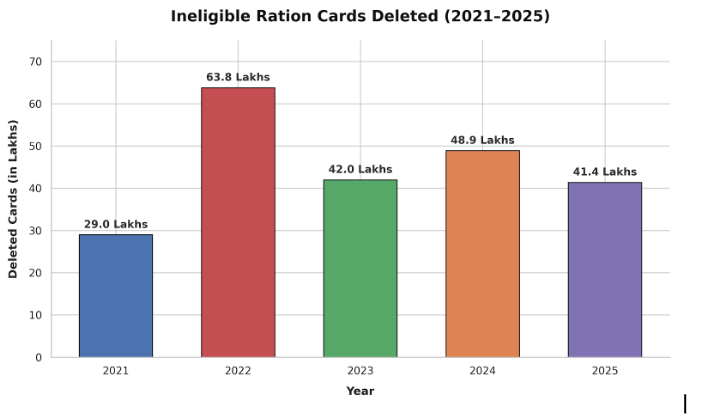
India’s Public Distribution System offers a useful test of whether welfare is reaching the people it is meant to serve. Fresh government data shows how many people are covered, where coverage is deepest, how ineligible names are being removed and whether funding has kept pace. Taken together, the numbers tell a larger story about the reach of the system, particularly in communities where access has historically been hardest. That brings the idea of Antyodaya into focus. Articulated most influentially by Pandit Deendayal Upadhyaya, Antyodaya combines antya, meaning “the last”, and udaya, meaning “rise”. Its central premise is that progress should be measured not simply by how well those already within the system are doing, but by whether those furthest from opportunity are being brought within it. For a welfare programme, therefore, size alone is not the measure. The more important question is whether its reach keeps extending towards the person who is still outside. The number of Indians covered by the Public Distribution System has risen since 2022. As of 2026, 78.86 crore people are registered beneficiaries under the National Food Security Act, according to data from the Department of Food and Public Distribution submitted in reply to a Lok Sabha question in August 2026. That compares with 77.90 crore in 2022. The number peaked at 79.96 crore in 2023 before declining slightly. Yet the larger picture remains clear: coverage is higher than it was four years ago. That matters because PDS expansion is not simply about adding names to a government database. Each additional beneficiary represents a household brought within the country’s formal food security framework. In the Antyodaya sense, the question is whether the system is reaching people who were previously beyond its protection. https://sansad.in/getFile/lsapps/loksabhaquestions/annex/188/AU4082_HQanov.pdf?source=lsapps The state-wise figures make the story more revealing. If PDS coverage were simply a reflection of population size, states would show broadly similar enrolment rates. Instead, the highest coverage is concentrated in regions with substantial rural, tribal and lower-income populations. Odisha leads the country, with 69.4% of its population covered, followed by Assam at 68.2%. Bihar and Jharkhand are close together at around 64.9%, while Chhattisgarh and Manipur also cross 64%. The significance lies in where these numbers appear. These are regions where distance, poverty and administrative access can make welfare delivery difficult. High coverage suggests that the PDS is reaching populations that cannot be assessed through national averages alone. It also shows why the success of a welfare system must be judged by its reach among vulnerable communities, not merely by its total size. The figures do not establish that every eligible household is covered or that foodgrain delivery is equally effective everywhere. But they do challenge the idea that welfare expansion is necessarily wasteful or disconnected from need. The direction of the data points to a system bringing more people within its reach, especially in states where that inclusion has the greatest social significance. The geography of these states helps explain why reaching their people was never a simple administrative exercise. Large parts of Chhattisgarh, Jharkhand and Odisha are forested, hilly and, until recently, poorly connected by road. Several of these districts also lay within the belt long affected by Left-Wing Extremism (LWE). That history matters because welfare delivery depends on more than a government scheme or an eligible beneficiary. It needs roads, functioning administration and the ability to move supplies safely. In districts where insurgent violence restricted movement, even a ration entitlement could remain a promise on paper. The declining footprint of LWE has changed that equation. Security operations and infrastructure programmes, including the Road Connectivity Project for LWE-Affected Areas, helped extend roads and administrative access into formerly difficult terrain such as Bastar and other parts of the Red Corridor. As insurgent networks weakened and transport risks reduced, the conditions for regular foodgrain supplies and functioning fair-price shops improved. This is where security and welfare delivery intersect. Better connectivity can help ration shops operate, make biometric verification more practical and allow eligible households to obtain active ration cards. None of these changes automatically guarantees that every village receives its full entitlement. But they remove some of the physical barriers that once kept welfare schemes from reaching the people they were designed to serve. For marginalised tribal communities, that distinction is important. Food security becomes meaningful only when an entitlement can be converted into food on the ground. The expansion of PDS coverage in these regions therefore reflects more than a change in beneficiary numbers. It also points to the importance of physical access, administrative reach and the restoration of everyday state services. Cleaning the list without losing the person A safety net designed to reach the last person also needs to know who is actually on the list. Between 2021 and 2025, deletions of ineligible ration cards rose from 29.03 lakh to 63.80 lakh in 2022, before settling at 41.41 lakh in 2025. Bihar saw a sharp jump from 0.16 lakh in 2021 to 16.86 lakh in 2024, followed by a fall to 1.49 lakh in 2025. Haryana shows a similar pattern. These deletions do not necessarily mean people losing access to food. They reflect efforts to remove ineligible or outdated entries and keep the beneficiary database accurate. That matters as coverage expands: cleaning the list helps the system focus its resources on genuine beneficiaries while making space for newly eligible households. None of this matters if funding does not keep pace. It has. Food subsidy releases reached ₹2.28 lakh crore in 2025-26, about 14% higher than the previous year, or roughly ₹2,888 per beneficiary annually. The separate fund for intra-state foodgrain movement and fair-price shop dealer margins has fluctuated, but even after falling from its 2023-24 peak, it remains well above its level five years earlier. The picture that emerges is one of gradual expansion rather than a simple increase in spending. Beneficiary numbers have risen since 2022, with higher coverage in several states where reaching people has traditionally been difficult. Better roads and improved security have also made it easier to extend ration services into previously isolated areas. At the same time, beneficiary lists are being cleaned and funding has continued to rise. That combination matters. Antyodaya is ultimately about making sure the last person is not left outside the system. The data suggests that the PDS is moving in that direction, even if the job of reaching everyone is far from complete.More people, not fewer
Growth where it matters most
The ground that was hardest to cover
Money following the intent
The larger point