Mumbaikar's new commute: How metro is rewriting the city's mobility
Visualisation
At a Glance
Ask Mumbaikars what the local train means to them, and you won't get a straight answer. You'll get a story. A missed train that cost someone a job interview. A friendship that started because two strangers stood shoulder to shoulder every morning for three years.
For over a century, this has been the Maximum City's lifeline. It made Mumbai run on time even when nothing else did. Hence, when Western Railway's own internal numbers show that lifeline losing riders, quarter after quarter, it’s worth asking why. And, this time, the answer isn't COVID, or a fare hike, or a service cut. It's the Metro.
The Numbers Behind the Shift
The 8:12 local from Borivali still rolls into Andheri looking exactly the way it always has: packed, punctual, unstoppable. But stand on that platform a little longer than usual and something feels different. A chunk of the crowd peels away before the stairs even come into view, drifting instead toward the walkway that climbs up to Metro Line 1. Blink and you'd miss it. But multiply that small daily drift across a hundred stations and three months, and you get a number Western Railway simply can't wave away. Between April and June this year, the suburban network carried 25.60 crore passengers, down from 26.04 crore over the same stretch last year. Do the subtraction and you land on 44.65 lakh fewer riders, a 1.71% dip. It sounds tiny written like that. It stops sounding tiny the moment you realise it means roughly 4.5 million train journeys that just didn't happen this year, or happened somewhere else entirely.
The Local Train's Oldest Riders Are Its Most Restless
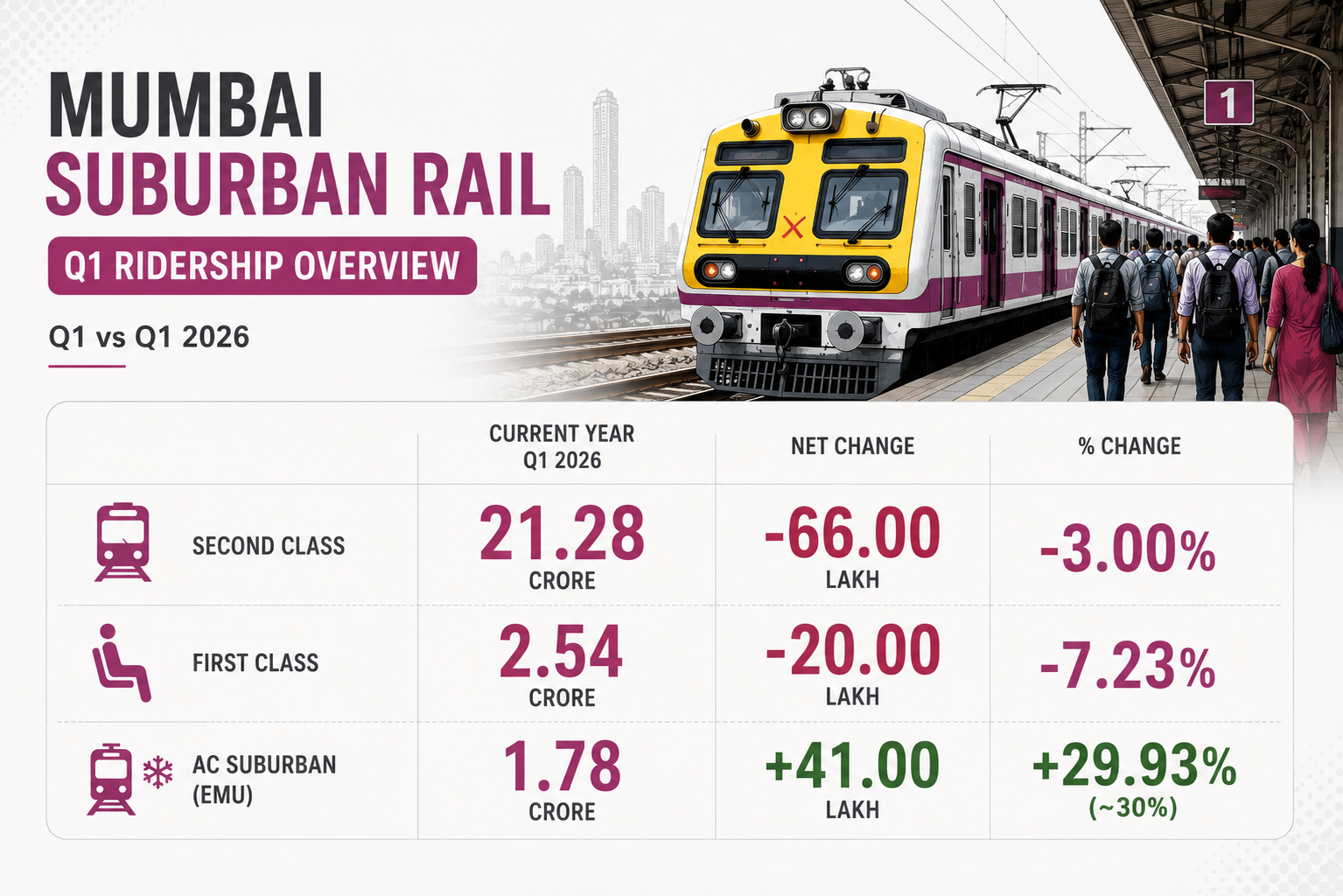
Split the numbers by class, and the story gets a lot more human. Second Class, the crowded, unreserved compartments that have carried the city's working population for generations, lost 66 lakh passengers, down 3%. First Class fell even harder in proportional terms, losing 20 lakh riders, a 7.23% drop.
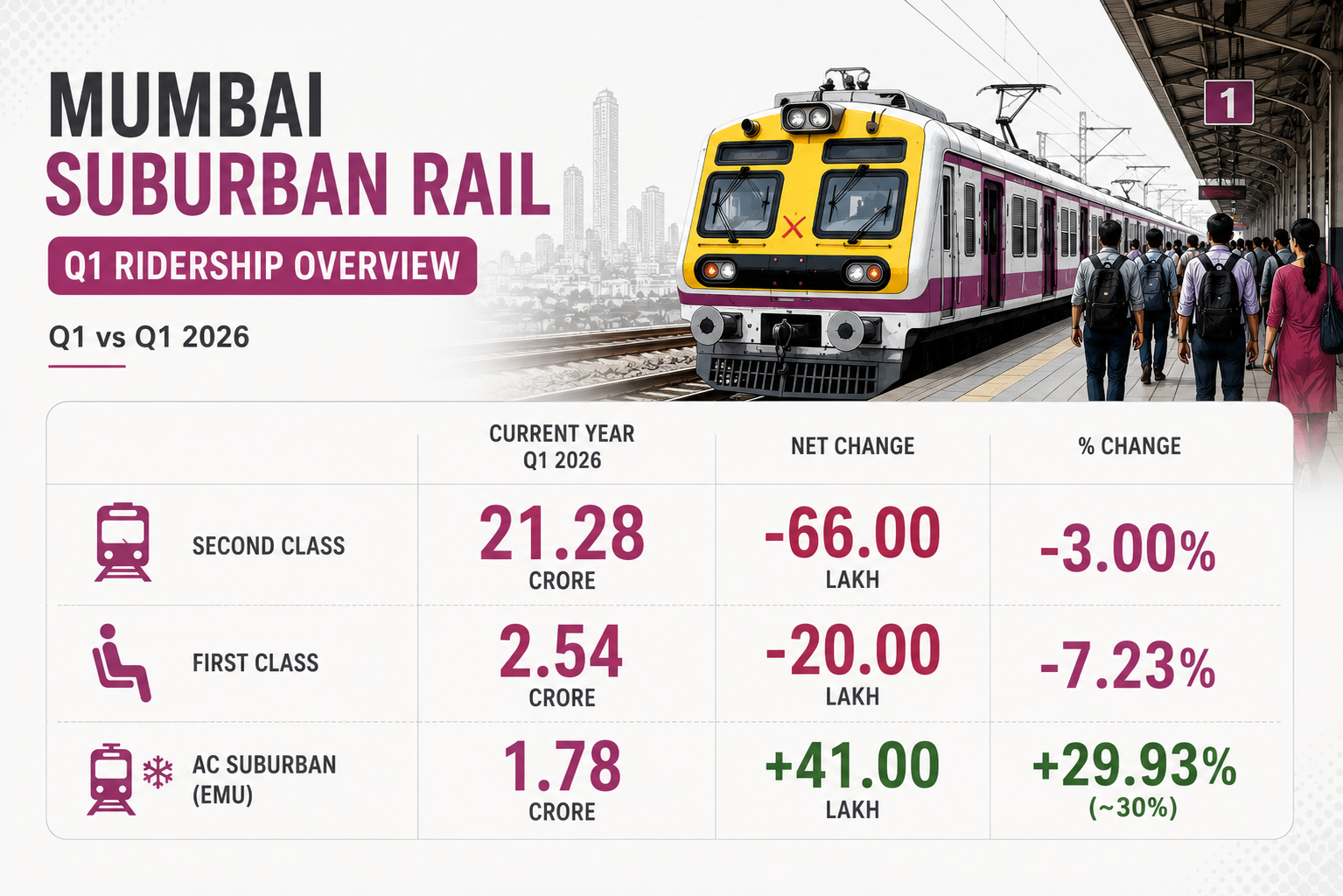
Then there's AC Suburban, which went the other way entirely. Nearly 41 lakh more people rode it this quarter than last, a jump of almost 30%. So the local train isn't just losing ground to the Metro. It's quietly losing an argument with itself. The commuters staying loyal to Indian Railways are voting with their feet, ticket by ticket, against the version of the train their parents grew up riding: unreserved, packed shoulder to shoulder, no relief from the heat. They are preferring AC Suburban’s experience.
Andheri, Borivali, Lower Parel: A City Rewriting Its Map
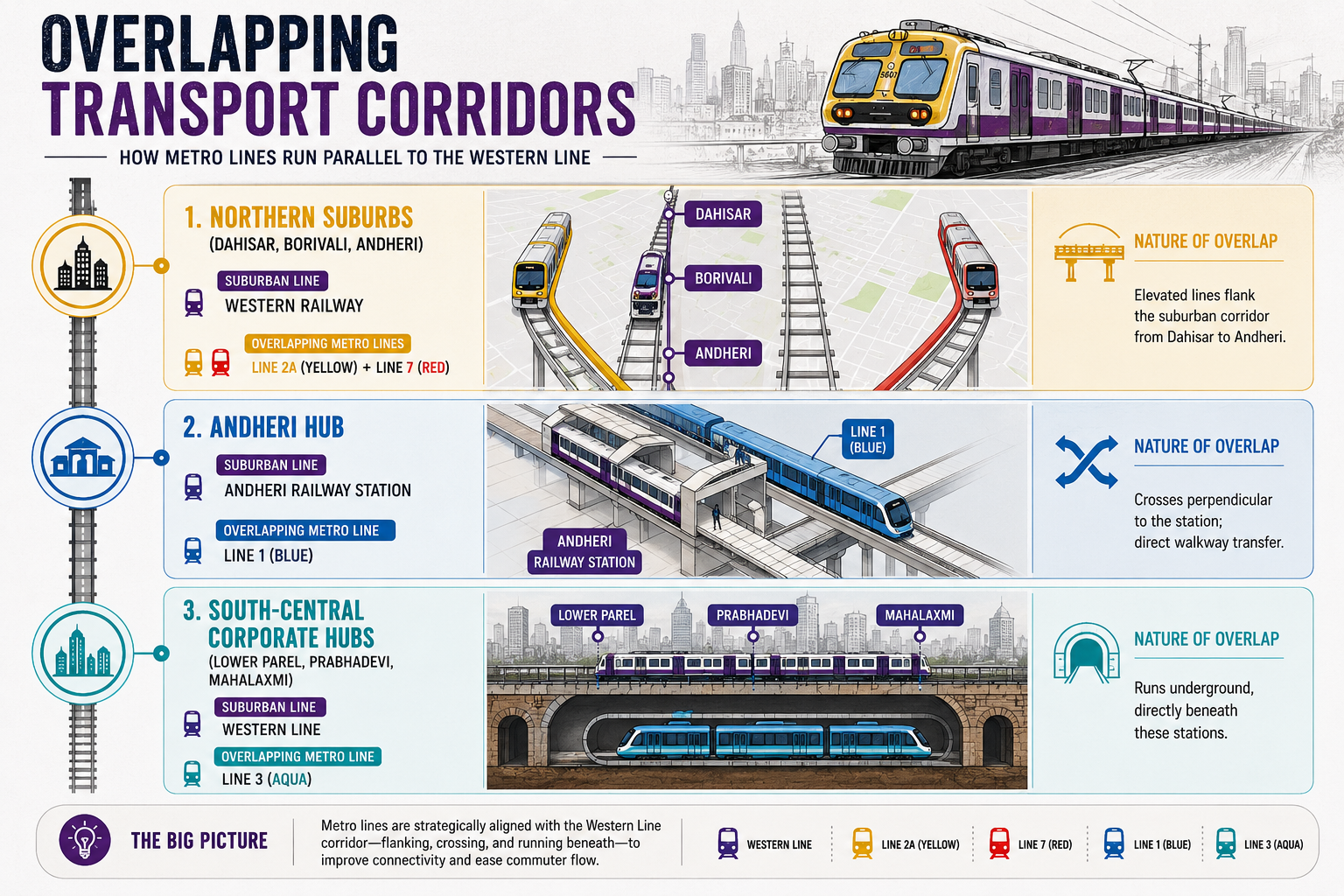
Walk the Western Line station by station and the losses don't spread evenly. They follow the Metro's own footprint almost exactly, as if someone had traced one map over the other.
At Andheri, where Metro Line 1 physically crosses the railway station, First Class bookings of locals are down 15.02%, and Second Class have dipped by 6.51%. Commuters heading in from Versova or the central suburbs no longer need to squeeze through a local train transfer at all. They just walk across the bridge and skip the whole ordeal.
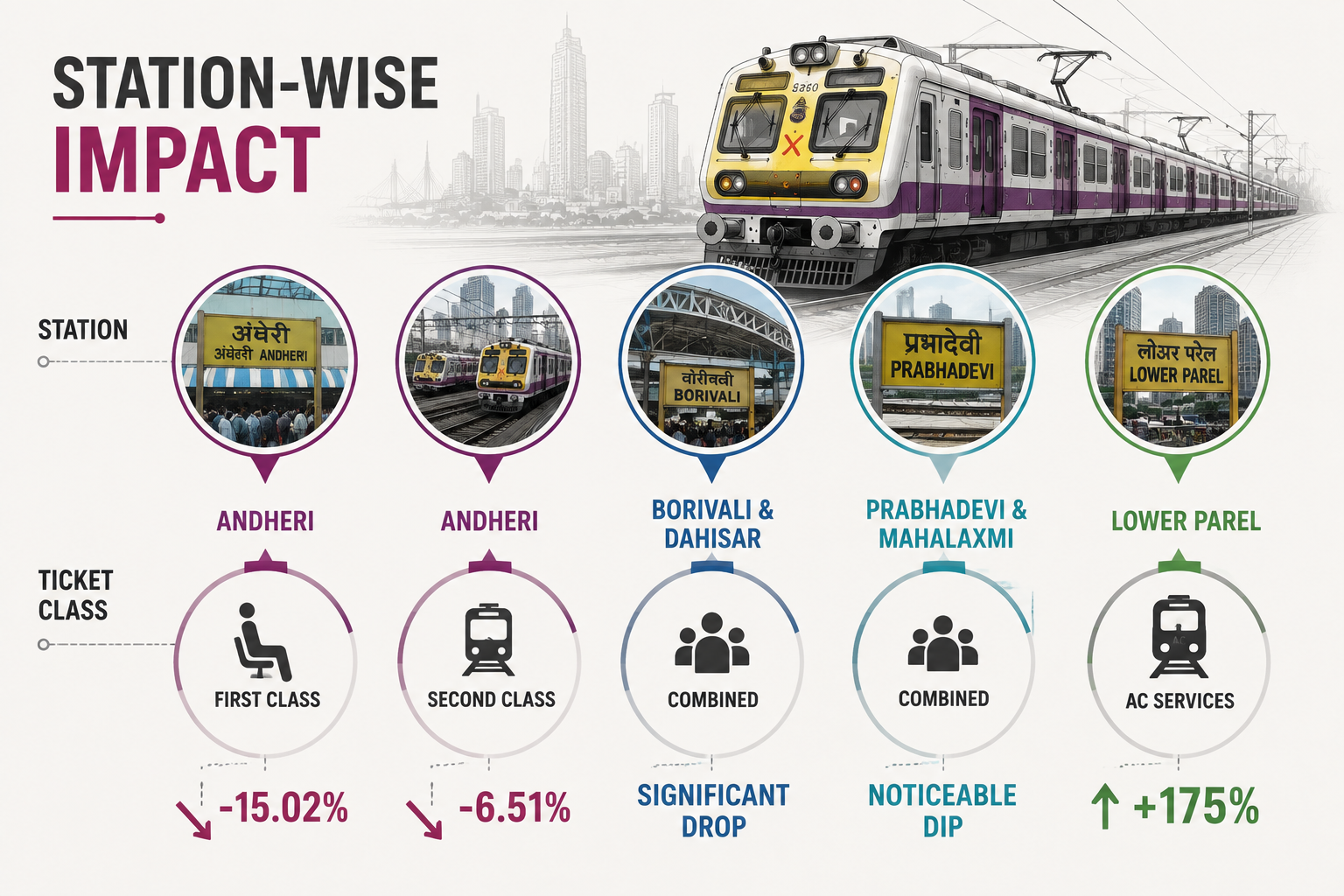
Head further north, to Borivali and Dahisar, and the same pattern shows up on a bigger scale. Two Metro lines flank the suburban corridor here, one on each side: the Yellow Line running along Link Road, the Red Line (Dahisar-East to Gundavali) along the Western Express Highway. Western Railway's own internal assessment simply calls the resulting drop in ridership ‘significant’, and doesn't bother softening the word.
South of that, around Prabhadevi, Mahalaxmi, and especially Lower Parel, it looks less like a slow leak and more like a rush for the exit. The Aqua Line (Aarey JVLR to Cuffe Parade) runs underground right beneath these stations, and it's pulling office-goers away from the locals almost entirely. At Lower Parel alone, AC ticket sales are up 175%.
Nearly Four Crore Rides, One Quarter, Three Corridors
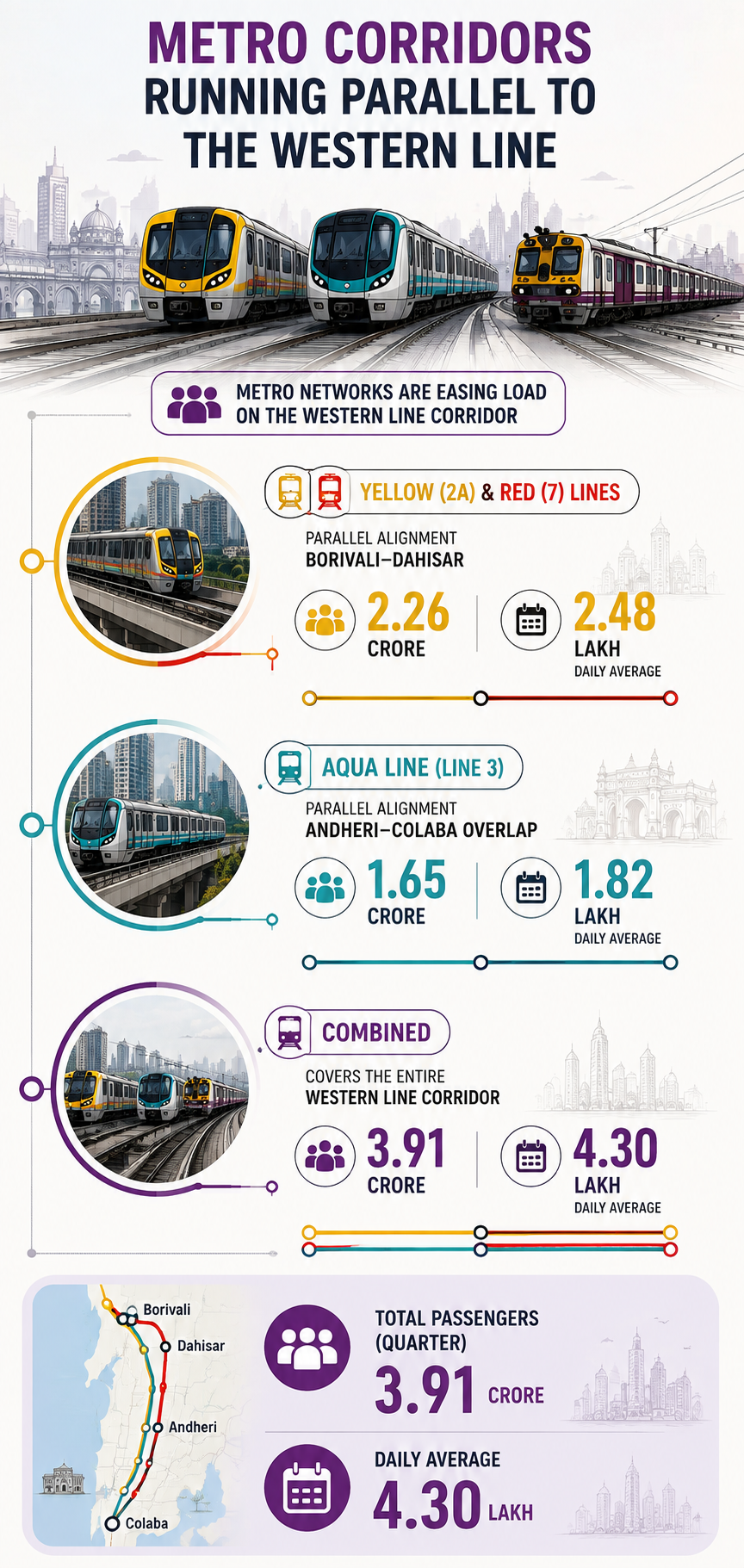
It's worth pausing to look at what the Metro is actually carrying along these same stretches, because the scale of it is easy to underestimate. The Yellow and Red Lines together moved 2.26 crore passengers between Borivali and Dahisar this quarter, roughly 2.48 lakh a day. The Aqua Line carried 1.65 crore between Andheri and Colaba, 1.82 lakh daily. Put them together and you get three Metro corridors, all running beside the Western Line, moving 3.91 crore people in 90 days. A network that barely existed a decade ago is now carrying a number close to everything the suburban railway lost across First and Second Class combined.
A Decade in the Making
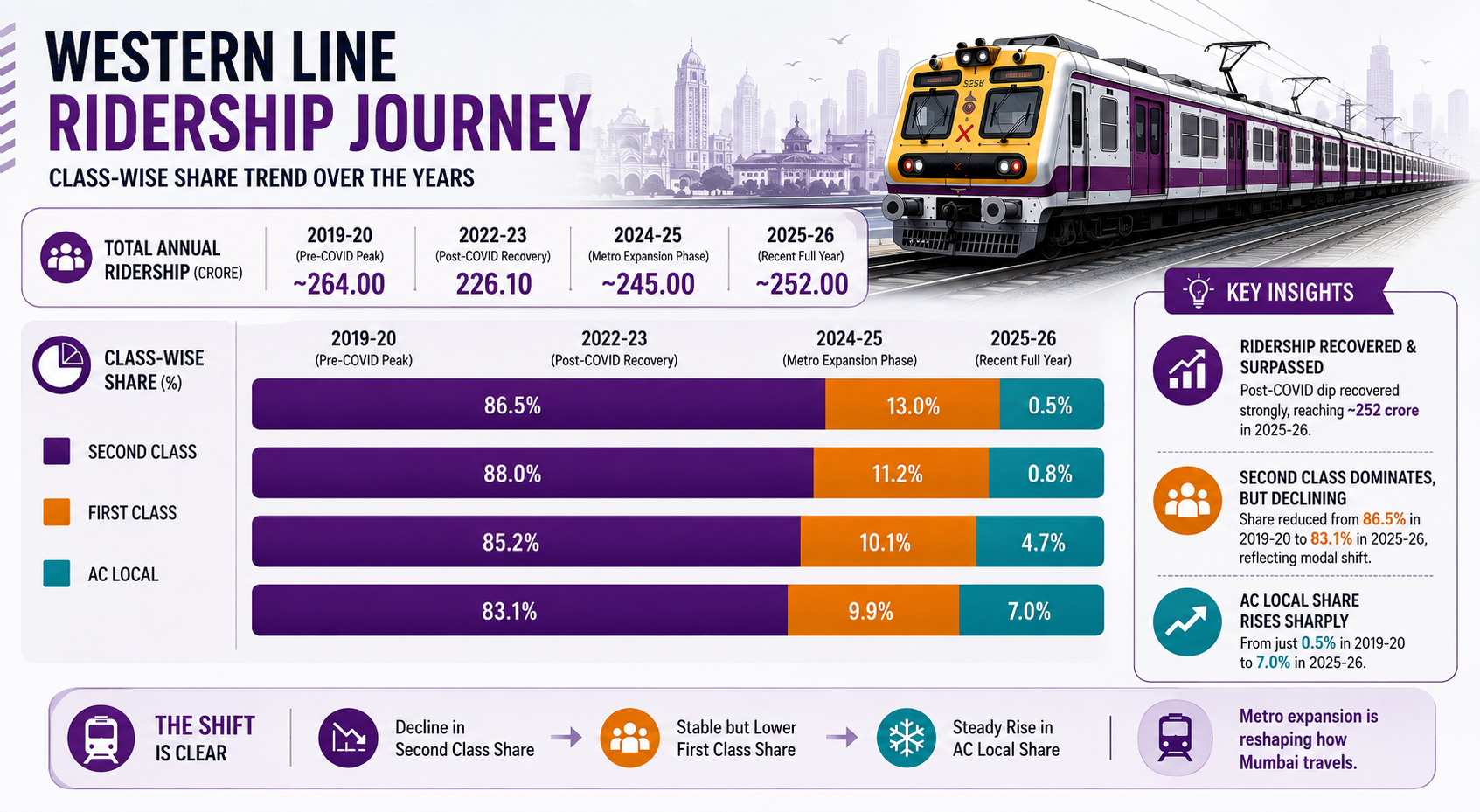
None of this happened overnight, and it's tempting to forget that when a single quarter's numbers grab the headline. Rewind to 2019-20, before the pandemic and before the Metro really picked up pace, and Second Class alone made up 86.5% of all suburban ridership; AC Local barely registered, just 0.5%. Fast-forward to 2025-26, and total annual ridership has climbed back to around 252 crore, but look under the hood and the mix has quietly changed. Second Class has slipped to 83.1%. AC Local has climbed to 7%, a 14-fold jump in its share over six years. Slow, unglamorous, and completely consistent.
What 44.65 Lakh Fewer Journeys Actually Feel Like
Here's the thing about numbers on a spreadsheet: they don't sweat through a shirt on a July morning. They don't get an elbow in the ribs at Dadar. Ask anyone who used to fight for a foothold near the Second Class door at Andheri what this data actually means, and you won't hear a percentage. You'll hear something closer to relief.
For years, riding the Second Class compartment during peak hours meant getting shoved in before you were ready, standing pressed against strangers for 40 minutes with nowhere to put your bag, and praying you'd land near the right door before your station rushed past. That wasn't a bad day. That was Tuesday. The 44.65 lakh people missing from this quarter's local train count aren't statistics who evaporated into thin air. Many of them are standing on a Metro platform right now, cool and unhurried, because they simply got tired of that fight.
Talk to someone who switched from the Andheri local to Metro Line 1, and they won't quote you a percentage either. They'll tell you about the minutes they've saved. About walking into the office without a soaked shirt clinging to their back. About getting an actual seat for the first time in years. Ask a Lower Parel office-goer who moved to AC Suburban what changed, and she isn't thinking about a 175% surge in ticket sales. She's thinking about the fact that her 15-minute train ride no longer leaves her needing 10 minutes to recover before her first meeting.
That's the real story sitting under all this data. Every lakh of ‘lost’ ridership on the Western Line is, for someone, a found half hour, a saved shirt, a commute that finally feels like getting somewhere instead of surviving something. The Mumbai local isn't dying. It still carries more than many people every quarter, a scale the Metro hasn't come close to touching, and for millions it remains the only option they can afford. But the city's oldest lifeline is no longer working alone. Metro lines now run beside it, above it, and beneath it, station after station, and Mumbaikars are quietly, steadily choosing, trip by trip, whichever one lets them arrive like a person and not like cargo.