Saptadhara: The blueprint of Viksit Bharat
Visualisation
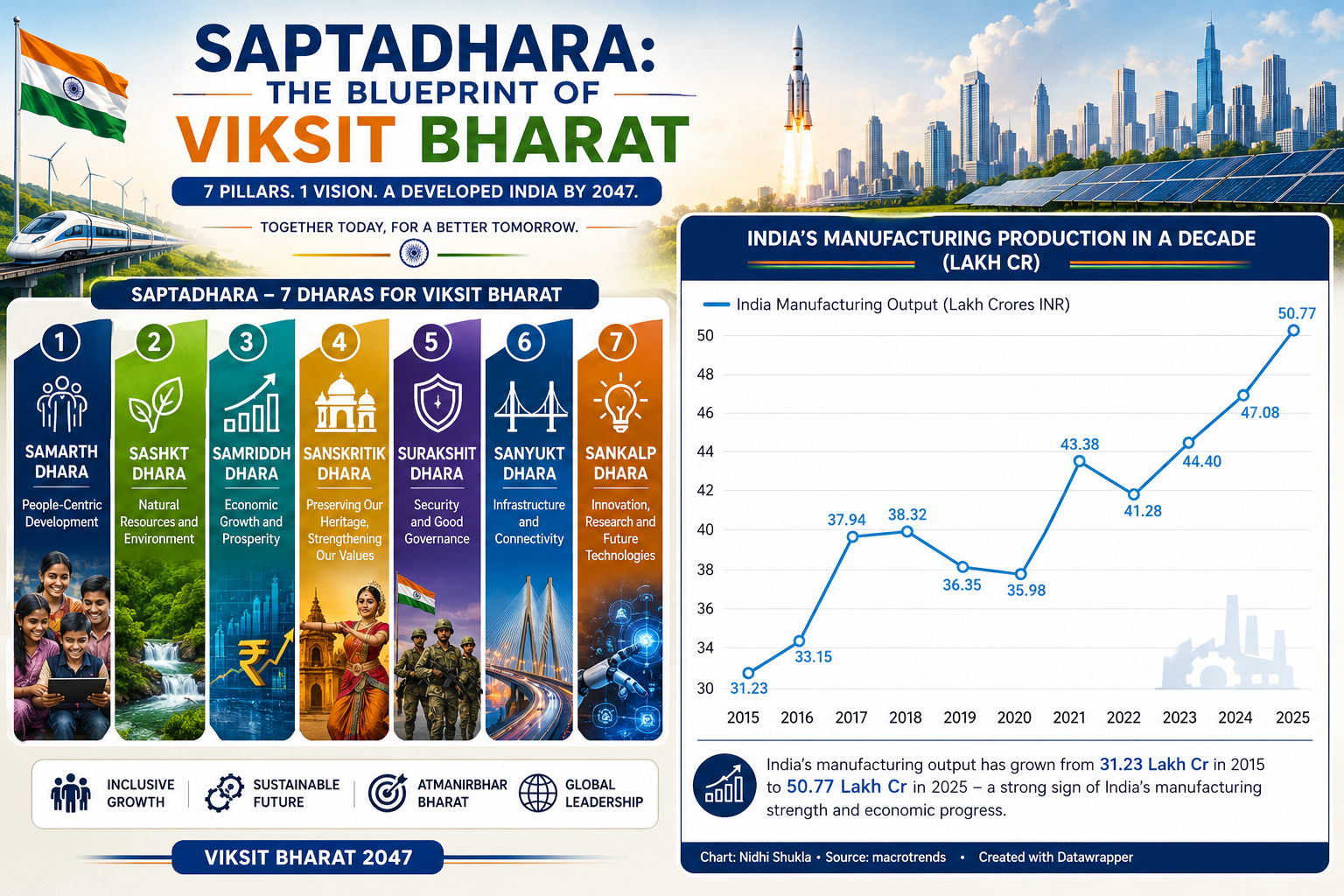
At a Glance
How manufacturing and infrastructure are reinforcing each other to expand connectivity, production, and access across India. For decades, distance shaped opportunity in India. A factory far from a freight corridor, a village without an all-weather road, or a student living far from an educational centre all faced the same constraint: access. That constraint is steadily weakening. India’s broader Saptadhara vision for Viksit Bharat brings together several engines of development, but manufacturing and infrastructure are especially closely linked. One expands production; the other allows that production to move. Together, they are beginning to reshape where economic activity can happen and who can participate in it. In his Independence Day address on August 15, 2026, Prime Minister Narendra Modi outlined Saptadhara, or seven streams of strength, as a framework for accelerating India’s journey towards achieving this goal of Viksit Bharat. The seven streams cover manufacturing, agriculture and food production, technology and innovation, Gati Shakti, defence, the green and blue economy, and India’s soft power. India’s annual manufacturing output rose from ₹31.23 lakh crore in 2015 to ₹50.77 lakh crore in 2025, an increase of 62.57%. The larger story is not only higher output, but a deliberate attempt to deepen India’s industrial base. The Production Linked Incentive scheme, with an approved outlay of ₹1.97 lakh crore, reflects this shift towards targeted support for strategic manufacturing. Electronics show the change most clearly. India has traditionally depended heavily on services for economic growth. The manufacturing push represents an effort to broaden that model by building greater industrial capacity, strengthening domestic supply chains and positioning Indian firms in global production networks. Mobile phone exports increased by around 1,626%, while overall electronics exports rose by roughly 1,015% over eleven years. The significance of this growth extends beyond export earnings. Electronics manufacturing creates demand across a much wider ecosystem: components, packaging, logistics, precision engineering, warehousing and skilled labour. The deeper this ecosystem becomes, the greater the possibility that India moves from merely assembling products to controlling larger portions of the manufacturing value chain. India’s National Highway network expanded from around 91,287 kilometres in 2014 to more than 1,46,572 kilometres by 2026, an increase of roughly 61%. Construction speed accelerated alongside network expansion. The pace of highway construction increased from approximately 11.6 kilometres per day to around 34 kilometres per day. Projects such as Bharatmala Pariyojana, economic corridors and new Greenfield Expressways have sought to connect industrial centres, cities, ports and consumption markets more efficiently. The economic effect of a highway does not stop with faster travel. Shorter journey times can reduce freight costs. More predictable logistics can allow manufacturers to maintain leaner inventories. Industrial locations previously considered too distant from large markets can become commercially viable. The scale of India’s expressway programme attracts attention, but another transformation is taking place much farther from the major industrial corridors. India’s rural road network has seen the construction of approximately 7,87,520 kilometres of roads and 10,404 bridges. These connections provide access to around: 1,46,784 schools, Better roads lower logistics delays, make freight movement more predictable, and allow businesses to access larger markets. Industrial locations that were once considered distant can become commercially viable when connectivity improves. In this sense, infrastructure begins to influence not only how fast economic activity moves, but also where economic activity can grow. Road infrastructure is only one side of the story. Indian Railways has also increased investment in track renewal and safety infrastructure. By 2023-24, gross expenditure reached approximately ₹17,850.25 crore, supporting a record 5,950 kilometres of track renewal. Five years earlier, expenditure was around ₹9,650 crore. The near doubling of spending reflects a growing focus on strengthening the physical network beneath railway operations. Track renewal may receive less attention than new trains or modern stations, but it directly affects safety, reliability and operating efficiency. These improvements serve a railway network carrying more than 700 crore passenger journeys annually. For passengers, better infrastructure means safer and more dependable mobility. For businesses, railways remain critical for moving bulk goods and raw materials across long distances at relatively low cost. The broader Saptadhara vision places manufacturing, infrastructure, technology and other strategic sectors within the larger goal of making India a developed economy by 2047. But the groundwork for this convergence has been developing for much of the last decade. Manufacturing capacity has expanded. Highway networks have grown. Rural connectivity has deepened. Railway expenditure has increased. Industrial incentives have become more targeted. Together, these trends suggest a shift from building individual assets towards building an interconnected economic system. The next challenge will be to translate this scale into productivity, employment and wider access to opportunity. 
Manufacturing

Highways: Shrinking the distance between states


Connectivity beyond the Expressway
1,38,637 agricultural markets, and
82,806 medical centres.
Railways: Strengthening the existing network
From infrastructure to access
Sources
Frequently Asked Questions
What is Saptadhara?
Saptadhara means “seven streams” or “seven streams of strength.” It is a framework linked to the vision of Viksit Bharat 2047, bringing together key areas such as manufacturing, agriculture, technology and innovation, infrastructure, defence, the green and blue economy, and India’s soft power.
How is better infrastructure supporting India’s manufacturing growth?
Better highways, rural roads, railways, and freight connectivity help manufacturers move raw materials, finished goods, and workers more efficiently. By reducing travel time and improving access to markets, infrastructure can lower logistics costs and make more locations economically viable for industries.
What does the growth in manufacturing and infrastructure mean for India?
The expansion of manufacturing output, highways, rural roads, and railway infrastructure points towards a more connected and integrated economy. The key challenge now is to convert this infrastructure and industrial capacity into higher productivity, more employment, and wider access to economic opportunities.