Six Charts, One Story: Of India's Quiet Deeptech Boom
Visualisation
At a Glance
On the morning of July 18, 2026, a rocket lifted off India's coast into a clear monsoon sky. It carried no state space agency's name on its side. Skyroot Aerospace, an eight-year-old startup founded by two former ISRO engineers, had just become the first private Indian company to reach orbit, making India only the third country in the world, after the US and China, where a private company has pulled that off.
Skyroot wasn't chasing a headline that day. It was riding a wave already visible in India's bank accounts. The same year Skyroot's valuation crossed a billion dollars. Even as funding for the rest of India's startups fell by nearly a fifth, Indian deeptech investors quietly wrote their biggest cheques on record, $2.96 billion in 2025 alone, almost three times what they invested a year earlier, signalling India’s deeptech boom.
Deeptech Sector :-
Deeptech simply means startups built on real scientific breakthroughs, rockets, chips, quantum computers, not clever apps stitched together from tools that already exist. This is the story behind that number.
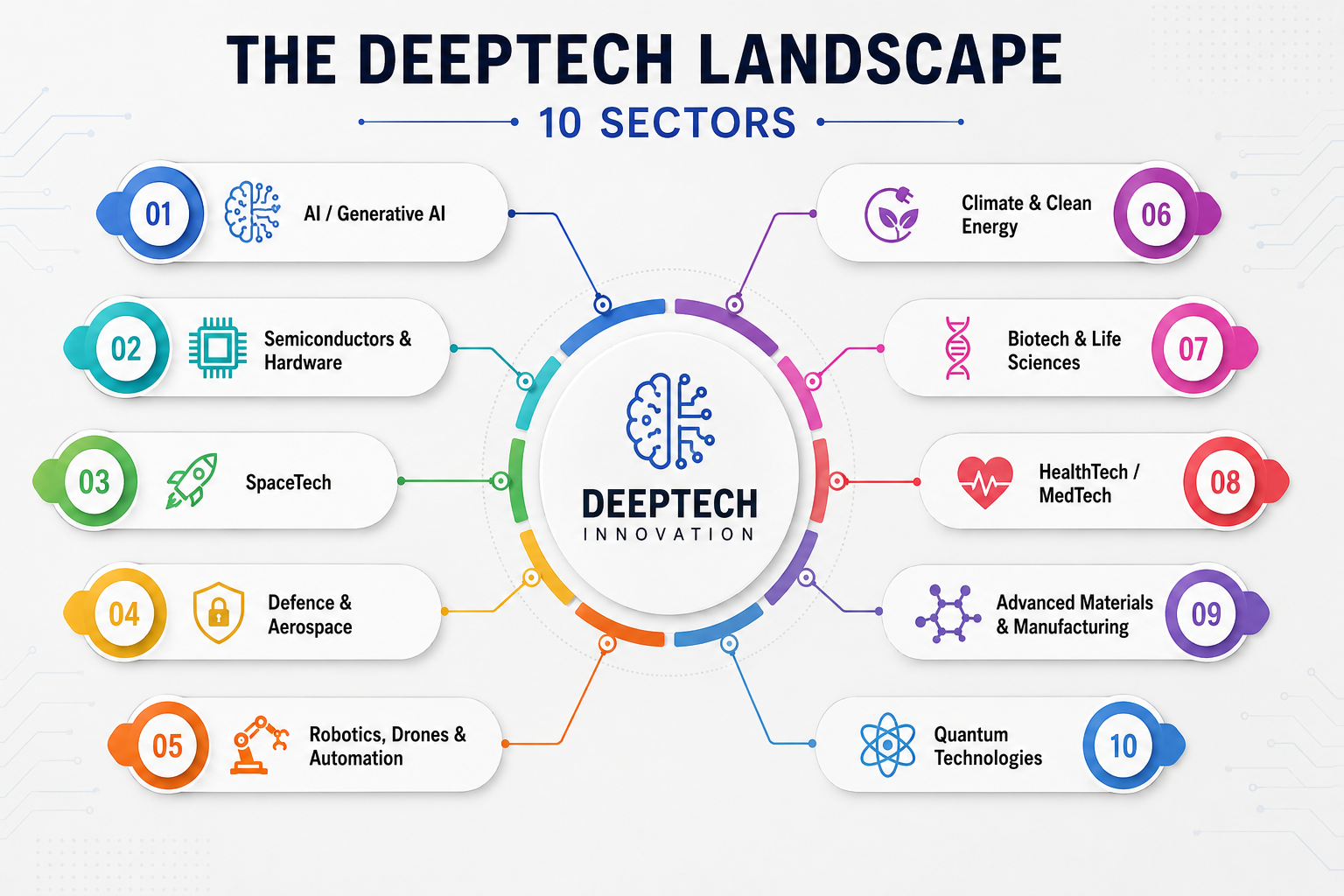
The Indian deeptech landscape has 10 major sectors ranging from quantum technologies to AI/Generative AI. And, each sector has been putting to test its ability to offer something new. This healthy competitive atmosphere is fuelling India’s deeptech boom.
The money curve
A decade ago, deeptech barely registered. In 2015, Indian deeptech startups raised $91 million, barely a rounding error against global venture flows. By 2025, that figure had reached $2.96 billion. Not a sudden spike, but a steady climb, compounding almost every single year.
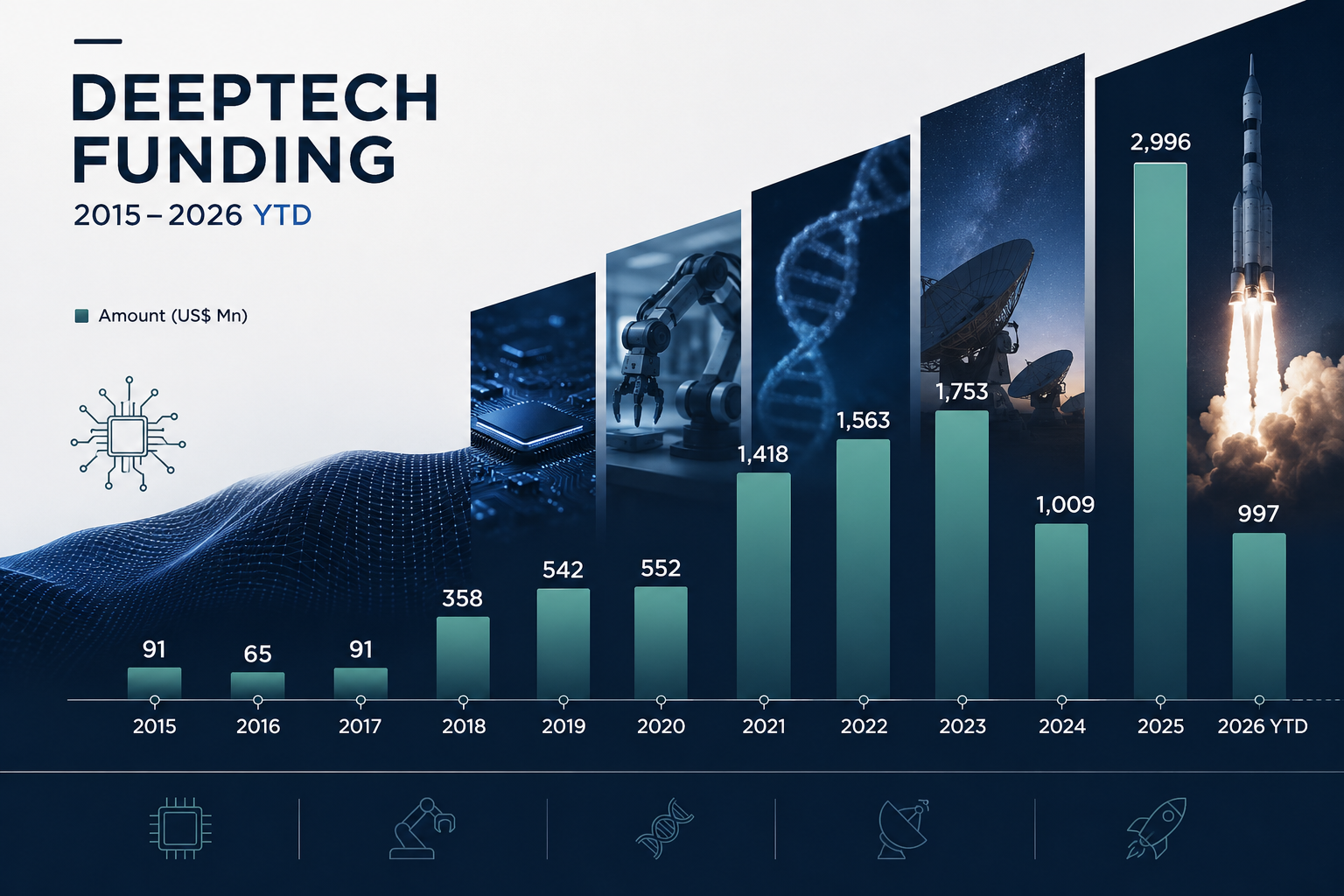
The timing is what lends the chart its weight. In that same year, 2025, India's broader startup funding fell 17 per cent. Investors elsewhere turned cautious, pulled back, and waited things out. Deeptech, notably, did not follow suit. Nearly a billion dollars more has already arrived in 2026. While the rest of the startup world went quiet, this corner of it grew louder.
Where the money goes
Follow the $11.4 billion raised since 2015, and it splits into very different stories by sector. Artificial intelligence leads, pulling in $2.8 billion across 96 deals. Sarvam AI, building language models for Indian languages rather than borrowing someone else's, sits near the top of that pile.
The EV and battery technology sector comes next, at $1.4 billion, but through only 35 deals. Investors aren't spreading small bets here. They're writing enormous cheques to companies they already trust. Ola Electric and Ather Energy account for over a billion of that.
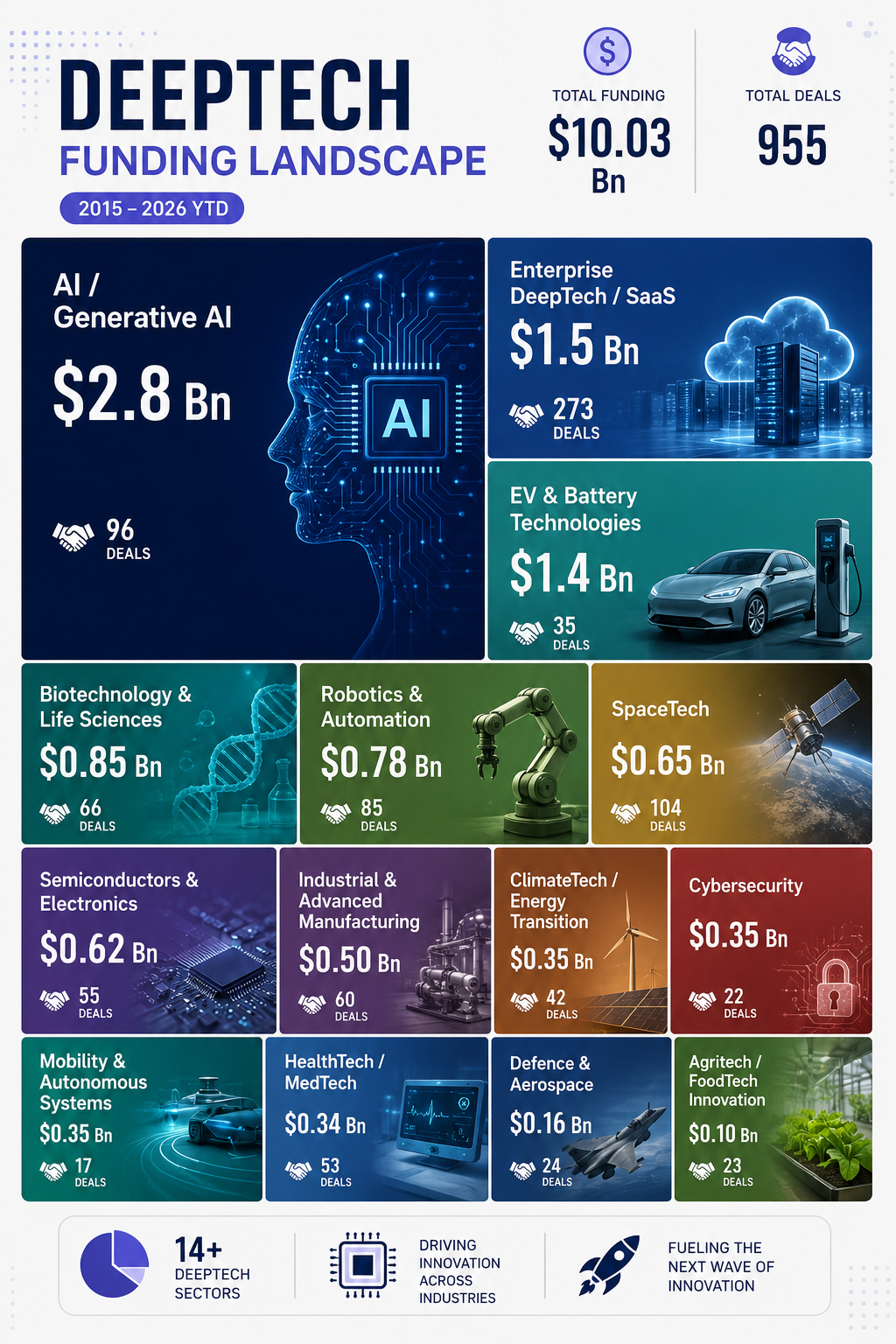
The timing is what lends the chart its weight. In that same year, 2025, India's broader startup funding fell 17 per cent. Investors elsewhere turned cautious, pulled back, and waited things out. Deeptech, notably, did not follow suit. Nearly a billion dollars more has already arrived in 2026. While the rest of the startup world went quiet, this corner of it grew louder.
Where the money goes
Follow the $11.4 billion raised since 2015, and it splits into very different stories by sector. Artificial intelligence leads, pulling in $2.8 billion across 96 deals. Sarvam AI, building language models for Indian languages rather than borrowing someone else's, sits near the top of that pile.
The EV and battery technology sector comes next, at $1.4 billion, but through only 35 deals. Investors aren't spreading small bets here. They're writing enormous cheques to companies they already trust. Ola Electric and Ather Energy account for over a billion of that.
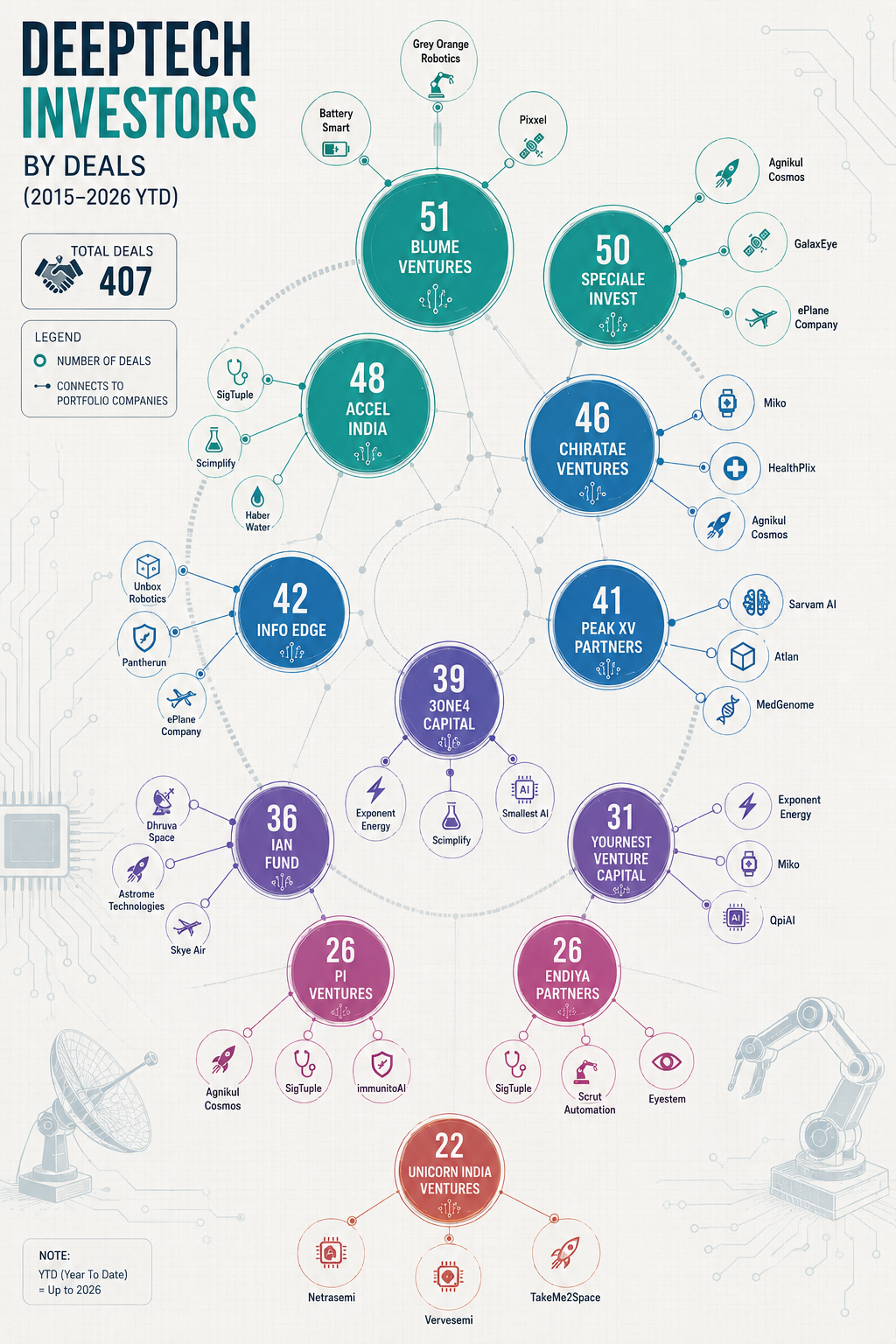
We now know which sectors are pulling the money, and which cities are catching it. But behind every one of those numbers sits a person who had to say yes. Blume Ventures, Speciale Invest, and Accel India top the list, together behind close to one in every six deeptech deals made since 2015. A small number of funds is still carrying most of the early risk. That's not a flaw. But it does mean the base holding this whole story up is still thin.
Blume's bets include Grey Orange Robotics and Battery Smart. Speciale Invest has backed both Agnikul Cosmos and the satellite-imaging startup GalaxEye. Most of this capital, notably, comes from inside India. Family offices, domestic institutions and wealthy individuals fund the bulk of these portfolios, giving the sector a patient, homegrown character. Global investors are involved too, and their presence is growing, but the backbone of this ecosystem remains distinctly Indian.
Where India stands in the world
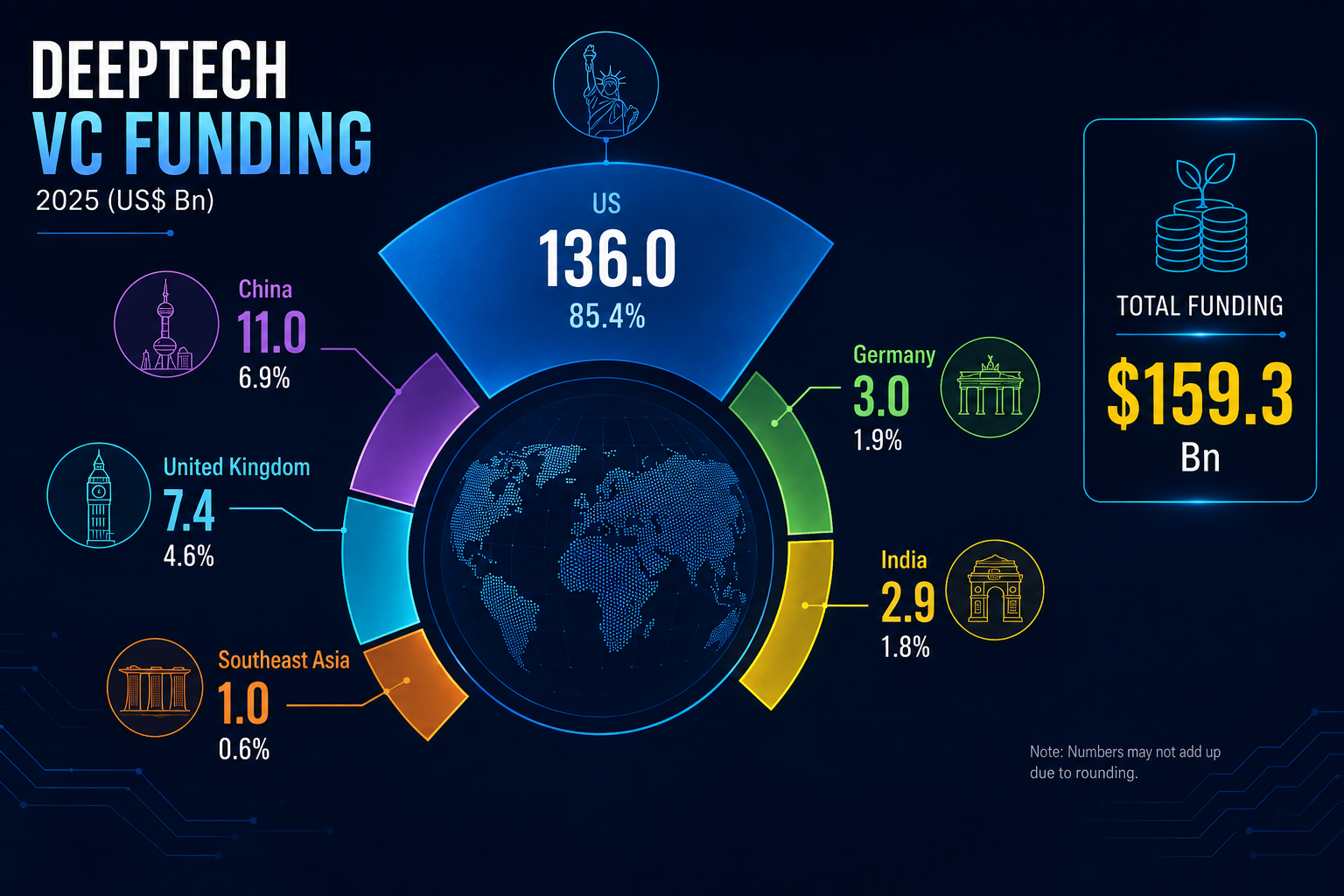
Here's the part that keeps things honest. The US raised $136 billion in deeptech funding in a single year. China raised $11 billion. India raised $2.9 billion, a fraction of either.
But a smaller number tells a bigger truth. In 2016, deeptech made up just 4 per cent of all venture money flowing into Indian startups. By 2025, that number climbed to 15 per cent. India isn't matching the giants in size. It's matching them in conviction, betting a growing share of its own money on hard science instead of easier, faster wins.
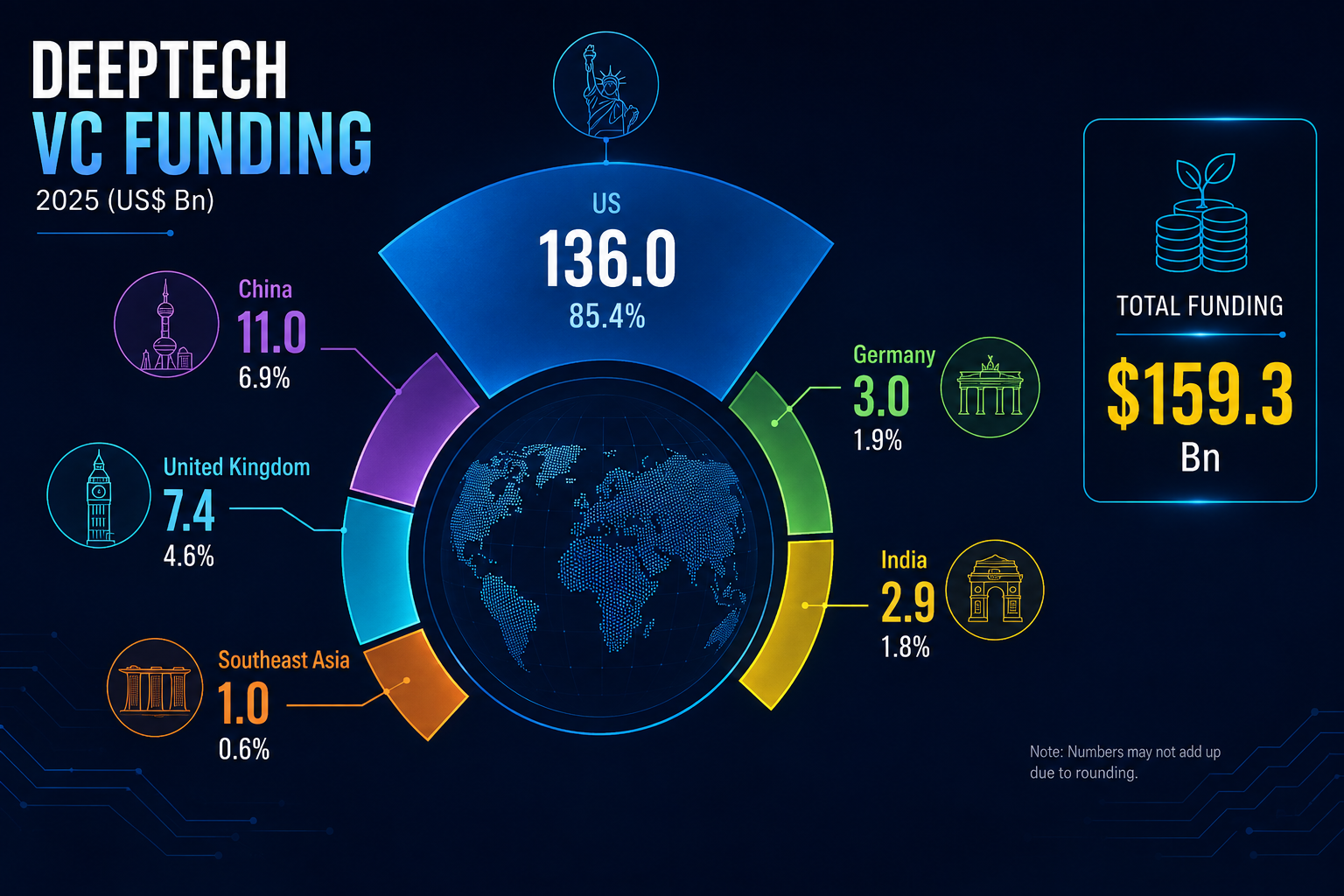
Conviction isn't the same as capacity, though. A rising share of a small pie is still a small number. Building a fab, training a rocket team, or scaling a quantum lab doesn't run on percentages. It runs on dollars, and on that count, India is still years behind, not quarters. The climb from 4 to 15 per cent shows where India's belief is heading. The 46x gap with the US shows how much ground that belief still has to cover. Both are true at once, and neither cancels the other out. India has proven it wants to build hard technology. What it needs next is simple to name and hard to deliver: more money behind that want, patient enough to survive the decade deeptech usually takes to pay off.
Where the Story Gets Hard
One more chart, and it's the one that matters most for what comes next. Getting a first cheque in Indian deeptech has gotten easier. Nearly 40 per cent of all deals happen at the earliest stage, before a company has proven much at all.
The trouble starts after that. Between the first serious round and the next one, deal count drops by almost two-thirds, even as the size of each cheque nearly triples. Very few companies make that jump. Fewer still reach the stage where investors write truly massive cheques.
That gap has a name in investing circles: the point where good science stalls, not because it failed, but because nobody was willing to fund the years it takes to prove it at scale. It's the one thing standing between the India that built Skyroot, and the India that builds the next hundred such deeptech companies.