The golden fibre: a success story from the delta
Visualisation
At a Glance
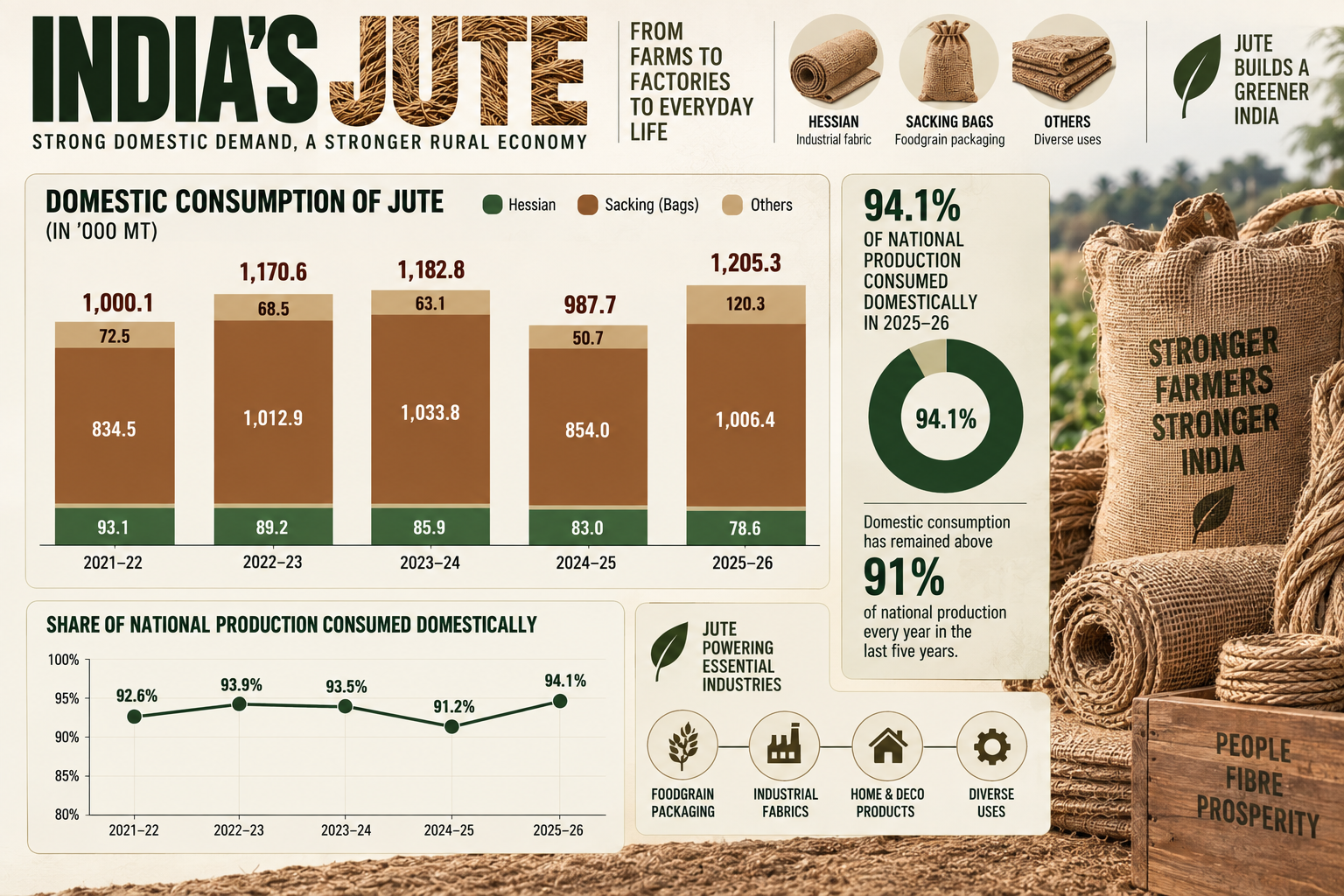
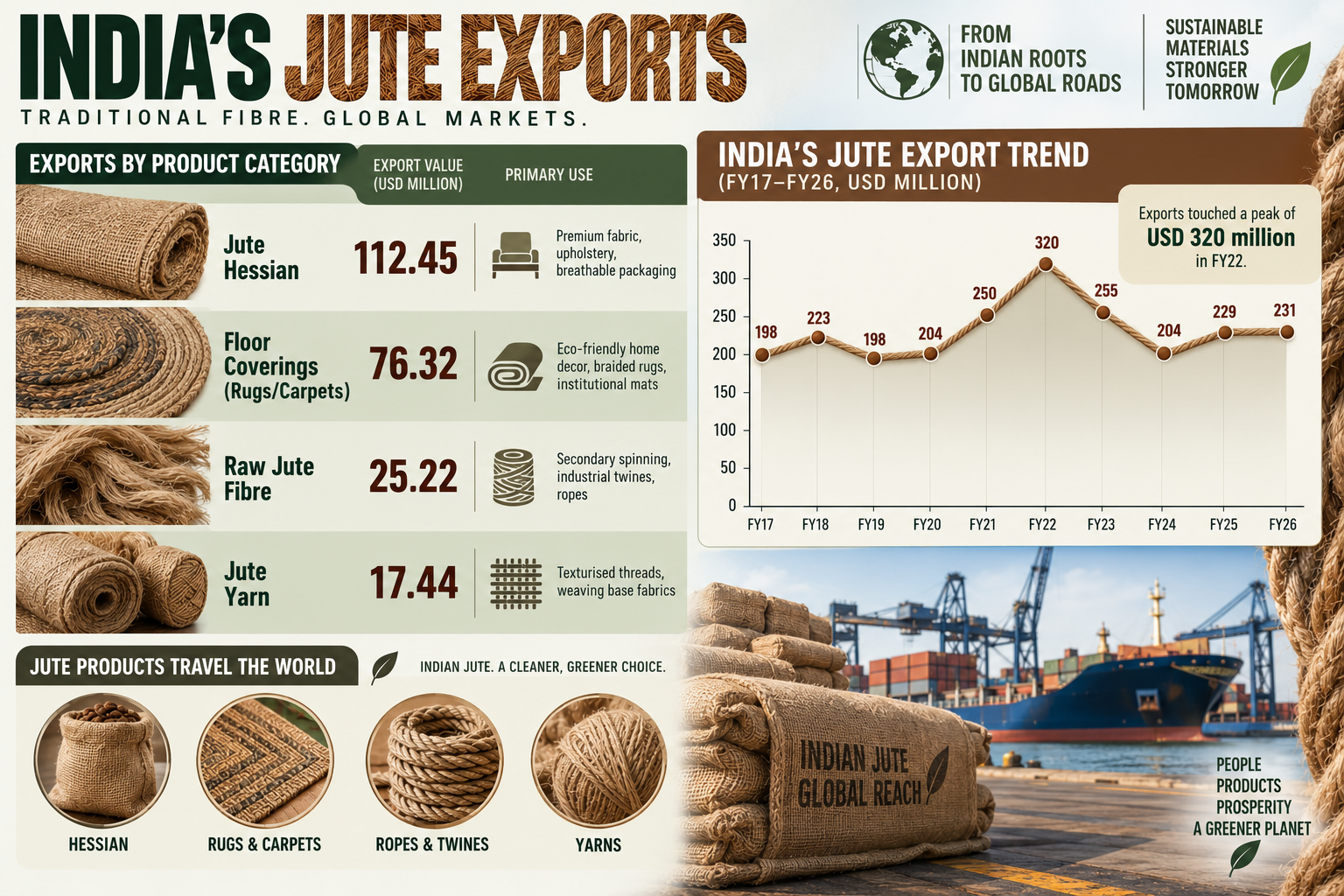
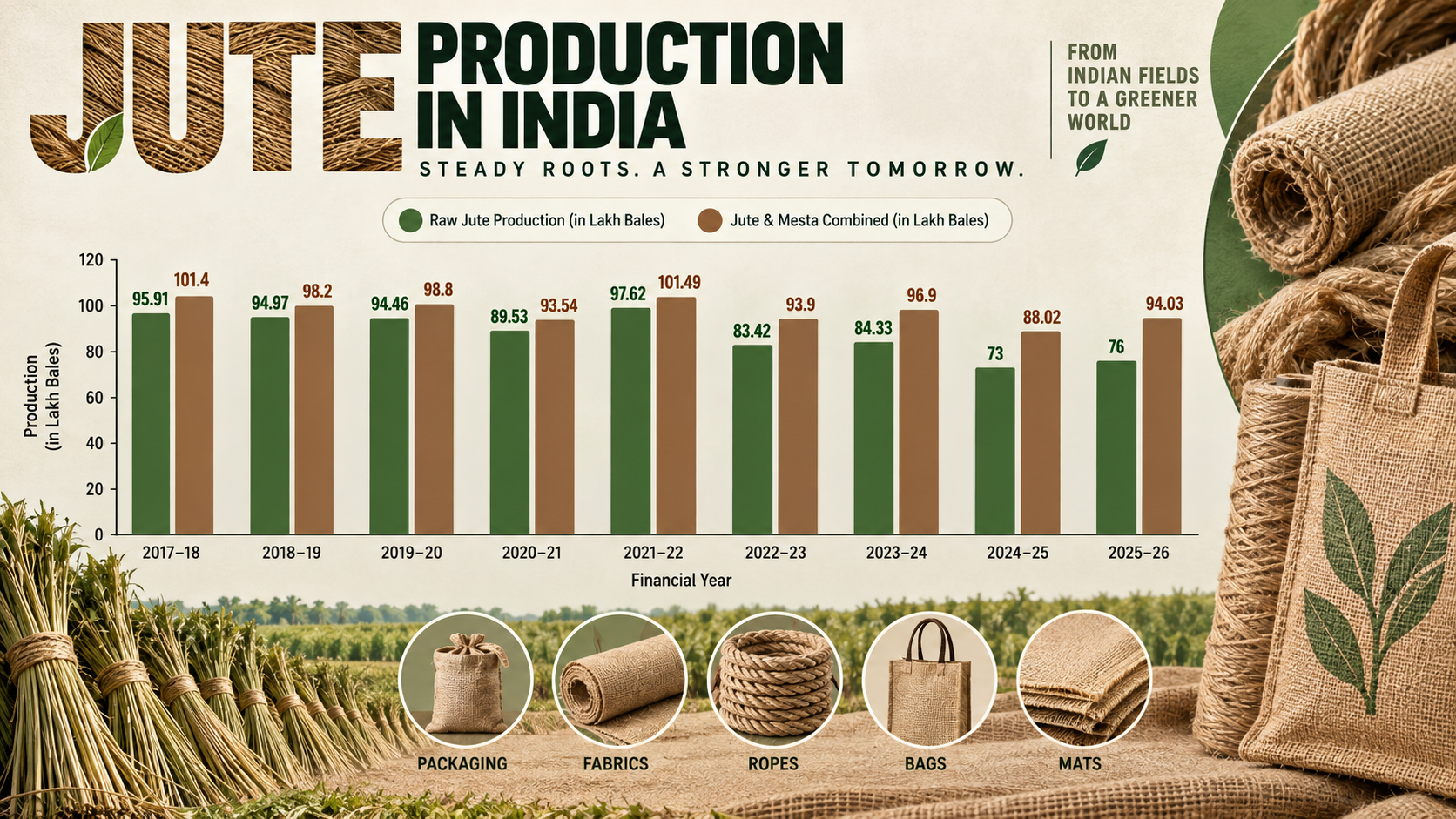
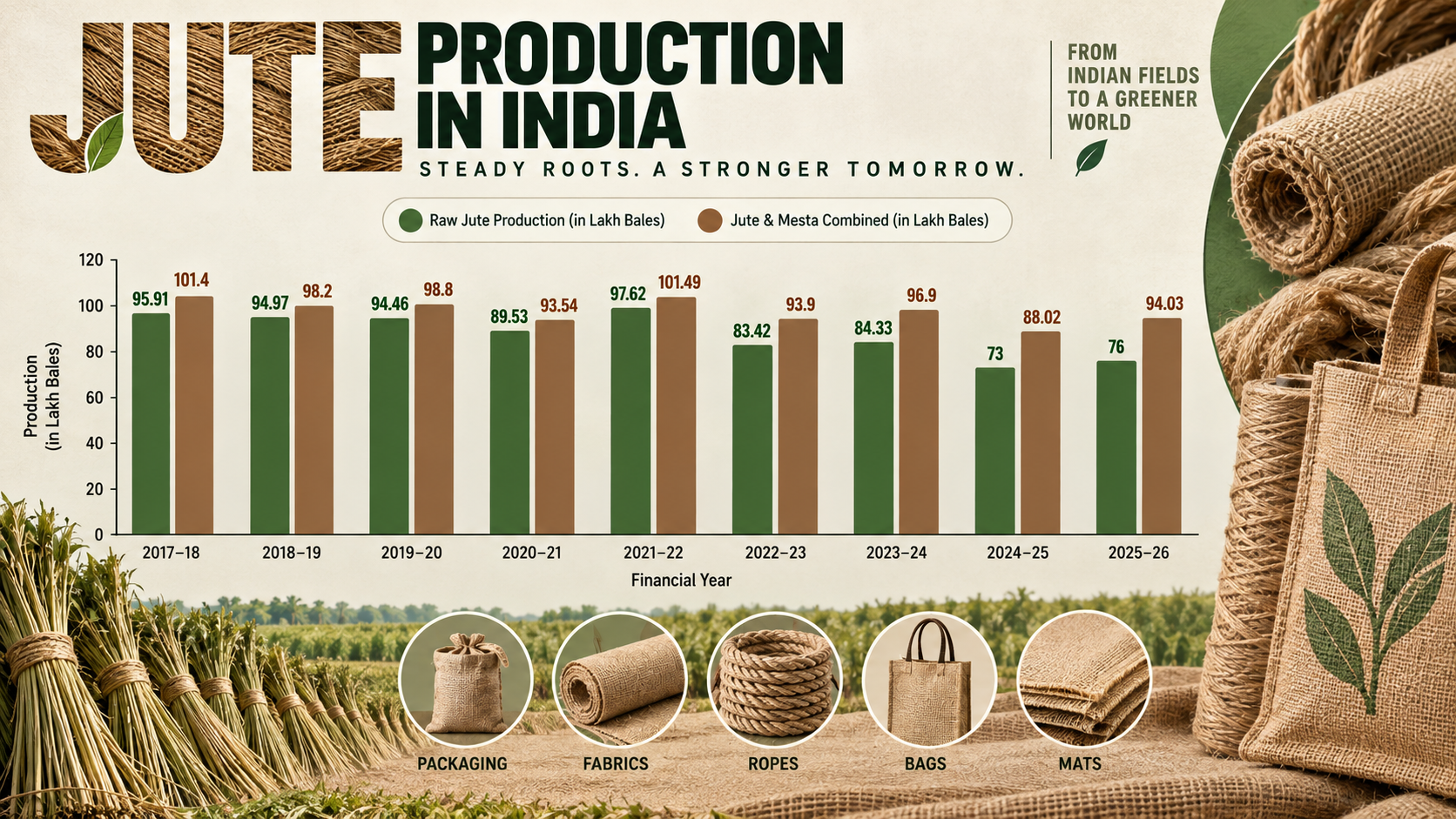
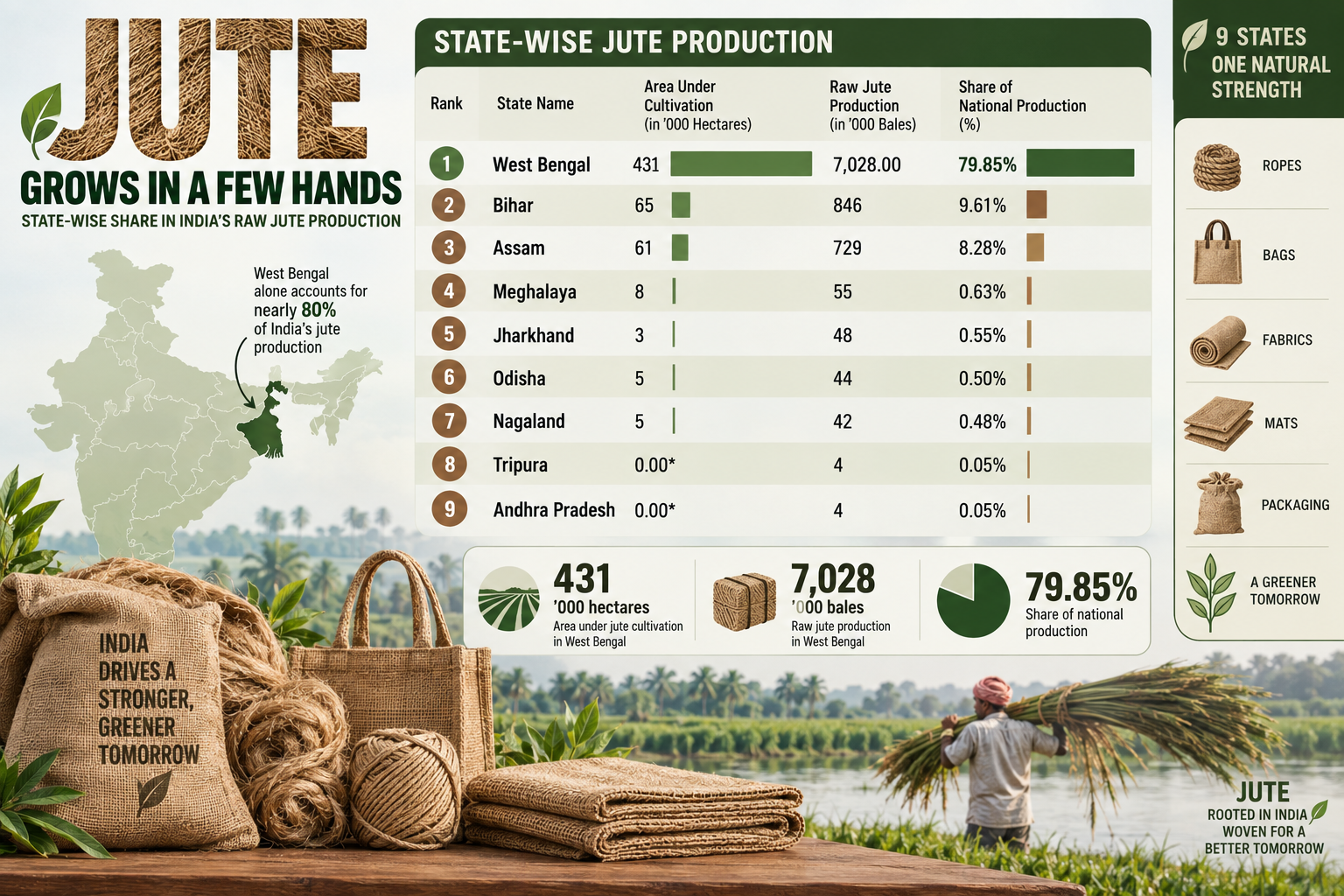
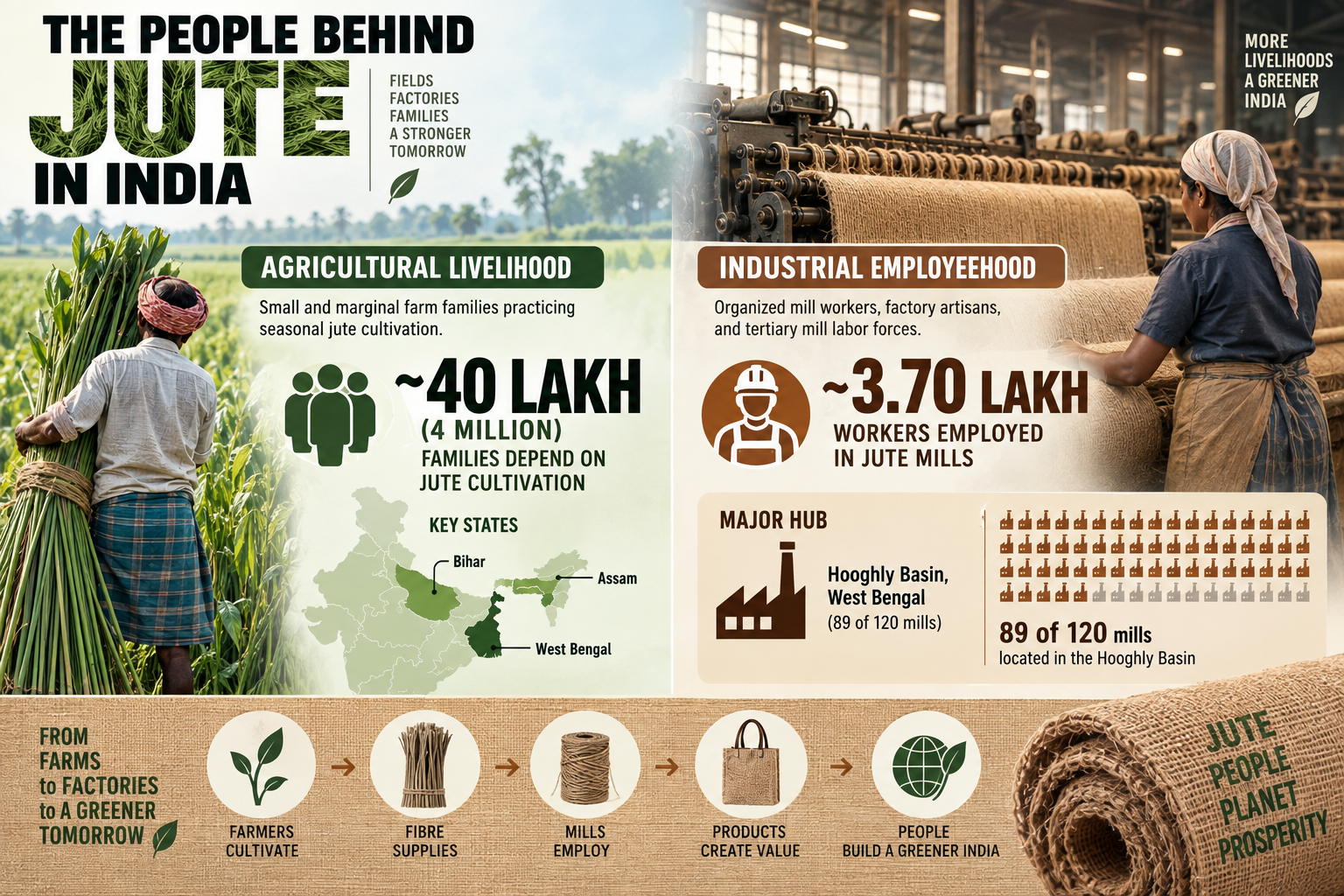
The story starts in mud. Along the Ganges-Hooghly delta, where the soil remains wet for months, farmers plant jute much as their fathers and grandfathers did. It grows fast, often taller than a man within weeks. By the time it is cut and retted in the ponds and canals of West Bengal, the region has produced 19 to nearly 20 lakh metric tonnes of raw jute in a single season. Across the border, Bangladesh produces about 8 to 8.5 lakh tonnes from its own river basin. China, Uzbekistan and Nepal follow at a distance, with around 65,000, 20,000 and 17,000 tonnes respectively. Put simply, one delta remains at the heart of the world’s jute economy. Jute and mesta are natural bast fibre crops, with the fibre extracted from the plant’s bark. Mesta, also known as kenaf, Deccan hemp or roselle, is a useful and cheaper substitute for jute. It can withstand drier conditions, poorer soils and tougher weather, making it suitable for areas where jute does not grow as well. Both crops are used for sacks, ropes, canvas and eco-friendly packaging, while mesta also finds applications in paper and composite materials. Like any crop, jute has its good and bad seasons. Between 2017-18 and 2025-26, India’s combined jute-and-mesta production moved between 88 lakh and just over 101 lakh bales. It began the period at 101.4 lakh bales, fell to 88.02 lakh in 2024-25 and recovered to an estimated 94.03 lakh bales in the latest year. Nine monsoons brought nine different weather patterns, yet the overall movement remained within a relatively narrow range. For a crop so dependent on rainfall, that stability matters. It reflects the combined role of farmers, mills and government price support in keeping the sector going through changing conditions. Where does India’s jute actually grow? The answer is overwhelmingly West Bengal. Of the 5.73 lakh hectares under jute cultivation in the country, 4.31 lakh hectares are in the state, accounting for about three-quarters of the total. Its share of production is even higher: 70.28 lakh bales out of 88.01 lakh. Bihar and Assam follow, with less than 10 per cent each. Meghalaya, Jharkhand, Odisha, Nagaland, Tripura and Andhra Pradesh together contribute less than two bales in every hundred produced in India. Jute is not a crop spread evenly across the country. It has found a natural home in the eastern river plains and remained firmly rooted there. In a jute-growing village in Bihar or Assam, the livelihood begins in the field. Along the Hooghly, it continues on the factory floor. Around 40 lakh families, or more than four million people, depend on jute cultivation, largely through small and marginal holdings. Their prices are supported by the Jute Corporation of India’s minimum support mechanism. Another roughly 3.70 lakh people work in the jute mills, with 89 of India’s 120 mills concentrated in the Hooghly basin. Connecting the farm to the factory is a piece of legislation that rarely gets public attention: the Jute Packaging Materials Act of 1987. It mandates the use of jute packaging for foodgrains and a fifth of the country’s sugar production. That requirement creates nearly ₹12,000 crore in demand every year and gives the industry a market that does not depend entirely on exports. The familiar image is of jute leaving Indian ports for overseas markets. The numbers tell a different story.Domestic consumption of jute products such as hessian cloth and sacking bags has remained above 91 per cent of national production in every year on record, reaching 12.05 lakh tonnes in 2025-26. Sacking bags alone accounted for 10.06 lakh tonnes, or about 83 per cent. In other words, most Indian jute does not travel very far. It is used at home, much of it for packaging the country’s own grain and sugar, before any significant quantity reaches an overseas market. Exports tell a smaller but changing story. Jute exports rose from $198 million in FY17 to a peak of $320 million in FY22. They then eased to around $204-255 million over the following two years before reaching $231 million in FY26. Hessian fabric accounted for $112.45 million and rugs and carpets for another $76.32 million. Together, they contributed more than three-quarters of export earnings.The nature of the buyers is changing as well. The United States now takes lifestyle bags and finished jute products worth $48.89 million. Nepal remains a buyer of raw fibre and yarn, while the United Kingdom, Germany and France import hessian cloth, geotextiles and handicrafts. The export basket is therefore moving gradually up the value chain. India is shipping more finished fabric, carpets and consumer products rather than simply sending out raw fibre. The numbers point to a fairly straightforward story. A crop concentrated in one region supports millions of farm families, feeds a large mill industry and supplies most of its output to the domestic market. A smaller export business is steadily moving towards finished products and higher-value applications. The strength of the sector lies in this entire chain working together: the farmer in the field, the mill worker along the Hooghly, the packaging industry that provides assured demand and the export market that is beginning to absorb more value-added products. Go back to where the story began, in the wet fields of the delta, and the arc becomes clear. A stalk cut by hand ends up holding a nation's grain, clothing a mill worker's family, and sometimes reaching a shop shelf in London or New York. None of this is a chance. It rests on a crop that keeps growing in the same soil, a law that has guaranteed its market for nearly forty years, and millions of farmers and mill hands who keep showing up regardless of headlines. Jute was never going to make front-page news. But measured by what it does – feed an industry, employ a workforce, hold its ground through nine straight years of uncertain weather – it has already told its own success story, one bale at a time. The golden fibre: a success story from the delta
Nine seasons and the swing
One state carries most of it
Two kinds of livelihood
Where the jute actually goes
A small door to the world
The whole picture
Conclusion