The numbers behind India's tiger revival
Visualisation
At a Glance
Somewhere in the forests of Tadoba, a camera trap fixed to the trunk of a tree flickers to life in the darkness. A tigress walks into the frame. She isn't in a hurry. She doesn't have to be. This is her territory, and every trail, stream and patch of bamboo carries her scent. Today, that confidence is backed by hard evidence.
India is now home to nearly 70% of the world's wild tiger population. Almost seven out of every ten wild tigers on Earth roam Indian forests. It is an extraordinary turnaround for a country that, just a few decades ago, feared it was losing its national animal.
Fifty years ago, the picture was very different. Hunting, habitat loss and illegal wildlife trade had pushed tiger numbers into steep decline. Pugmarks that once marked muddy trails became increasingly rare, and many reserves were running out of the very animals they had been created to protect.
This is the story of one of the world's greatest conservation recoveries. India pulled its tiger population back from the brink to become home to the largest wild tiger population on the planet. It was a long journey, shaped by setbacks, difficult decisions and decades of sustained effort.
Where It Started
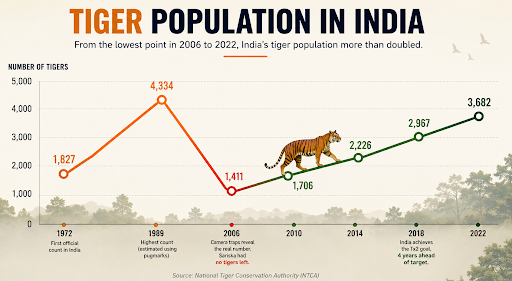
Rewind to 1972. India conducted its first nationwide tiger census and found just 1,827 wild tigers, a shadow of the thousands that once roamed the subcontinent. A year later, Project Tiger was launched with nine reserves and one clear mission: save the tiger before it was too late.
For a while, the numbers looked encouraging. By 1989, official estimates put India's tiger population at 4,334, the highest on record. But those figures were based largely on counting pugmarks left in the mud. The method seemed convincing. It wasn't.
In 2006, India switched to camera traps and scientific estimation. This gave the real count. There were just 1,411 tigers, fewer than in 1972. In Rajasthan's Sariska Tiger Reserve, not a single tiger remained.
That was rock bottom. Everything after that was a climb.
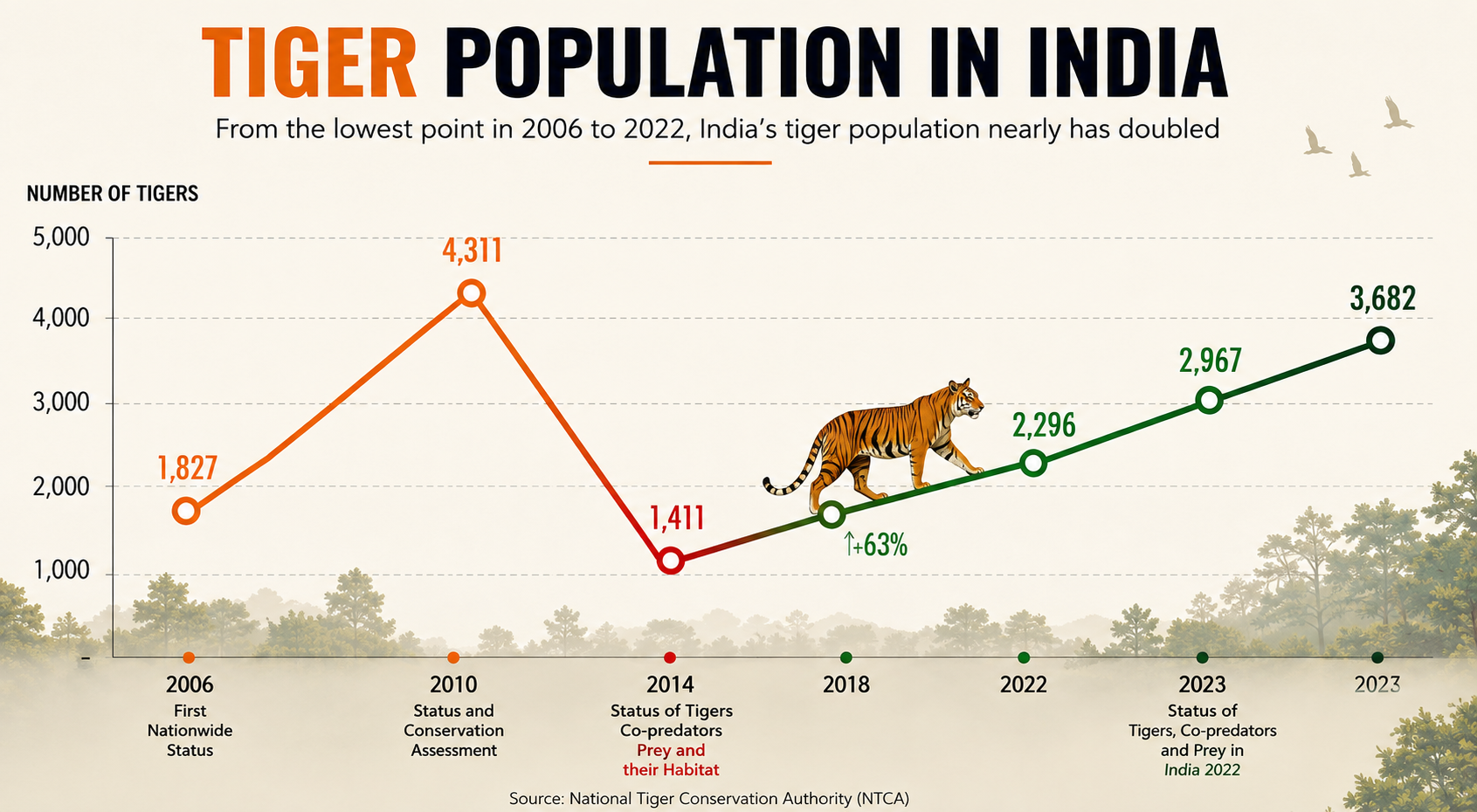
By 2010, India's tiger population had risen to 1,706. Four years later, it reached 2,226. In 2018, the count climbed to 2,967, allowing India to quietly achieve the global Tx2 target – doubling its tiger population – four years ahead of schedule. By 2022, the number had grown to 3,682.
Taken together, the turnaround was remarkable. In just sixteen years, from the low of 1,411 tigers in 2006 to 3,682 in 2022, India's wild tiger population had more than doubled. Between 2018 and 2022 alone, it grew by about 6% a year, making it one of the fastest wild tiger recoveries ever recorded anywhere in the world.
A success with many homes
That national total is really the sum of several regional success stories.
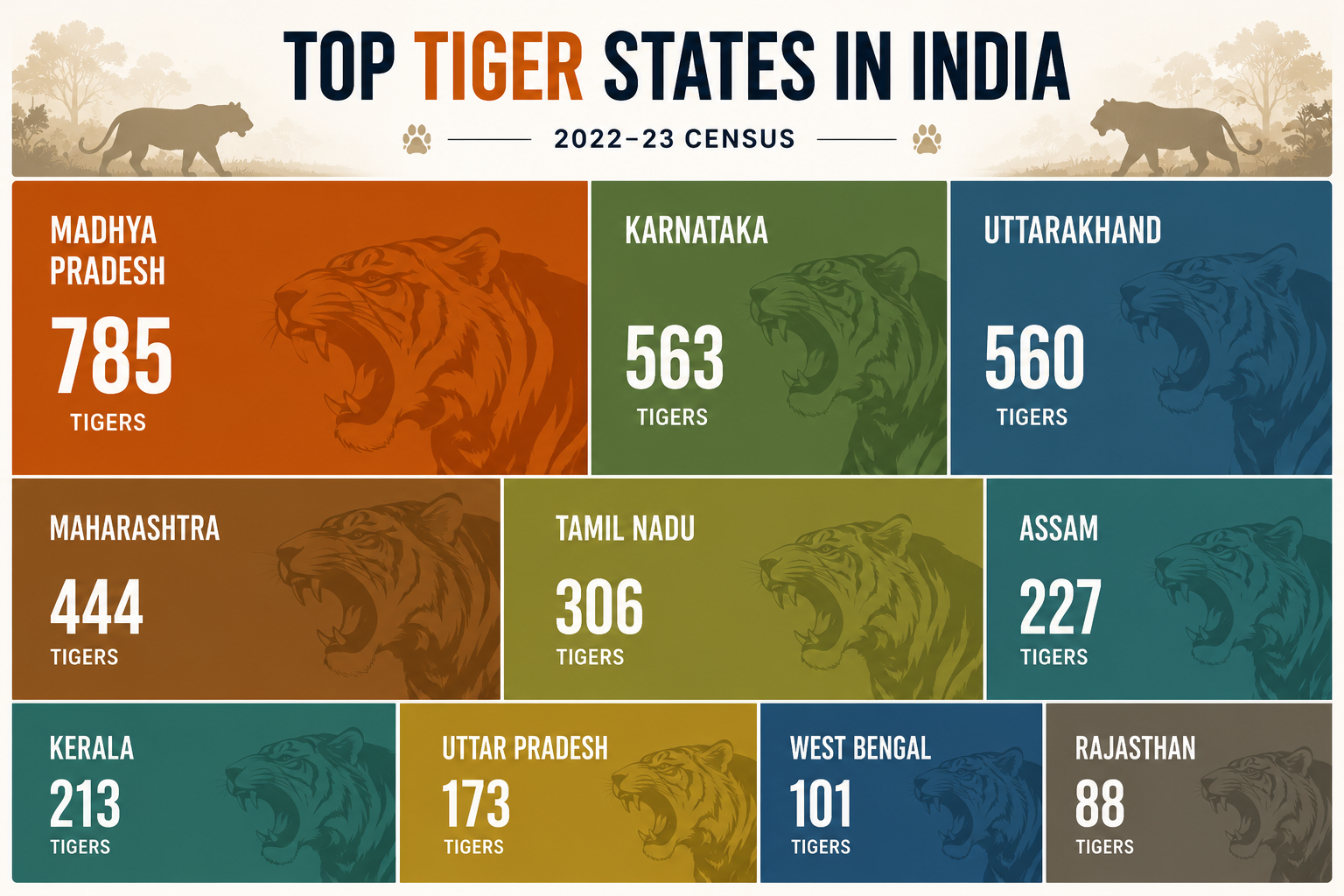
India's tiger recovery was never driven by a single reserve or one outstanding state. It unfolded across forests with different landscapes, climates and conservation challenges, showing that the turnaround was national rather than local.
Some states emerged as strongholds, others rebuilt populations that had nearly vanished, and several quietly expanded their tiger range year after year. Together, they demonstrate that sustained protection, habitat management and scientific monitoring can deliver results across very different ecosystems.
Building more room to roam
Tigers needed more than protection. They needed space, and India kept making room for them.
Project Tiger began with just nine reserves in 1973. Today, the network has grown to 59, covering 84,487 square kilometres—an area larger than Austria. The expansion has continued even in recent years, with Ramgarh Vishdhari and Ranipur added in 2022, Veerangana Durgavati and Ratapani in 2024, and Madhav in 2025. Madhya Pradesh alone now has nine tiger reserves, the highest for any state.
Each new reserve expanded protected habitat, giving tigers more room to breed, disperse and reclaim forests they had once lost.
More protected habitat meant young tigers had somewhere to disperse, establish territories and breed. It was the foundation on which India's tiger recovery was built.
A family growing in Tadoba
National estimates reveal the scale of India's recovery. Tadoba-Andhari shows what that recovery looks like on the ground.
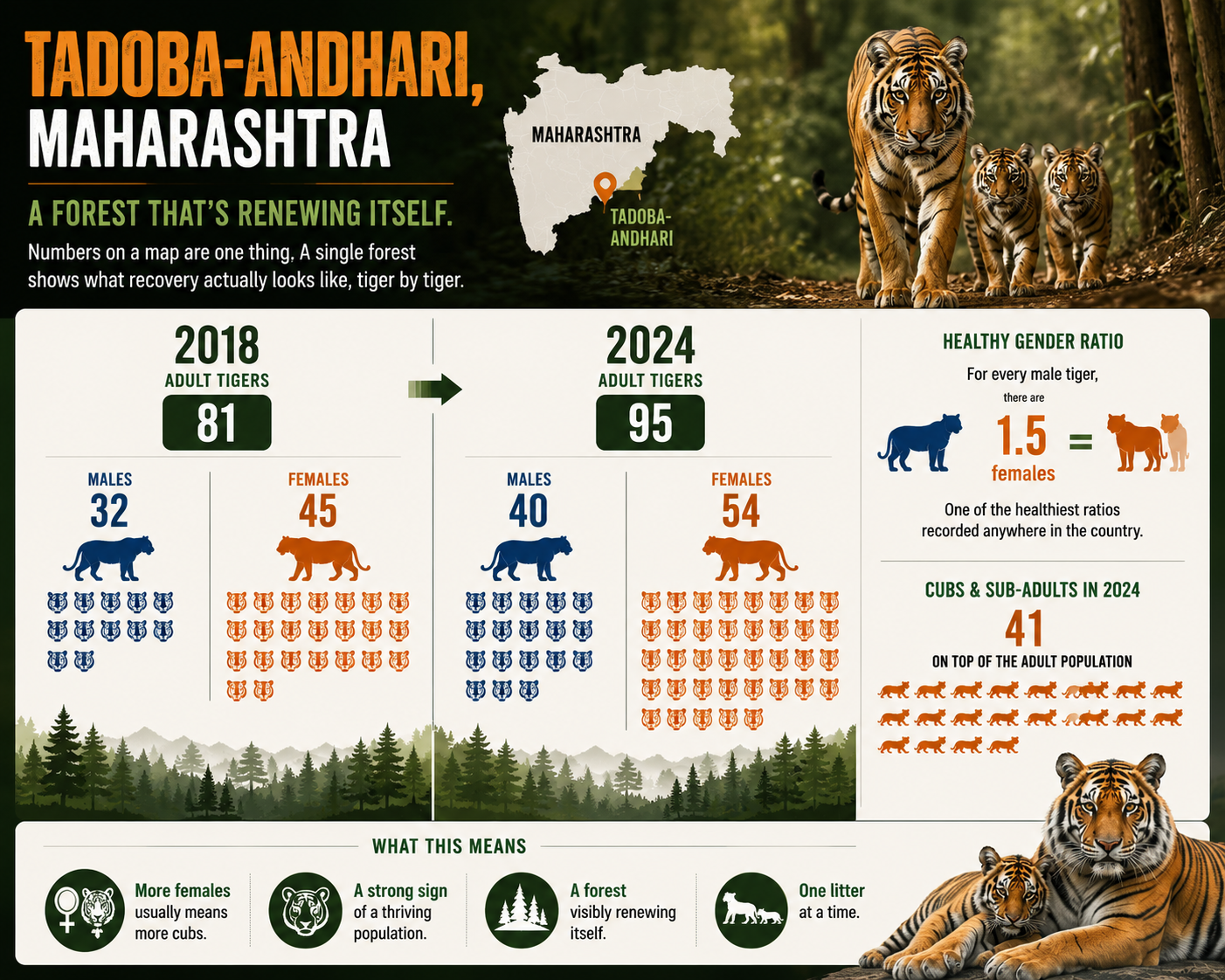
A healthy tiger population is about more than rising numbers. It needs breeding females, surviving cubs and enough space for young animals to establish territories of their own. Tadoba now reflects all three. Once known primarily as a good place to spot tigers, it has become one of India's most successful breeding landscapes, demonstrating that conservation is no longer just about preventing extinction. In forests like this, tiger populations are renewing themselves naturally, offering perhaps the strongest sign that the recovery is built to last.
The wealth of the wild
For years, tiger conservation was seen as a cost. Increasingly, it is being recognised as an investment.
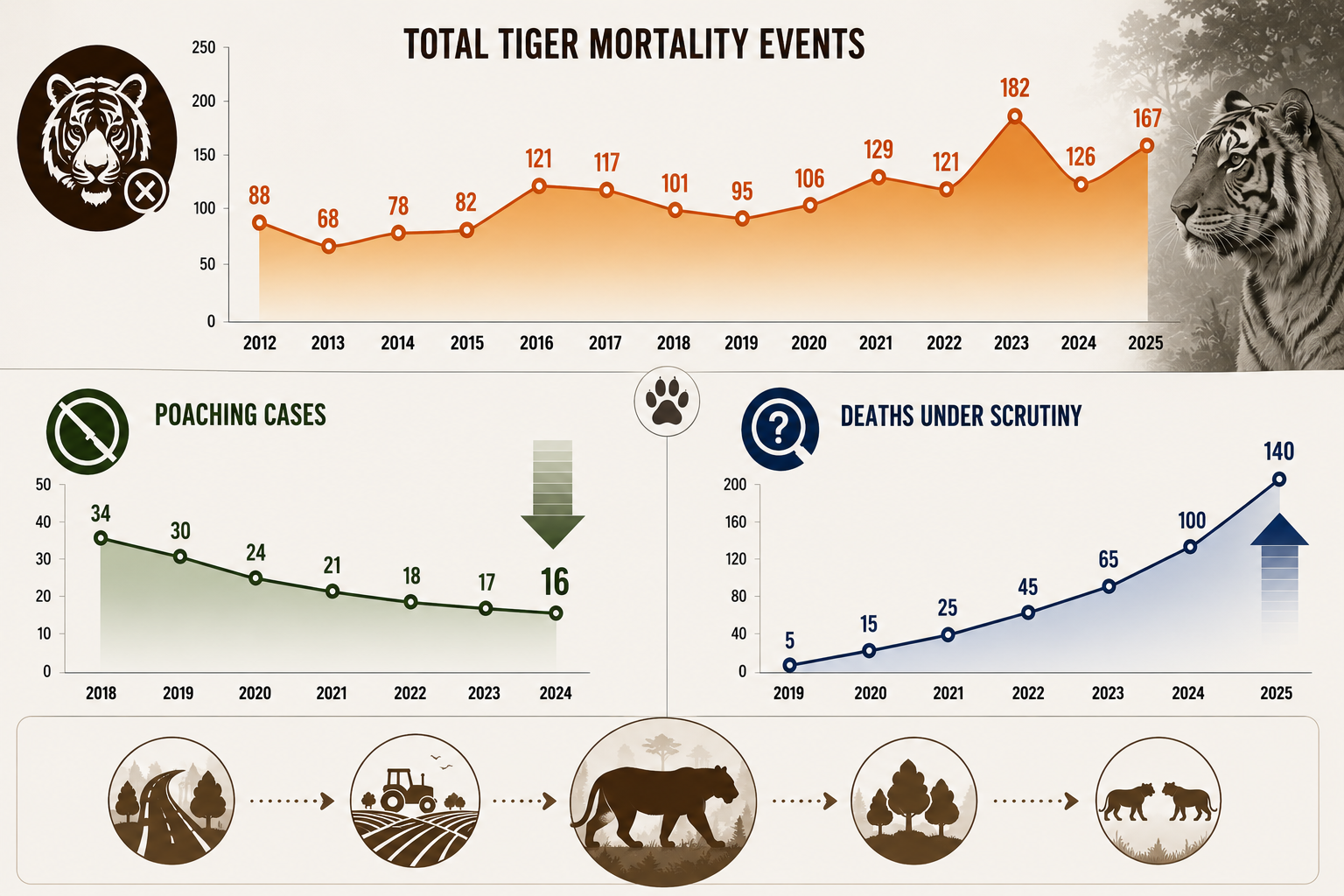
A 2019 study by the Indian Institute of Forest Management and the National Tiger Conservation Authority attempted to measure the economic value of tiger reserves. It found that their contribution extends far beyond wildlife. Healthy forests store carbon, protect watersheds, conserve soil, support biodiversity and sustain livelihoods, generating benefits that run into lakhs of crores of rupees every year. Tourism is simply the most visible part of that equation. Around reserves such as Ranthambore, Corbett and Tadoba, hotels, safari operators, guides, drivers and local businesses all depend on thriving tiger populations. The tiger has become more than India's flagship species. It is also an engine of rural economies, proving that conservation and development can reinforce each other rather than compete. India's tiger recovery has brought with it a new set of challenges. As tiger populations expand beyond the boundaries of protected reserves, they increasingly encounter villages, highways, farms and one another. Conservationists now spend as much time managing conflict as they do protecting the animals themselves. The greatest threat is no longer simply preventing extinction, but ensuring that a growing tiger population can continue to share an increasingly crowded landscape with people. Success, in other words, has made conservation more complex, not less. July 29 is International Tiger Day. India's tiger recovery did not happen by chance. It was built on decades of political commitment, scientific monitoring and sustained conservation. When older methods of estimating tiger numbers proved unreliable, the country adopted more rigorous techniques and accepted a far smaller count. It expanded protected habitats, strengthened anti-poaching efforts and, every four years, measured its progress with greater accuracy. The result is one of the world's most remarkable conservation success stories. Few countries have managed to bring a large predator back from the brink on this scale. India has. But no conservation story is ever truly finished. A growing tiger population now faces new pressures from expanding infrastructure, shrinking habitats and increasing encounters with people. The next chapter will not be about bringing tigers back. It will be about ensuring they continue to have enough space to survive and thrive. Somewhere tonight, a camera trap in an Indian forest will capture another tiger slipping silently through the darkness. It is an image that was once becoming increasingly rare. Today, it has become a symbol of what determined conservation can achieve and of the responsibility to protect that success for generations to come. The other side of success
Why this story matters