The riot years that young India never saw
Visualisation
At a Glance
The riot years that young India never saw
For much of today's younger generation, riots are something they have seen only in old news footage, documentaries or Bollywood films—not something they have experienced firsthand. Their parents and grandparents remember a very different India, where curfews, burning streets and communal clashes were unsettlingly familiar. That contrast is no accident. Over the past decade, India's streets have grown noticeably quieter, the result of changes that are easy to overlook because they unfolded gradually rather than all at once.
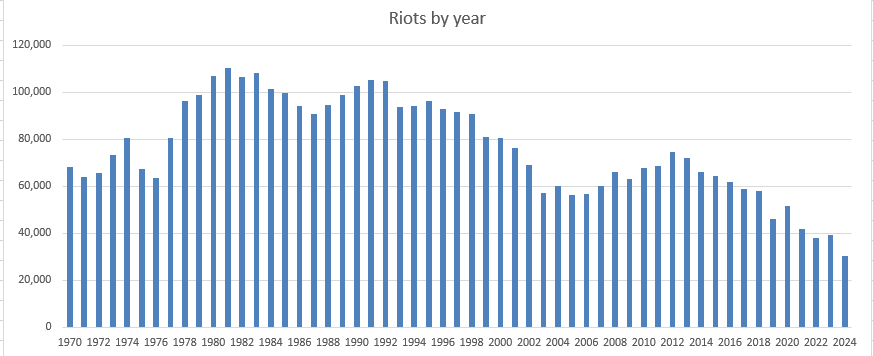
The numbers tell the story. Riot cases recorded across India fell by 46%, from 72,126 in 2013 to 39,260 in 2023. By 2024, the figure had dropped further to 30,348, the lowest since official records began in 1953.
Behind those statistics lies one of India's least-discussed transformations. An entire generation has grown up assuming peaceful streets are the norm, rarely pausing to consider what it took to make them that way. Sometimes, the biggest changes in a country are not the ones that dominate the headlines, but the ones that quietly reshape everyday life.
The India of 1970 was a different country
Riots were not exceptional headlines. They were a recurring feature of everyday life. A land dispute could erupt into mob violence. A political rally could descend into clashes. A rumour could set entire neighbourhoods ablaze.

In 1970 alone, India recorded 68,331 riots. That works out to nearly 190 riots every single day.In 1981, the country recorded 110,361 riots, the highest annual figure ever documented, before or since.
The assassination of Prime Minister Indira Gandhi in 1984 triggered horrific anti-Sikh violence in Delhi and several other cities. Thousands of families were affected, and the scars remain visible even today. For those who lived through those decades, unrest was not an occasional disruption. It was part of the national landscape.Try to imagine that. Basically every day, somewhere in the country, something was burning. That was normal life for your parents or grandparents. And then it just… stayed bad, for a really long time
Behind these defining national events lay a broader reality: year after year, riot numbers remained persistently high, refusing to decline.
The slow return of stability
The first meaningful shift appeared during the 2000s. The decade averaged around 64,000 riots annually. The numbers were still substantial, but for the first time they were moving consistently downward. The 2010s broadly sustained that trend.
Comprehensive state-wise riot data is available only from 2001 onwards, but even within that shorter period, the pattern is remarkably consistent. Take Uttar Pradesh, long associated with communal and political unrest. The state recorded 7,343 riots in 2001.By 2024, it had fallen further to 2,610, nearly two-thirds lower than a decade earlier. Apart from UP, West Bengal, Bihar, Karnataka Kerala, Maharashtra too witness similar trend. Such widespread declines across states with vastly different political histories and social compositions suggest something larger than coincidence. There is, however, one major exception. For more than two decades, from 2001 to 2022, Manipur remained comparatively stable, recording between 35 and 165 riot cases annually. Then came 2023. The number surged to 5,421 before falling back to 273 in 2024. The Manipur violence, however, belongs to a different category from much of the historical pattern discussed here. It arose primarily from a complex ethnic conflict between the Meitei and Kuki communities, centred on questions of land, identity and tribal status. Unlike the communal or politically driven riots that shaped much of India's earlier history, the Manipur crisis was rooted in local ethnic dynamics. State-level data from the 1970s is unavailable, making long-term comparisons impossible. What the available data does show is that more than two decades of relative calm were disrupted by one intense, geographically concentrated conflict rather than by a nationwide resurgence of riot-related violence. So what does this actually mean for you If you were born after 2000, your whole life has happened during the calmest stretch this data has ever recorded. You've never lived through a hundred-thousand-riot year. 1984 isn't a memory, it's a paragraph you skimmed once. Not your fault. But it leaves a blind spot. You know the number down 46%, down 54% without ever knowing what the other half actually felt like. It's not about pinning blame on one community, government, or party. The real history is too tangled, full of communal violence, caste conflict, and local disputes that resist a single villain. The real lesson: the calm wasn't automatic. It was built, decade by decade, and it has to be maintained on purpose, every year. India didn't get quiet by accident. It got quiet by fixing something, slowly, over fifty years. You inherited the result. The one thing you didn't inherit is the memory of what it cost, and that's worth going looking for. Possible reasons for decline Several factors may have contributed to the steady decline in riots over the past decade. Policing has become more technology-driven, with better intelligence gathering, CCTV networks, drones and digital surveillance enabling authorities to identify and contain potential flashpoints before they escalate. Governments have also adopted a more proactive approach, using preventive arrests, rapid deployment of security forces and stricter law-and-order measures to curb violence. At the same time, India's expanding economy and growing urbanisation have raised the costs of prolonged unrest, creating stronger incentives to maintain public order. While social and political tensions have by no means disappeared, many analysts argue that they are now more likely to play out online than on the streets, making large-scale riots less frequent than they once were. 
Compare 2013 with 2023 instead, and the decline stands at 46%. Whichever way the data is measured, the last decade represents the steepest and fastest sustained fall in riot cases in modern India's recorded history.
A country that once experienced more than one lakh riots in a single year now records less than one-third of that number. That is more than statistical improvement. It reflects a profound change in the country's internal security landscape.
Does the trend hold across the states? It does

Manipur stands apart and that matters
Sources
Frequently Asked Questions
How much have riot cases declined in India?
According to official crime data cited in the article, riot cases fell from 72,126 in 2013 to 39,260 in 2023, a decline of about 46%. In 2024, the number declined further to 30,348, the lowest since official records began in 1953.
Was India always this peaceful?
No. During the 1970s, 1980s and much of the 1990s, riots were far more common. In 1981, India recorded 110,361 riot cases—the highest annual figure on record.
When did India record the highest number of riots?
The highest number of recorded riots was 110,361 in 1981. That is more than three times the 30,348 cases recorded in 2024, highlighting how dramatically the country's internal security landscape has changed.