The silent shift: How BRICS overtook the G7 in real economic power
Visualisation
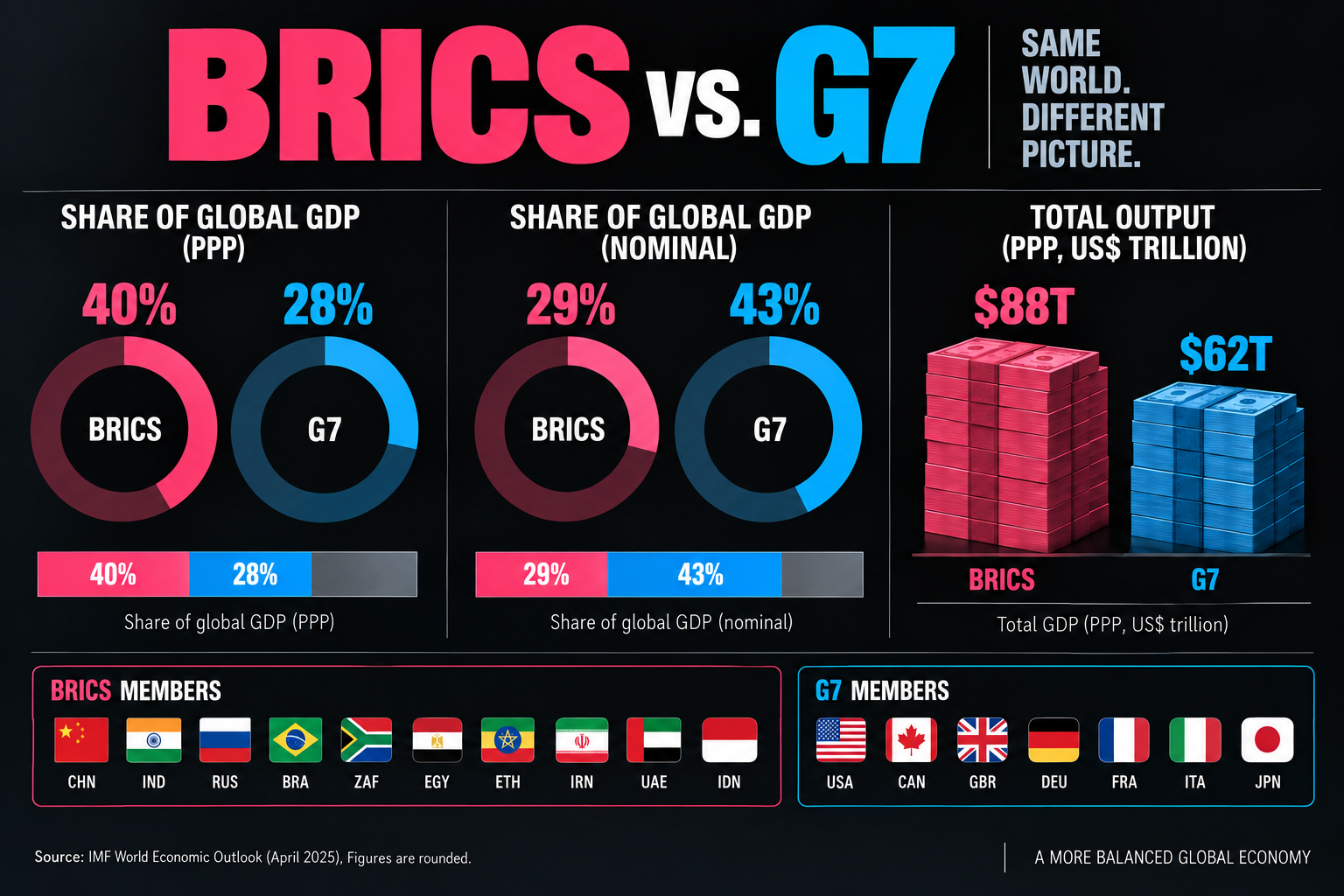
At a Glance
In 2018, something remarkable happened that almost nobody noticed. Two economic titans, the G7 and BRICS, hit the exact same number: both held 30.8 per cent of global GDP, measured in Purchasing Power Parity (PPP). No bell rang. No headline ran. But that was the year the trendlines crossed – and once a line crosses on a chart like this, it rarely goes back. Look closely at the data and the pattern is striking. In 2012, BRICS held about 28 per cent of global GDP in PPP terms, while the G7 held nearly 33 per cent. By 2026, BRICS sits at 40 per cent while the G7 has slipped to 28 percent. The gap hasn't just closed; it has completely inverted.
The Milestone Year
Some years matter more than others in a structural shift like this. Take 2023. That was the year the G7's share of world GDP fell below 30 per cent for the first time in modern economic history, not a temporary dip, but a historic precedent. .
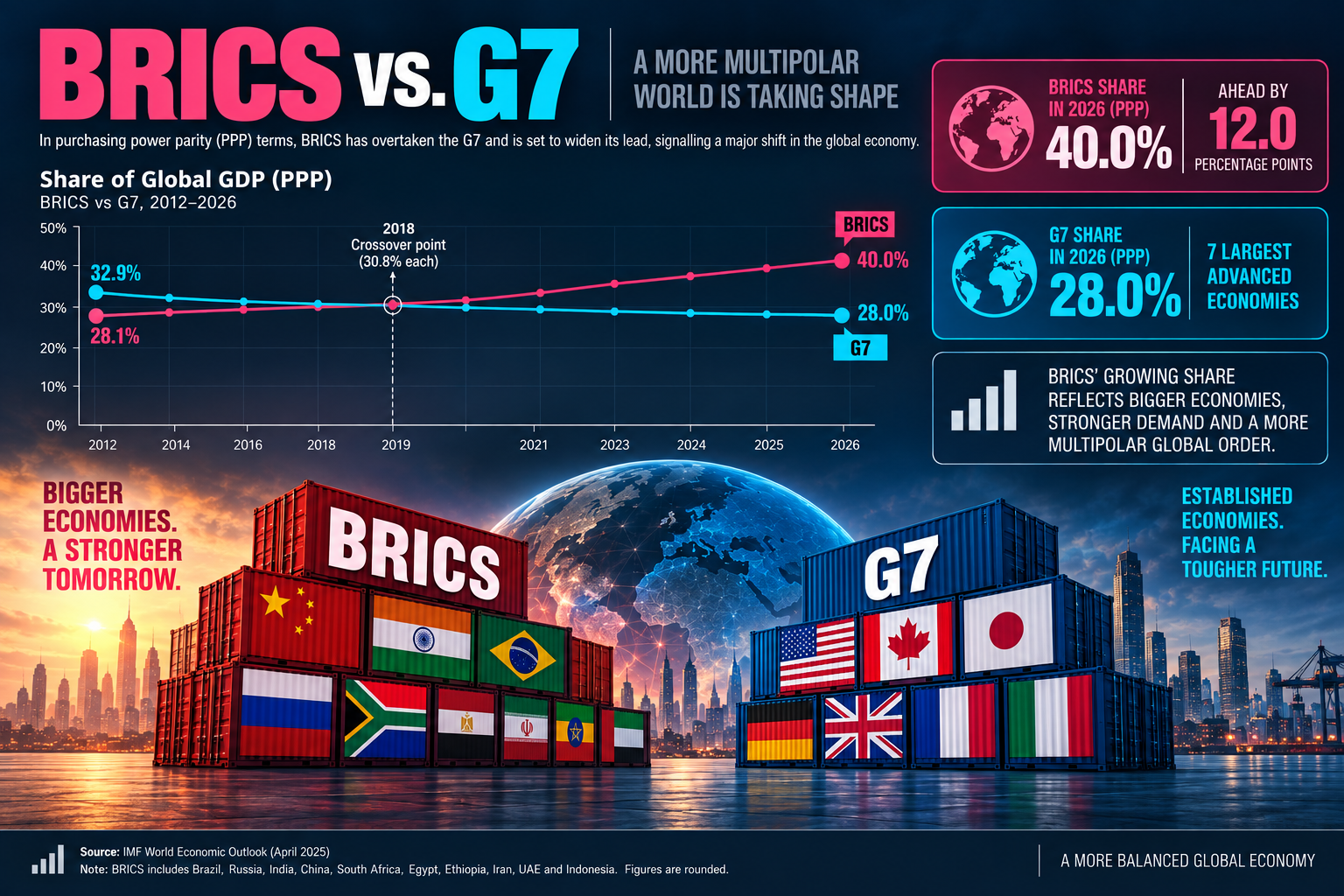
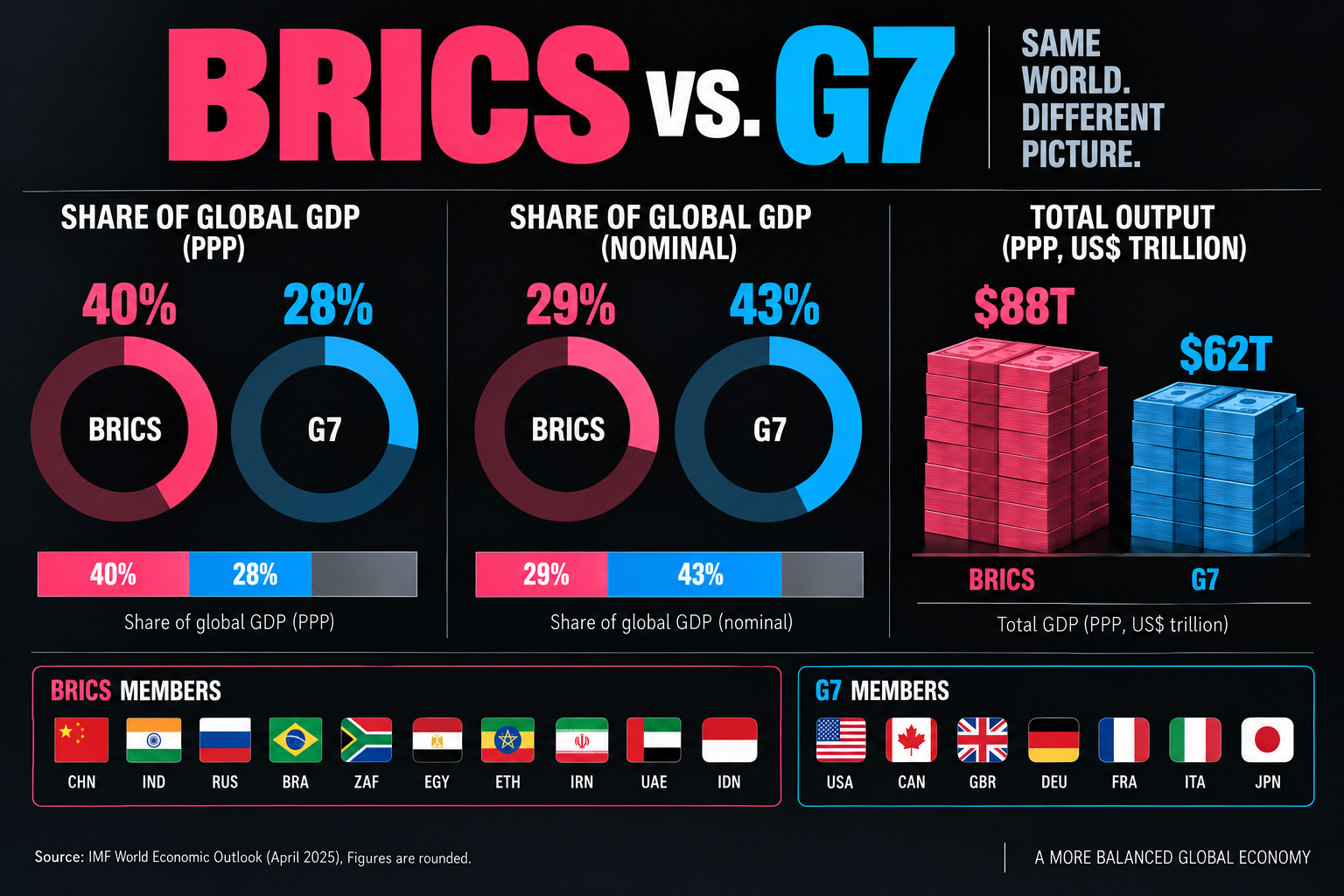
Then came the bloc's rapid expansion. In 2024, Iran, Egypt, Ethiopia, and the UAE joined BRICS. In 2025, Indonesia followed. There was no ceremonial expansion. Today, these eleven nations pool an economic output that has crossed $88 trillion, compared to the G7's $62 trillion. Every new member adds immediate weight to a scale that was already tilting.
The catch: Real world vs. paper markets
Before drawing definitive conclusions, there is a crucial caveat. In nominal dollar terms – which strips away local purchasing power – the picture reverses entirely. The G7 still controls 43 percent of global nominal GDP, while BRICS holds 29 per cent.So which metric is real? Both—they simply measure different dimensions of power. PPP reflects what nations can actually buy, build, and produce inside their own borders. Nominal GDP measures how international banks and capital markets value these economies in US dollars. BRICS is winning on the ground; the G7 retains dominance on paper. An honest assessment requires holding both realities at once.
Scale without full efficiency
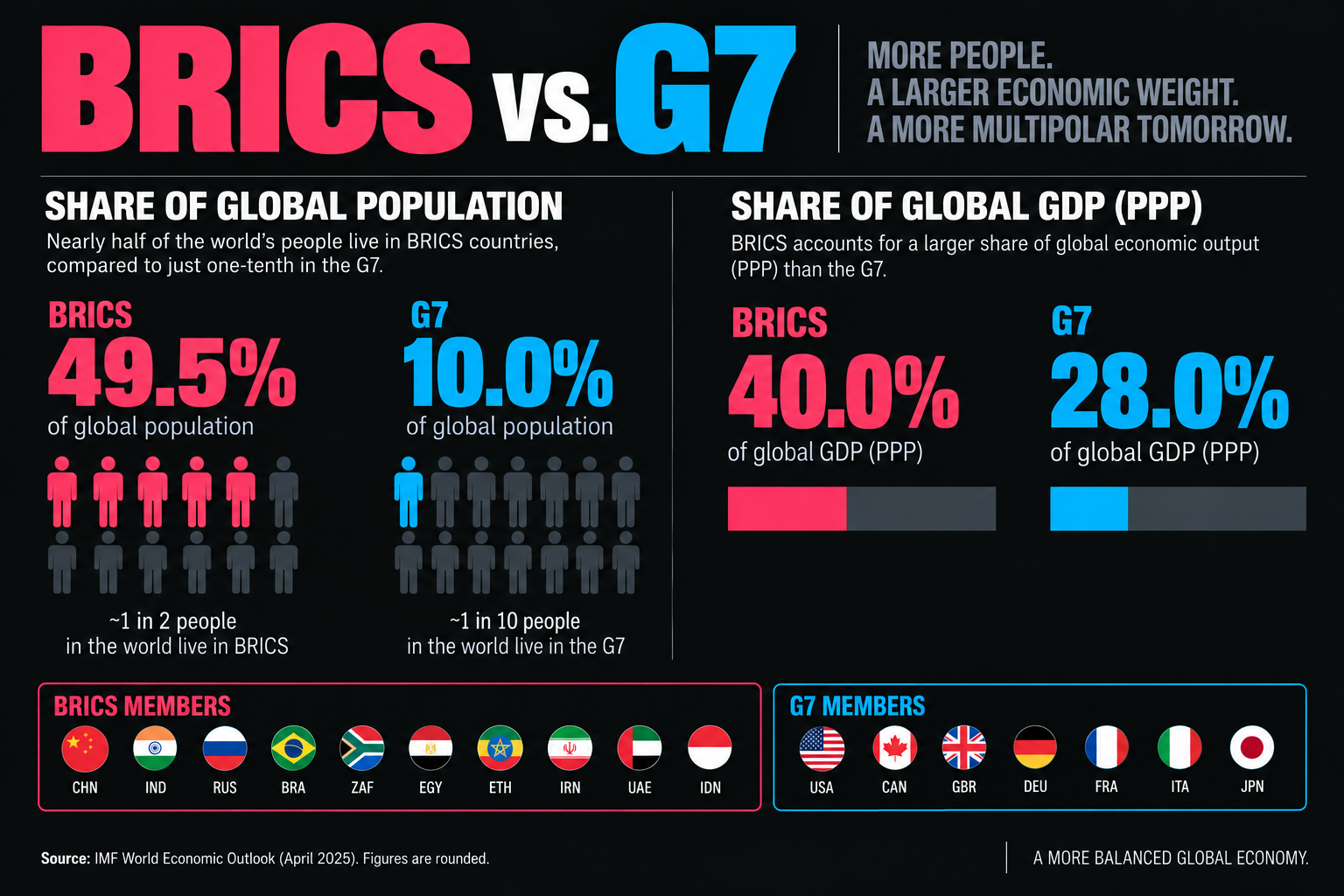
There is another stat worth examining. BRICS represents nearly half the world’s population at 49.5 per cent. Yet, its share of PPP-adjusted GDP sits at 40 per cent.That gap reveals a key vulnerability: the bloc has scale, but it has not yet converted that sheer human volume into maximum economic productivity. Scale came first; efficiency is still catching up.
Who controls what the world needs
Beyond macroeconomics lies a critical supply-chain reality: who actually controls the baseline resources required to run the modern world?
Start with energy. BRICS controls 42 percent of crude oil production, sits on 50 percent of natural gas reserves, and produces 78 percent of the world's coal. The G7 is nowhere close on any of these fronts.
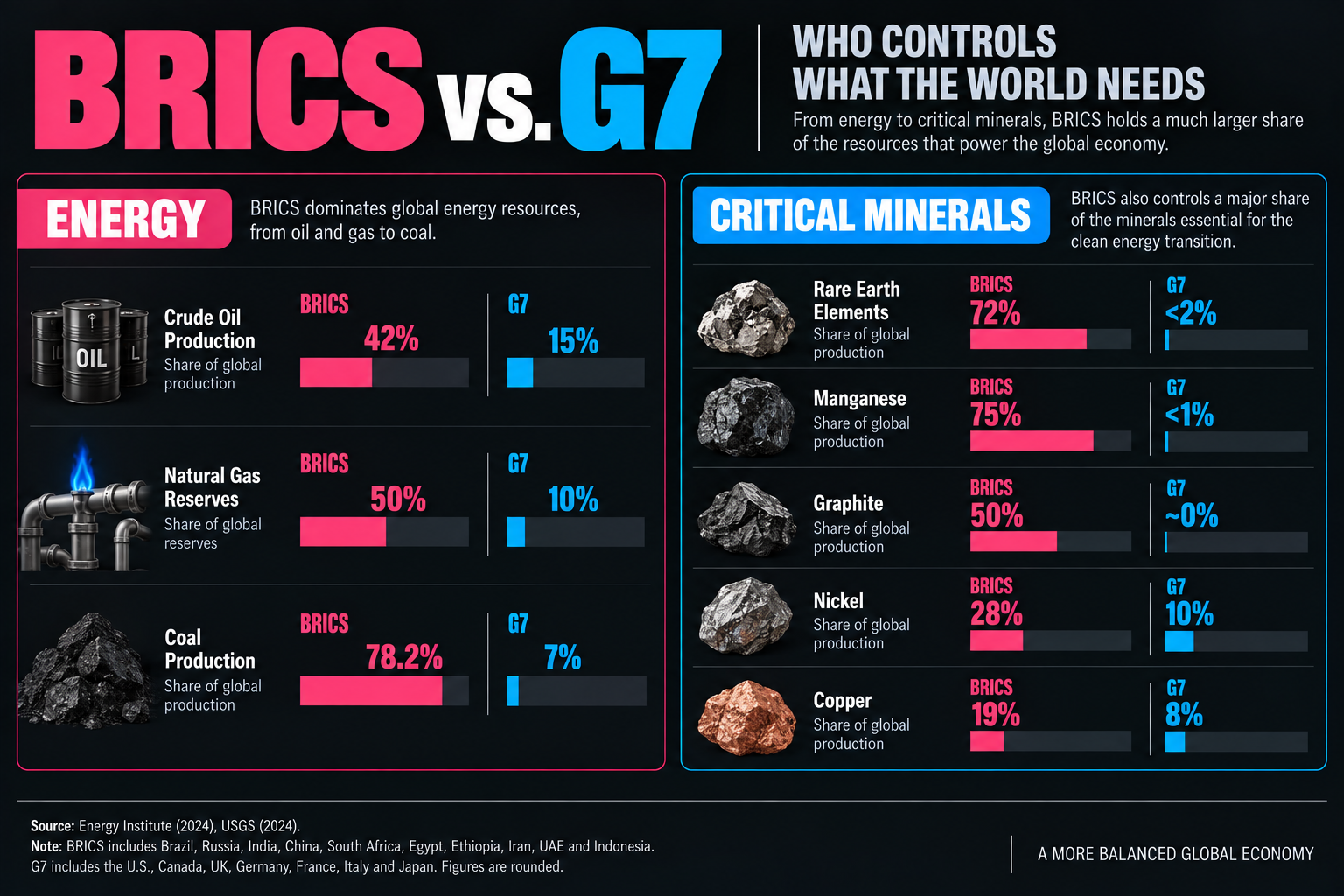
Then consider critical minerals – the unseen backbone of modern tech. In rare earth elements, BRICS controls 72 per cent of global mining, while China alone refines almost 90 per cent of the global supply. That means virtually every smartphone, missile guidance system, and wind turbine produced in the West runs through a Chinese refinery.
BRICS also controls 75 per cent of global manganese and nearly half of the world's graphite – a core component of electric vehicle batteries, where the G7's share is near zero. These unglamorous commodities rarely make headlines, but they dictate who builds the next generation of technology.
Food on the Table
Food tells a similar story, and this one hits closer to home than mineral charts usually do. Rice: BRICS controls 52 per cent, the G7 barely 1 per cent. Wheat: 42 per cent against 24 per cent. Only soybeans stay genuinely competitive, with Brazil and the United States running close, 46 percent to 33 per cent.
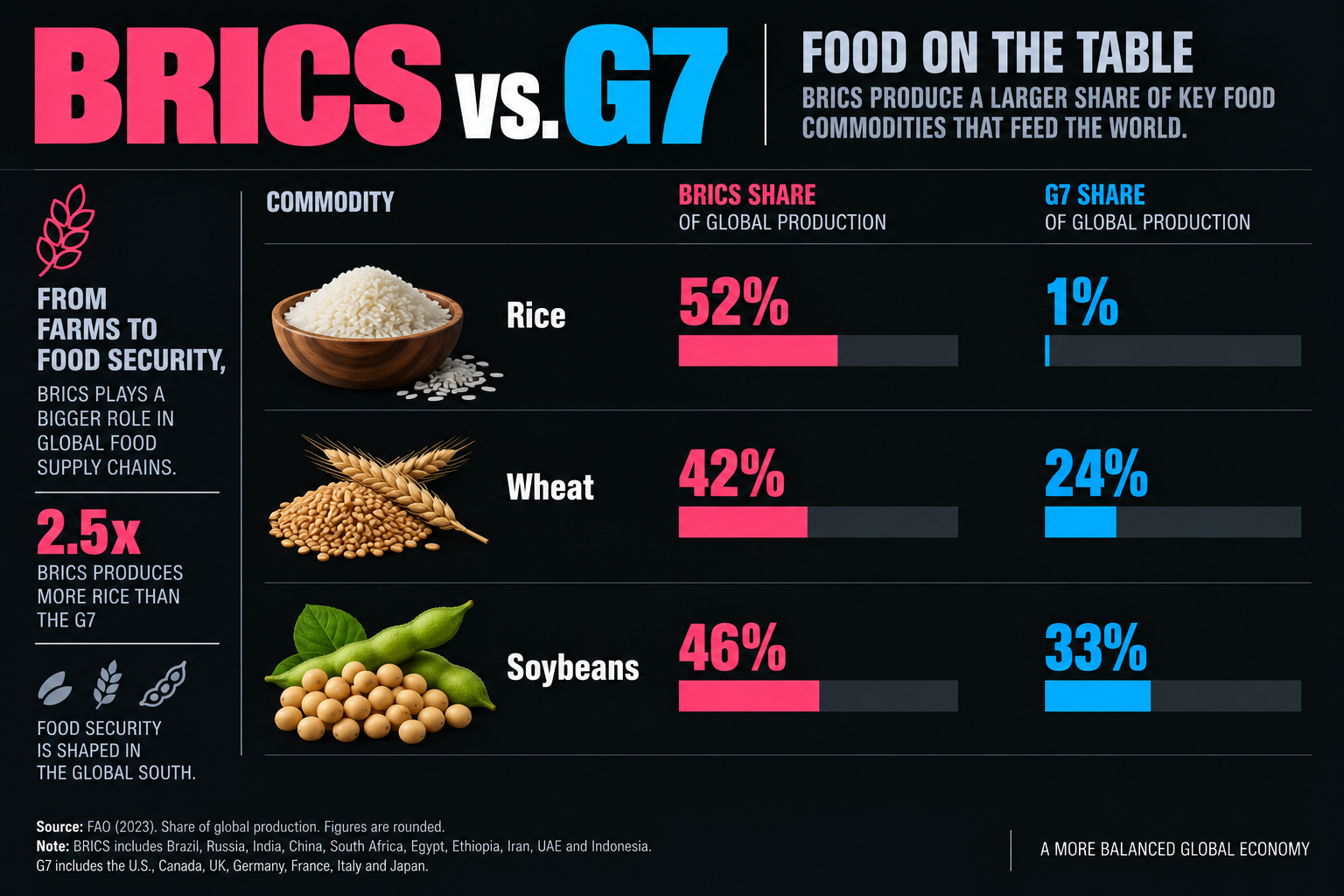
This is not an abstract statistic for economists to argue over. It decides what half the planet eats and at what price.
Trade: The next threshold
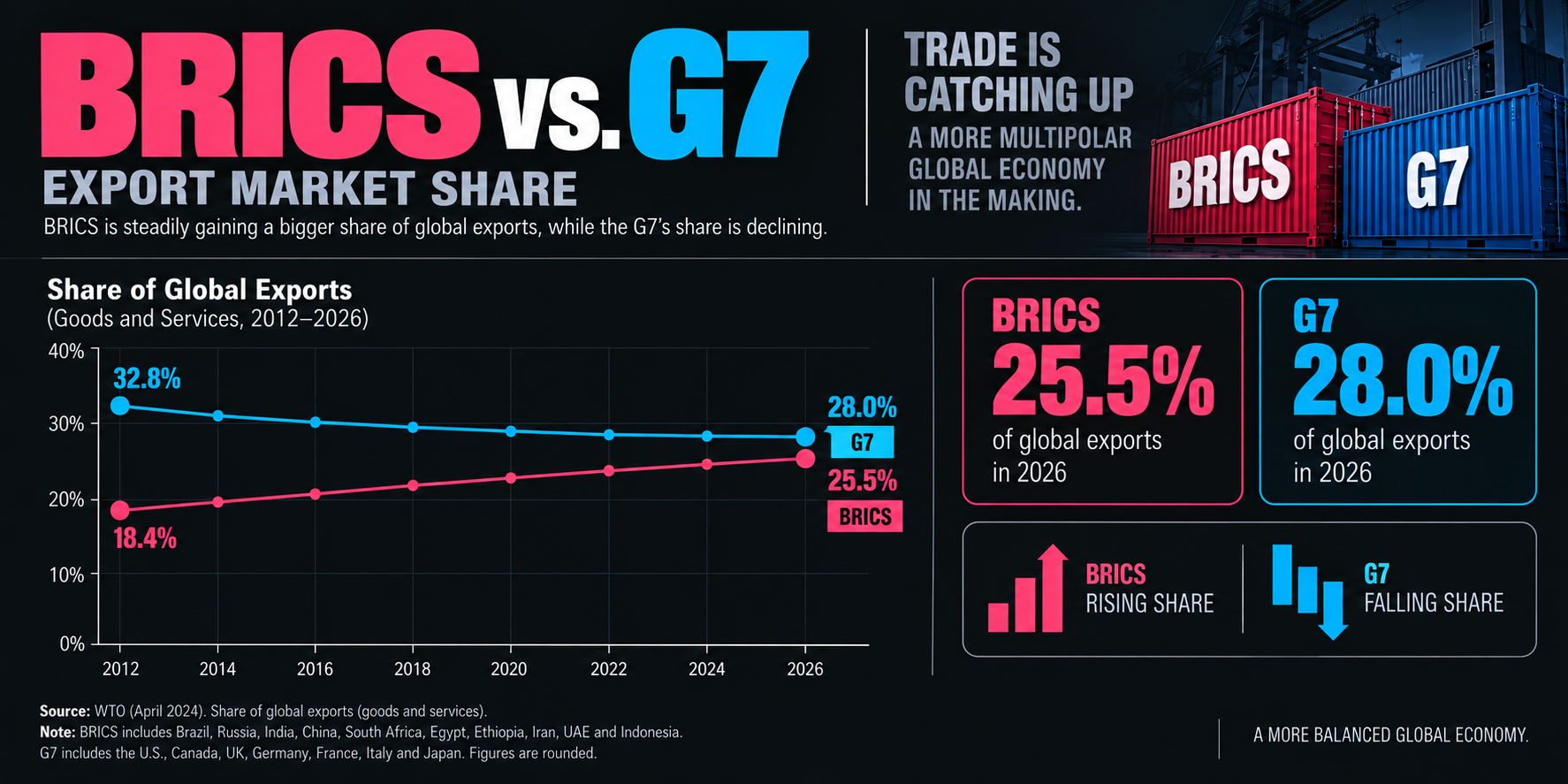
Global trade share is shifting along the same trajectory, albeit at a slower pace. BRICS’ share of global exports is rising toward 25.5 per cent, while the G7’s share has fallen to 28 per cent. The trendlines are converging, pointing toward an inevitable crossover if current trajectories hold.
De-dollarisation: evolution, not revolution
This shift is often mischaracterised as a coordinated attempt by BRICS to immediately destroy the US dollar. That narrative misses what is actually happening.
There is no unified "BRICS currency" in development. Instead, the strategy is quieter and more pragmatic. Member states are shifting to local-currency trade and building alternative, lower-cost payment rails to bypass Western clearing systems. The 2024 Kazan Declaration and 2025 Rio Declaration outline a clear path: not the sudden replacement of the dollar, but a systematic reduction in dependency upon it.
It isn't a frontal assault on American financial dominance; it is a gradual diversification away from single-point vulnerability..
The economic landscape ahead
Economic hegemony rarely collapses overnight. Shifts happen incrementally, possibly one percentage point, one trade route and one supply contract at a time.
The data highlights a clear reality: BRICS produces a dominant share of the physical goods, energy, and food required to sustain the global economy, and its output share has overtaken the G7's.
However, resource control does not automatically equate to structural financial power. The G7 still writes the rules of global finance, maintains the deepest capital markets, and issues the world's primary reserve currencies. That institutional advantage will not dissipate overnight.
What we are witnessing is not a sudden coup against Western economic leadership, but a steady erosion of its exclusivity. Whether BRICS can turn raw physical output into a lasting geopolitical framework depends on political choices still unfolding across Beijing, Brasília, New Delhi, and Washington.
The data shows the trajectory, but its ultimate destination remains to be written.