The steel giant: How India built its way to global #2
Visualisation
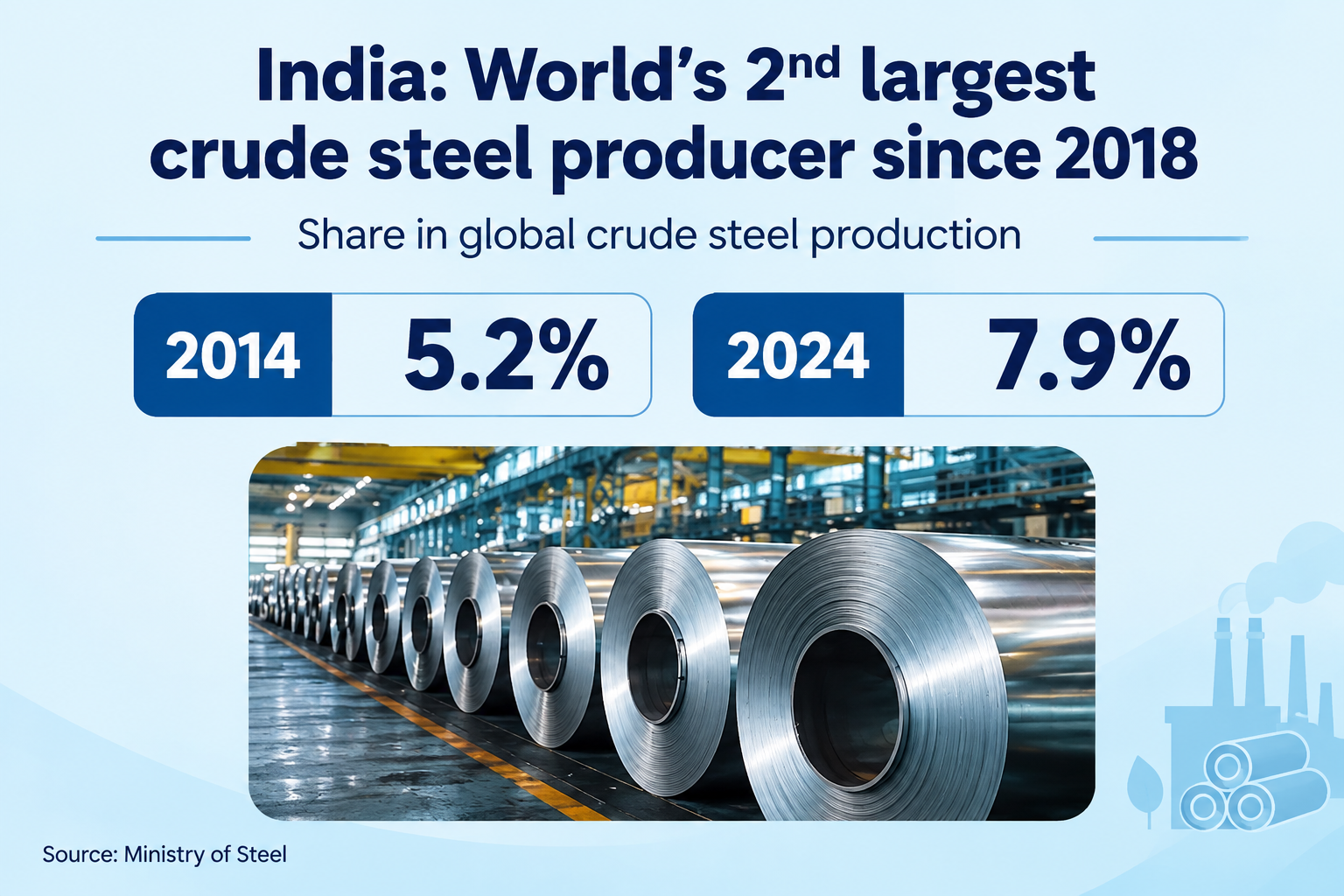
At a Glance
India’s steel industry has undergone substantial expansion over the past decade and a half, supported by rising domestic demand and investment in manufacturing capacity. The change has been more than an increase in production from existing plants, with new capacity and modernisation helping strengthen the country’s position as a major global steel producer.
Between 2010 and 2026, steel production followed a varied trajectory, with periods of steady growth followed by the disruption caused by the COVID-19 pandemic and a subsequent recovery.
Crude steel output increased from 68.3 million tonnes (MT) in 2010 to 110.92 MT in 2018–19. Production then eased to 109.22 MT in 2019–20 before falling to 99.57 MT in 2020–21 as the pandemic disrupted construction, manufacturing and industrial activity. Output recovered thereafter as economic activity resumed and demand from infrastructure, automobiles and other steel-consuming sectors strengthened.
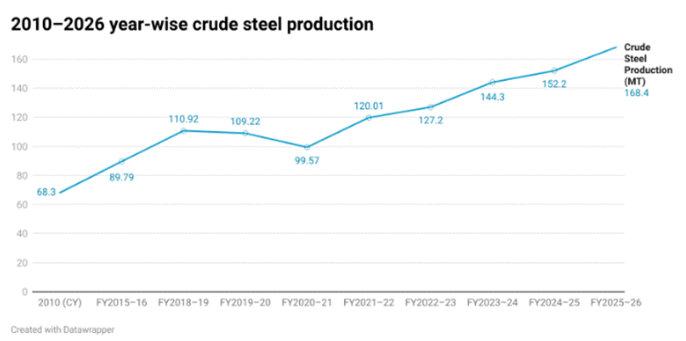
The rebound, however, set new benchmarks. Powered by aggressive public spending on mega-projects — highways, high-speed rail, and large-scale housing initiatives — alongside targeted manufacturing incentives like the Production Linked Incentive (PLI) scheme, output surged. Official figures show a steep upward trajectory: 120.01 MT in 2021–22, 144.3 MT in 2023–24, and a record peak of 168.4 MT by 2025–26.
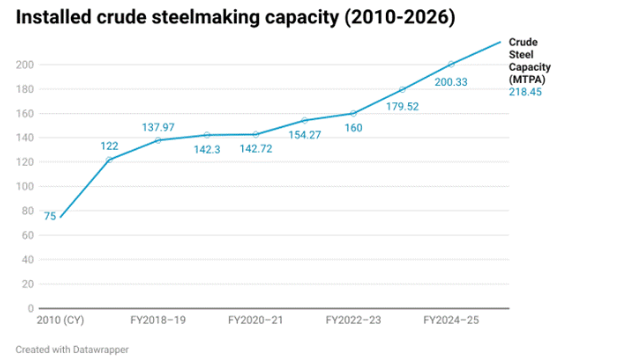
The capacity expansion tells an even bigger story. Around 2010, total domestic capacity sat at roughly 75 MT. As rapid urbanization collided with the government's push to modernize national infrastructure, demand spiked. Millions moving into cities created an insatiable need for housing, factories, and vehicles, driving installed capacity to 137.97 MT by 2019.
India’s factories could only make 75 million tonnes of steel a year. But as the government started a massive push to modernise the nation, the steel demand skyrocketed. Millions of people moved to cities, creating a huge need for new apartment buildings, factories, and cars. To match this energy, steel capacity climbed quickly to 137.97 million tonnes by 2019. Even when global challenges arose, India didn't falter.
Rather than pulling back during post-pandemic global economic headwinds, the government doubled down.
The National Steel Policy 2005 focused on building capacity and encouraging investment. The National Steel Policy 2017 raised the ambition substantially.
Through frameworks like the National Steel Policy, policy support lowered expansion risks and encouraged local producers to scale aggressively. Total capacity rapidly cleared the 200 MT threshold, eventually touching 218.45 MT.
That domestic foundation gave India a major strategic edge. While traditional manufacturing heavyweights like Japan saw production plateau or contract, India leveraged two distinct assets: an immense internal market and vast, accessible domestic iron ore reserves.
Sailing past established industrial powers to claim the #2 spot globally is a major milestone, but scale alone isn't the final destination. The real test for India's steel sector over the next decade will be moving up the value chain—pivoting from raw volume toward domestic production of advanced specialty steels and high-grade alloys needed for advanced manufacturing.
Sources
1. https://www.pib.gov.in/FeaturesDeatils.aspx?NoteId=153290®=48&lang=2
2. https://www.pib.gov.in/PressReleasePage.aspx?PRID=2258028®=3&lang=1
3. https://www.pib.gov.in/PressReleasePage.aspx?PRID=2039000®=48&lang=2
4. https://www.pib.gov.in/PressReleasePage.aspx?PRID=2250022®=48&lang=2
5. https://beyondthefyp.com/infopack/india-is-the-worlds-no-2-steel-producer-whats-next