When Protecting Dharma Became a Crime: The Story of India’s Nomadic Tribes
Visualisation
At a Glance
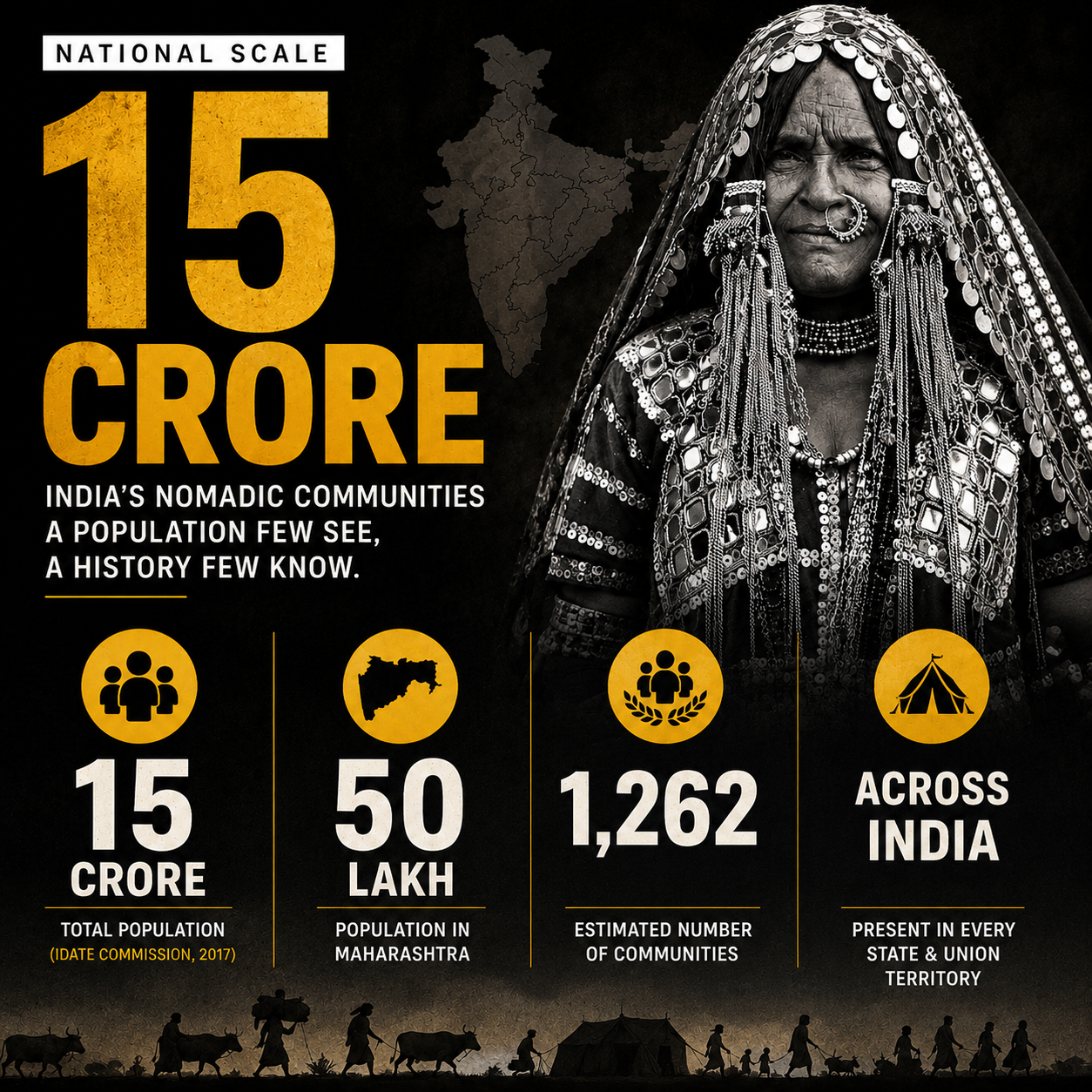
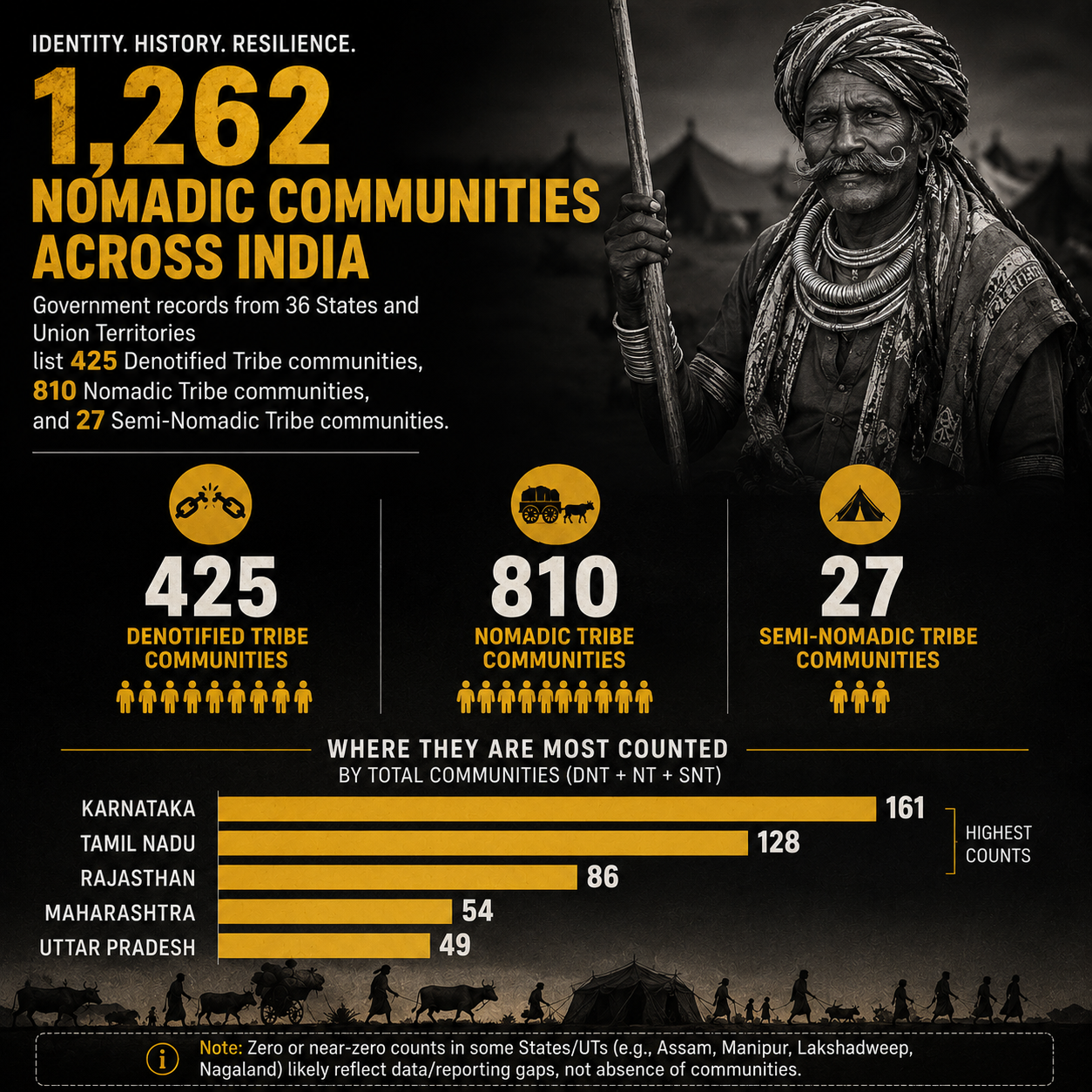
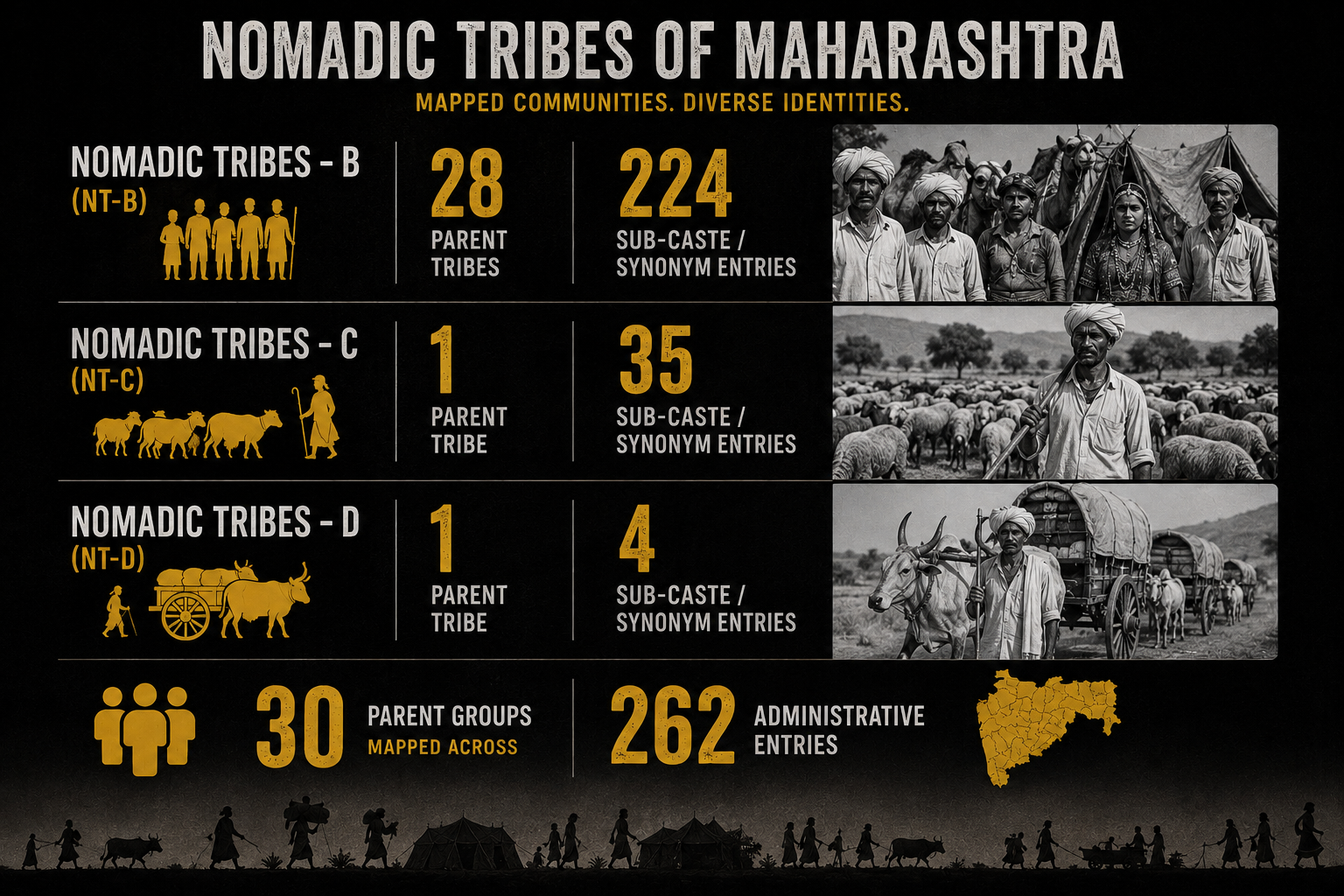
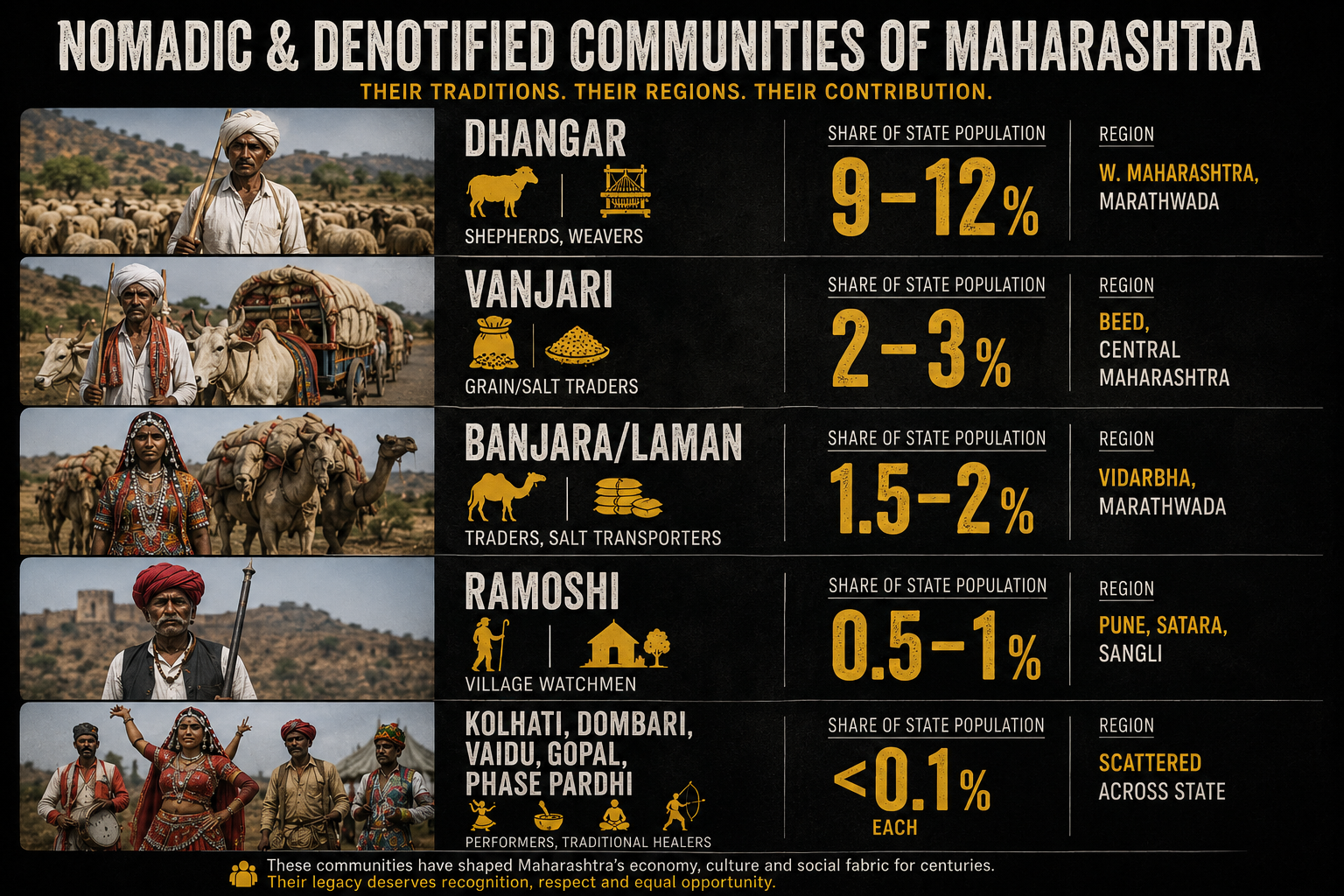
On 31 August 1952, India repealed the Criminal Tribes Act, 1871 – a colonial law that had branded entire communities as ‘born criminals’ for generations. But the story behind that label is rarely told. Many of these communities had fought to protect their traditions, territories and faith, often resisting forces that threatened their way of life, including missionary expansion during British rule. Instead of recognising that resistance, the colonial state turned suspicion into law and attached criminality to identity. People were watched, registered, restricted and punished simply for belonging to a community. The Act was repealed in independent India. Independent India eventually removed that label in 1952, five years after independence. The law disappeared. The stigma, however, did not disappear with the law. More than seven decades later, that leaves a larger question: Who were these communities that the British once considered dangerous enough to criminalise? Where do they live today? How many communities are there? And how many Indians still carry the consequences of that colonial history? The answer begins with a number surprisingly few people know. They are not a small population living on the margins of India’s story. Their numbers run into crores. Faces without a name So, who were the people declared as ‘criminal tribes’ by the British? Let’s take a few examples: The Ramoshi community, who stood guard over Deccan villages through the night while everyone else slept. The Bhil, who knew every ridge and gorge of the forests they lived in, and used that knowledge to fight, not to plunder. The Dhangar, who walked with their flocks across half of Maharashtra, season after season, asking nothing of the land but grass and water. The Vanjari, whose bullock caravans once carried grain to armies on the move. The Beldar and the Lohar, who cut stone and shaped iron for a living. Names that were once occupations, then identities, then a chargesheet under a colonial pen. These are not communities that appeared out of nowhere in some census registers. They had lived, worked, fought and prayed on this soil long before a foreign government decided their bloodline itself was a crime. The number that does not add up Ask how many people this history touches today, and the answer becomes a small scandal. The Idate Commission, set up by the Union Government, submitted its report in 2017 and placed the figure at close to 15 crore people, spread across an estimated 1,500 communities. Even the more conservative estimates put the number at around six crore nationally, with close to 50 lakh in Maharashtra alone. A population this size would rank among the more populous countries in the world. Yet, there is no permanent national commission with constitutional backing to look after their interests. The Idate Commission's own recommendation for one remains, years later, a recommendation. Government records from 36 States and Union Territories list 425 Denotified Tribe communities, 810 Nomadic Tribe communities, and 27 Semi-Nomadic Tribe communities. Karnataka and Tamil Nadu carry the highest counts. Assam, Manipur, Lakshadweep, and Nagaland report next to nothing of this population though these have a large number of Scheduled Tribe population. Nobody seriously believes these tribes do not exist in the North-East or the islands. An estimated 15 crore people, and the country cannot say for certain where most of them are due to lack of proper survey and records. A paper trail 30 families deep Maharashtra carries one of the largest populations of these once-criminalised communities, close to 50 lakh people, scattered across its plateaus, riverbanks and grazing tracts. In Maharashtra today, Dhangar remains the largest of these communities, an estimated 9 to 12 per cent of the state, still shepherding and weaving their way through Western Maharashtra and Marathwada. Malharrao Holkar, the man who built one of the mightiest Maratha military houses, was born a Dhangar, a ‘criminal tribe’, and the founder of a dynasty that fought empires. The two labels were never meant to sit together, and yet colonial history put them in the same sentence. The Vanjari, at 2 to 3 per cent, are still known around Beed for trade. The Banjara and Laman, at 1.5 to 2 per cent, once moved salt and goods across Vidarbha and Marathwada, and many still carry that memory in their family names. The Ramoshi, smaller in number, around 0.5 to 1 per cent, guarded the villages of Pune, Satara and Sangli through the night and it was precisely that closeness to arms and vigilance that made the British nervous enough to notify them first. Then there are the smaller communities that rarely make it into any conversation at all – the Kolhati, the Dombari, the Vaidu, the Gopal, the Faase Pardhi each under 0.1 per cent of the population, living off performance, traditional medicine and skills that a settled, salaried India no longer knows what to do with. There is something striking about what the 1931 Census recorded. The same colonial government that had branded many mobile communities as “criminal” had also counted them in large numbers. In Maharashtra alone, seven communities — including Bhoi, Dhivar, Dhimar, Dhangar, Hatkar, Kurub, Vanjari, Lohar and Beldar — together accounted for more than 13.3 lakh people. They were not outsiders to Indian society; they were pastoralists, boatmen, traders, craftsmen and carriers of traditions that connected villages and regions. But after 1931, there was no comparable national enumeration of DNT/NT/SNT communities. Today, estimates vary from 6 crore to 15 crore nationally, making a clean population comparison difficult. That raises a more important question: are these communities shrinking, or are they simply disappearing from the statistics? As traditional livelihoods decline and generations settle into a changing economy, the danger is not merely losing a number. It is losing communities, occupations and living traditions that have been part of India’s civilisational fabric for centuries. 74 years, and still counting Every year, ‘Vimukti Diwas’ observed on August 31 to mark the repeal of the British-era Criminal Tribes Act asks the same quiet question: Was this freedom actually delivered, or only announced? They were called warriors once. Then the British called them criminals. Independence changed the ruler. It did not immediately change the reflex. The government that took charge in 1947 undid much of what the British had built, yet the Criminal Tribes Act was allowed to stand for five more years, as if nobody quite knew how to argue against a law simply because the people who wrote it were now gone. That was the first failure. The second was worse. When the Constitution was being drafted, when every other community found some mention, some safeguard, some line written in their name, these tribes found none. A nation writing its founding promise to itself somehow forgot to write-in the people it had inherited as ‘criminals’ from the very empire it had just defeated. It has taken decades, commissions, and committees, many of them only now taking shape to even begin correcting that omission, to bring these communities into the mainstream and hand back a measure of dignity that should never have been taken from them in the first place. Seventy-four years on, that correction is still a work in progress, not a fulfilled promise. What a colonial census could not hide
Sources
Tags
Frequently Asked Questions
What do NT-B, NT-C and NT-D mean?
They are Maharashtra’s administrative categories for Nomadic Tribes. NT-B covers 28 parent groups, while NT-C and NT-D each cover one parent group — Dhangar and Vanjari respectively.