Who Is Driving India’s Electric Revolution?
Visualisation
At a Glance
Not long ago, electric vehicles were a novelty in India. Showrooms kept one tucked into a corner, more for photographs than sales. Buyers looked, smiled and went back to the petrol pump.The change came slowly, one incentive at a time. National schemes brought prices down. States added their own subsidies and policies. FAME, and later PM E-DRIVE, reduced the upfront cost. Taxes on electric vehicles fell sharply. None of these changes was dramatic enough to make headlines on its own. Together, year after year, they changed the market. That is how big changes often arrive. Not with noise, but with patience.
Then the numbers took off
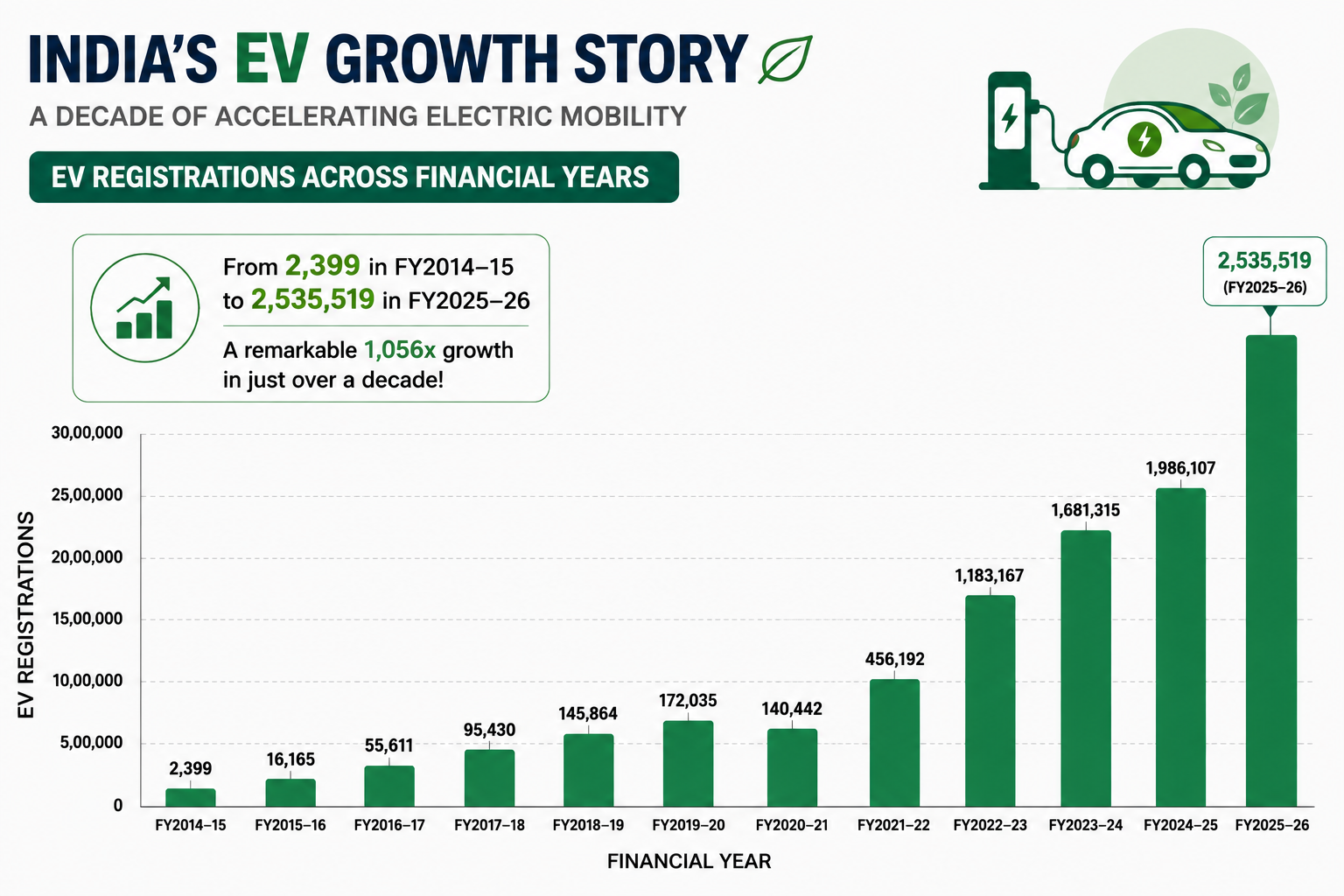
In 2014-15, India registered fewer than 4,000 electric vehicles in an entire year. An EV on an Indian road was still a curiosity. People turned to look. Some stopped to ask the owner questions, half curious, half doubtful. By 2025, that stranger had become a neighbour. India registered more than 25 lakh electric vehicles in the financial year, taking the annual number from 4,000 to 25 lakh in roughly a decade — a leap that would normally take a generation.
Those 85 lakh vehicles are not spread evenly. The story is overwhelmingly about two- and three-wheelers. Scooters and rickshaws have carried the shift, while cars and buses have played a much smaller role. Add up every electric vehicle registered so far and the total is roughly 85 lakh. Each one means less petrol bought, less money spent on imported oil and more money retained by Indian households.
What carried the shift
That pile of eighty-five lakh vehicles doesn't spread out evenly. It leans almost entirely toward two wheels and three. The scooter and the rickshaw carry this revolution on their backs, while the car and the bus barely lift a finger.
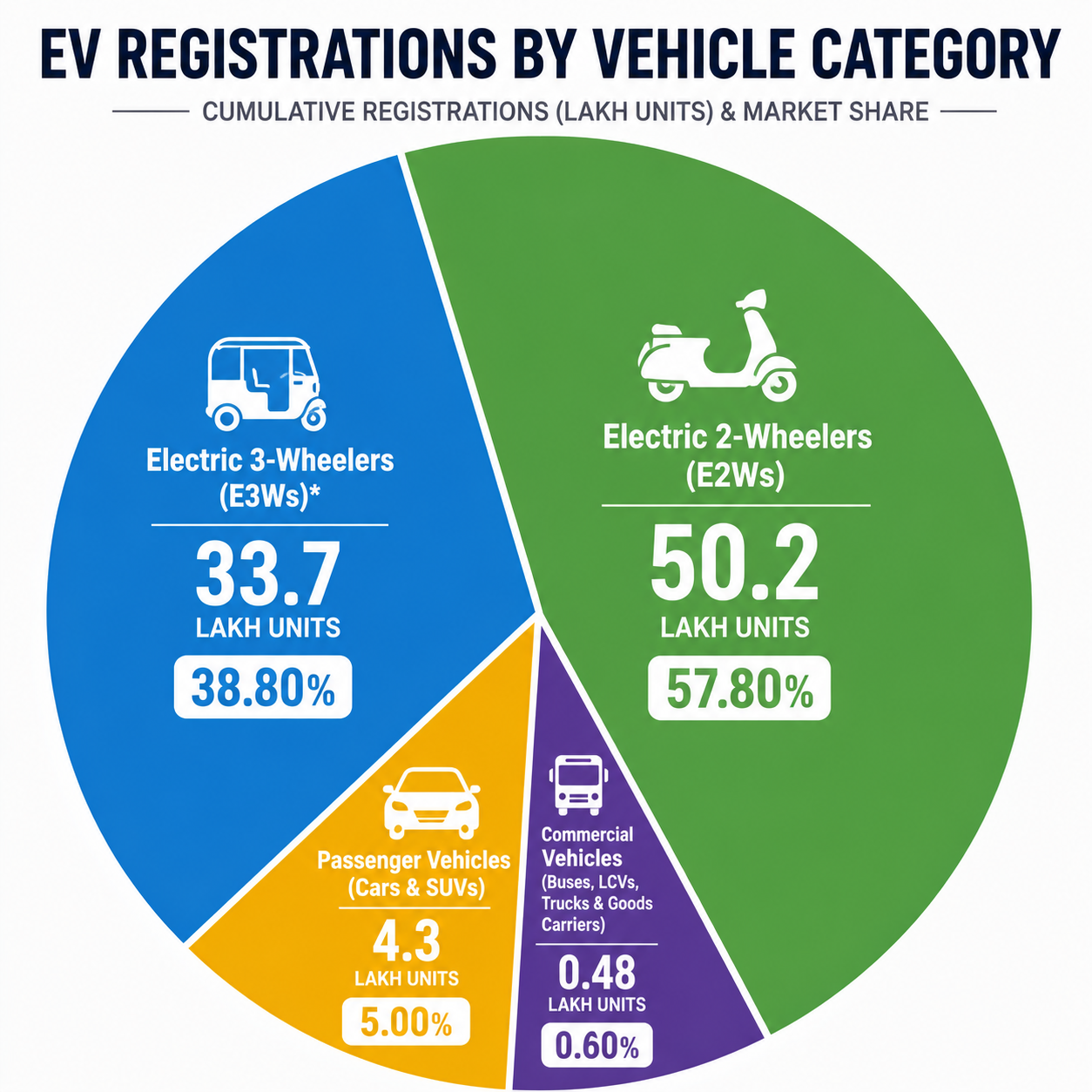
That tells us something important. India’s electric transition did not begin in showrooms serving the wealthy. It began with the daily commute and the daily wage, where saving a rupee matters more than a badge on the bonnet. Four-wheelers, the vehicles most closely associated with the EV story in richer countries, are still finding their feet here. In India, the future arrived first for the many, not the few.
One country, many different roads
Zoom into the map and one story splits into several.Uttar Pradesh leads the country, showing the shift isn't simply urban. Maharashtra and Karnataka follow, with Rajasthan, Madhya Pradesh and Bihar close behind. Even Ladakh, Lakshadweep and Sikkim now have EVs on their roads.Every state and union territory has joined. A handful carry most of the weight, but the shift has reached almost everywhere.One country, several routes, the same destination.
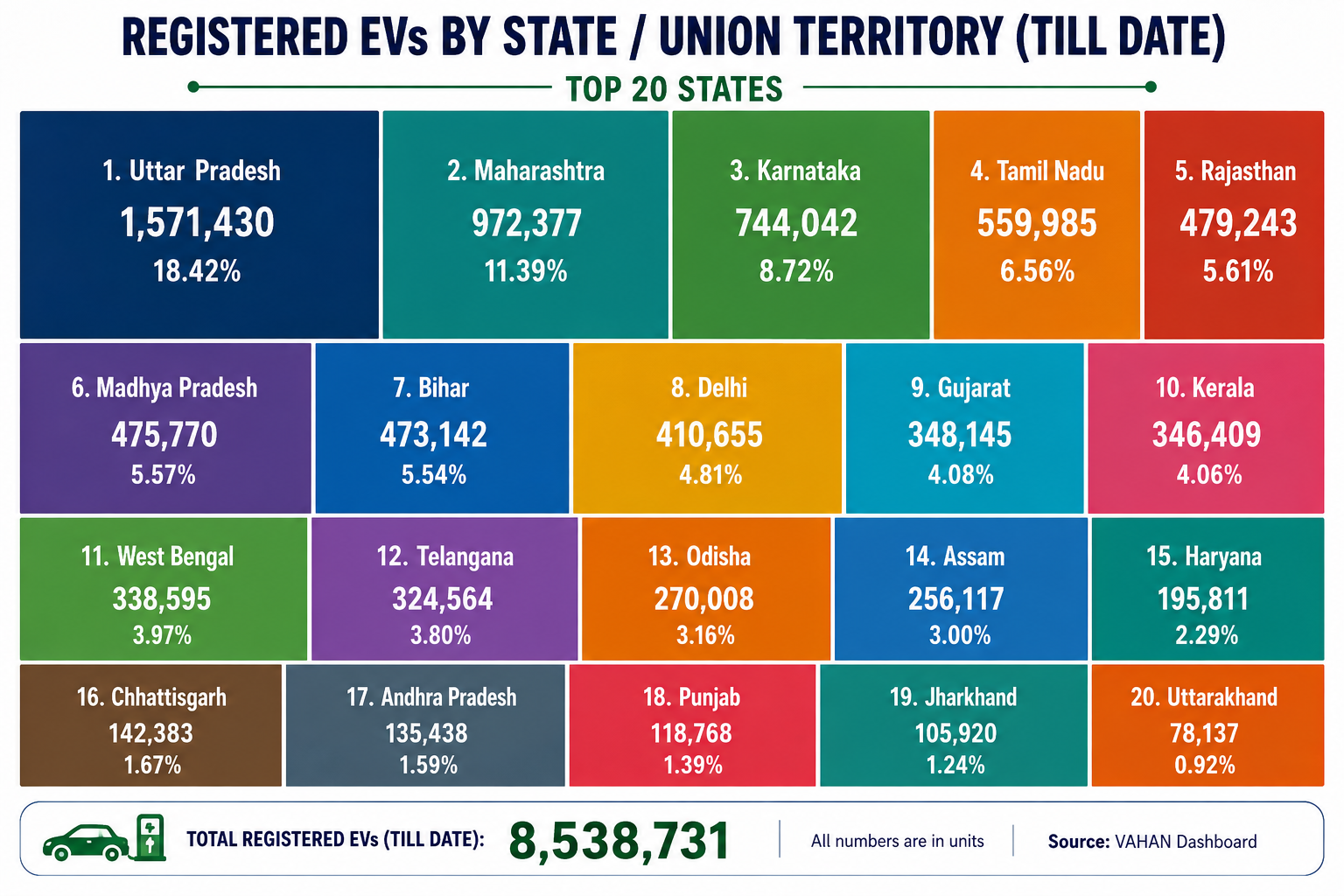
State-wise numbers reveal a pattern the national total alone cannot show. Uttar Pradesh, neither a metro nor a wealthy state, leads the country, showing that the shift is not just an urban phenomenon. Maharashtra and Karnataka follow, while Rajasthan, Madhya Pradesh and Bihar are close behind states better known for tractors than tech headlines. Even Ladakh, Lakshadweep and Sikkim, where an EV showroom once seemed unlikely, now have electric vehicles on their roads. .
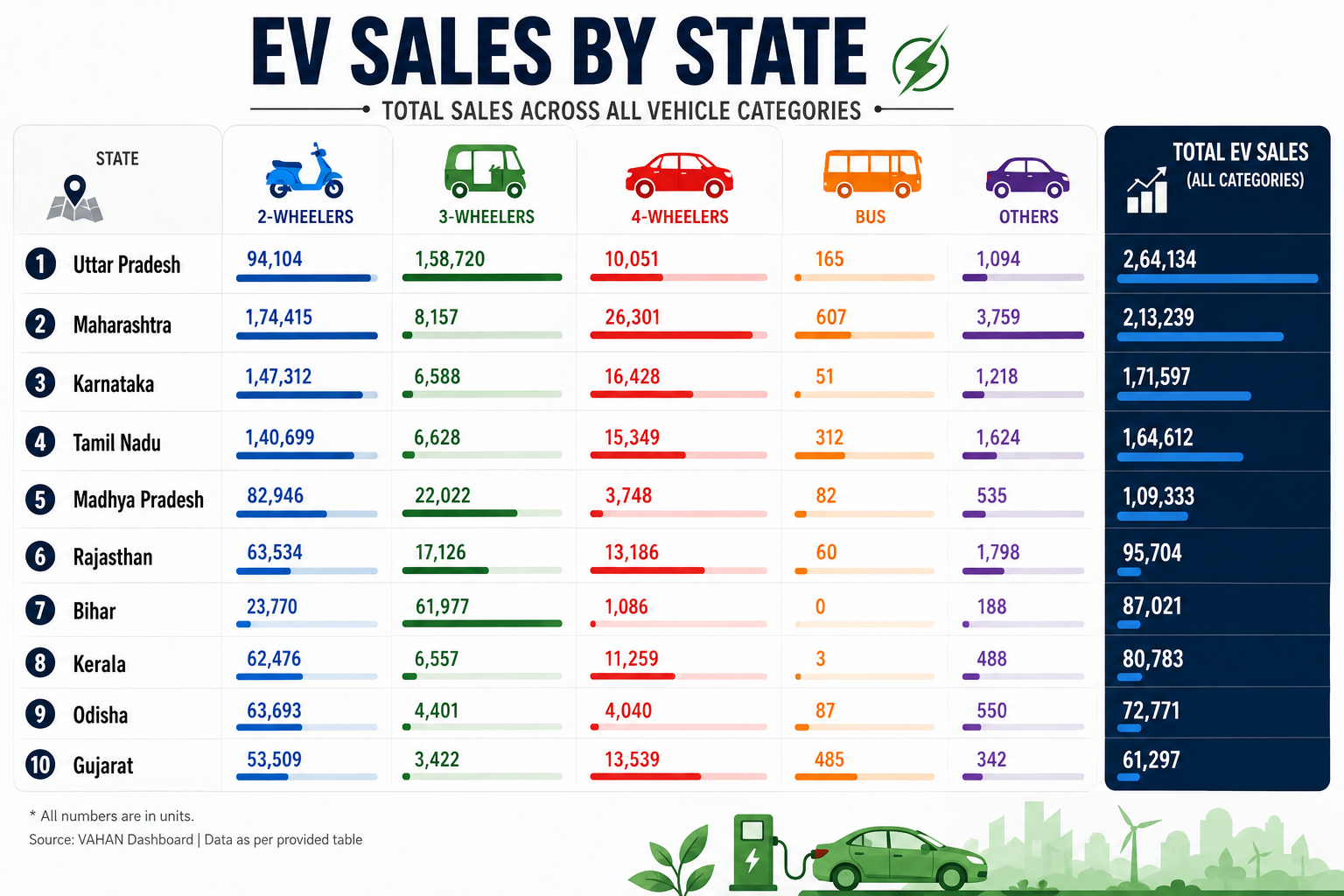
In Karnataka and Maharashtra, the shift looks personal: a scooter for the commute, an app for the charger, a car in an office basement.In Uttar Pradesh, Bihar and Assam, it arrived on three wheels. E-rickshaws carry schoolchildren, vegetables and workers through lanes no car can enter. For their drivers, this isn't a lifestyle choice but a livelihood, financed by a small loan and repaid one fare at a time.
The order matters less than the spread. Every state and union territory has joined the shift. A handful carry most of the weight, but even the smallest hill state and farthest island territory now have electric vehicles on their roads — places that had few, if any, a decade ago.
The sockets follow the wheels
Every new technology outgrows its own infrastructure before that infrastructure is ready. Railways carried passengers before timetables settled into place. Phones found their way into pockets before towers could keep pace with them. Electric vehicles have followed the same old rule.
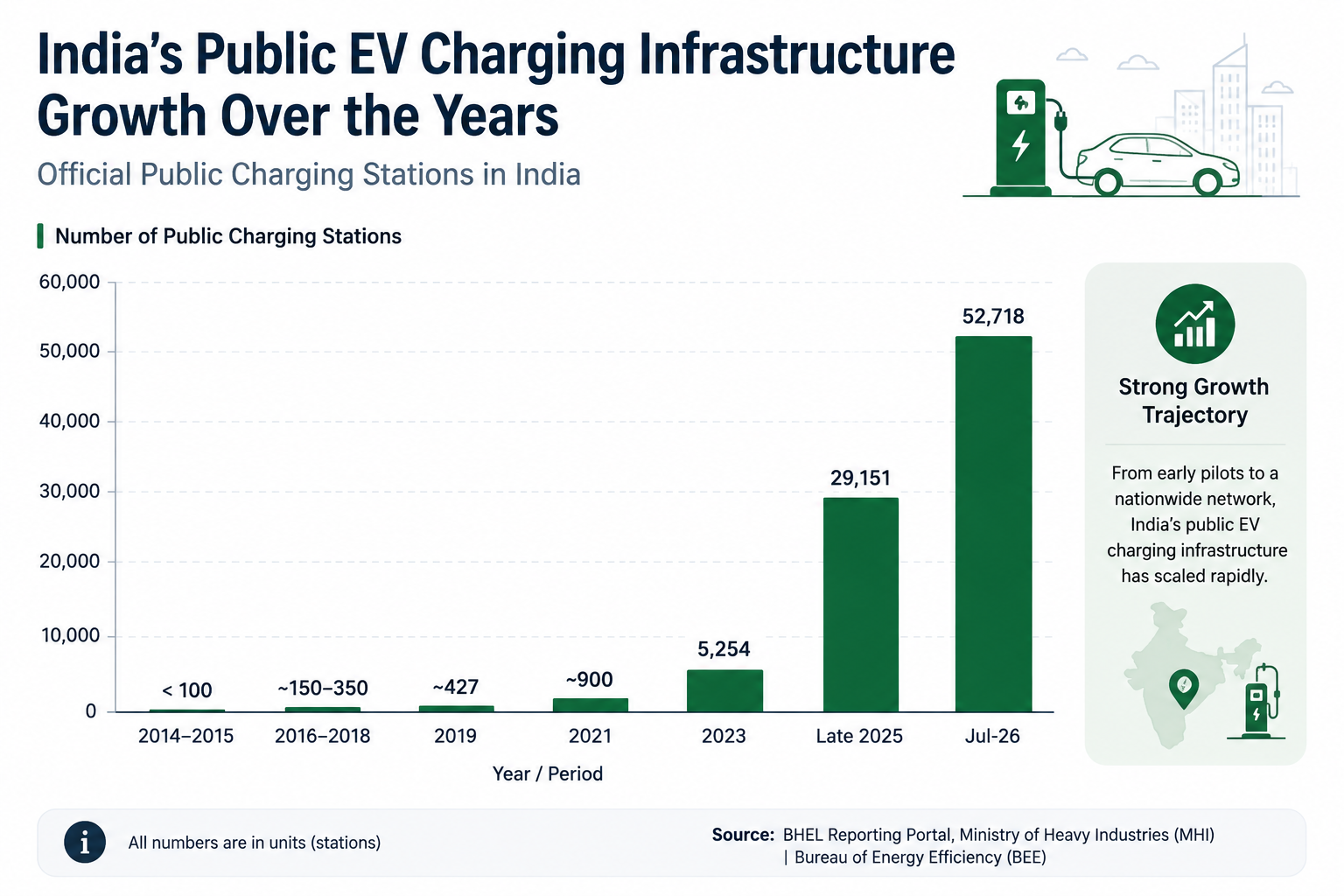
Before 2015, the country had fewer than a hundred charging points, scattered pilot projects with no real network behind them. By 2019, that number had crept up to around 427, as policy finally opened the door for anyone to set one up. Then the pace changed: stations multiplied past five thousand by 2023, crossed twenty-nine thousand by late 2025, and as of July 2026, India counts 52,718 public charging stations, of which 16,561 are fast chargers built for cars, not just two-wheelers.
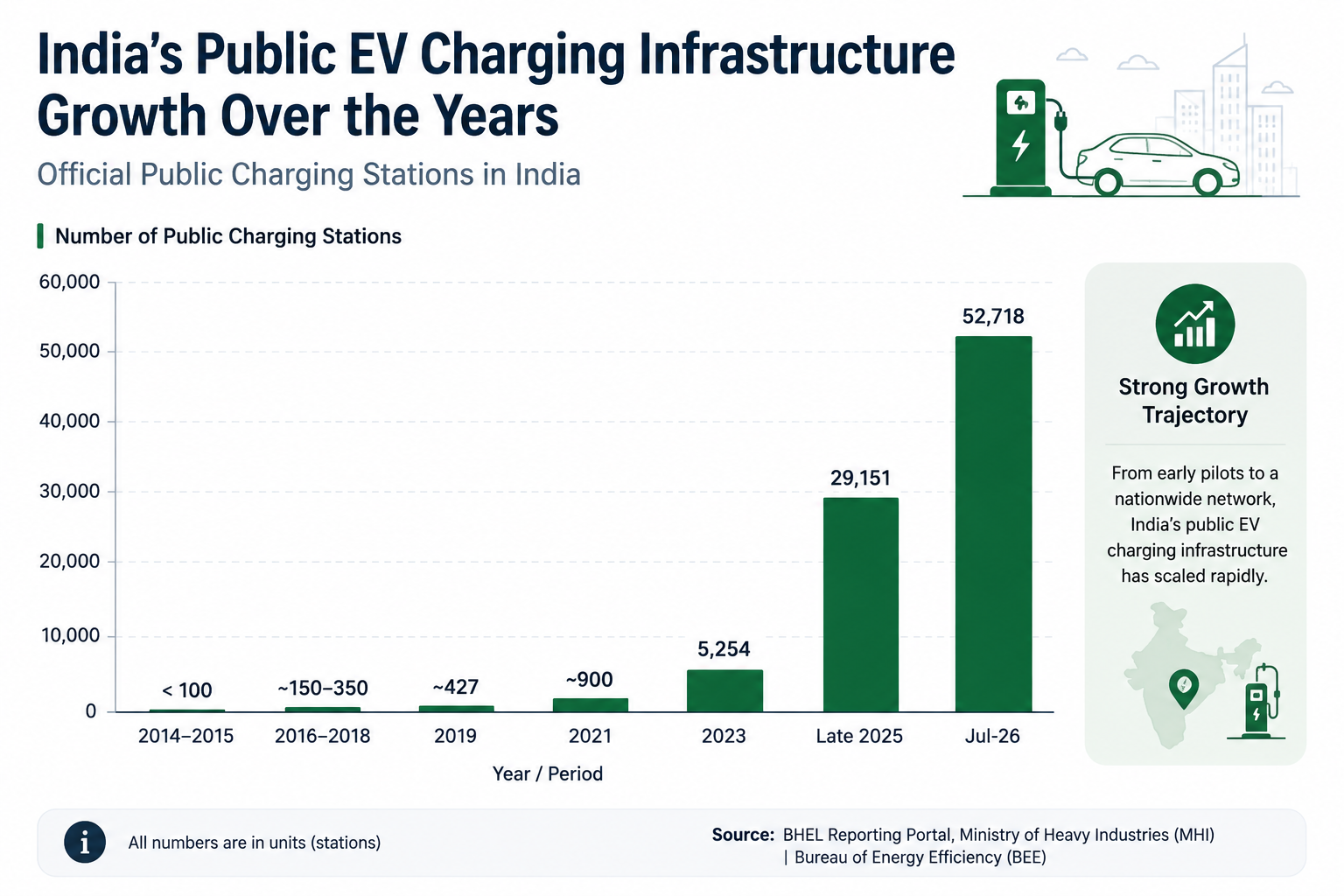
The gap between vehicles and chargers has not disappeared. But it is no longer the wide, worrying distance it once was. Somewhere along the way, the charging network stopped simply playing catch-up and began keeping pace.
What sits inside the machine
Most buyers never see what goes into an electric vehicle. Battery cells, magnets and computer chips are among its key components, many of which still come from abroad, particularly China.India has become good at assembling EVs. Building their components is harder and has only begun. Incentives for battery manufacturing, the national semiconductor mission and new plants are helping, but factories take years to become productive. Until then, many critical components will continue to come from elsewhere.
For the buyer, the source of a chip matters less than the benefits of an EV: a quieter ride and lower fuel costs.India has shown it can adopt electric mobility quickly. The bigger challenge is building the technology and components behind it, rather than assembling vehicles from parts made elsewhere.